 |
|
|
|
|
Nagaur Information
|
Nagaur
About Nagaur | Tourist Attractions in Nagaur | How To Reach Nagaur |
Where To Stay in Nagaur | Where To
Shop in Nagaur
About Nagaur
The picturesque town of Nagaur lies in the state of Rajasthan, India. It is midway
between Jodhpur and Bikaner. The dull sandy stretch of Thar desert surrounds it.
The city itself has three main entrances called the Delhi gate, the Tripolia gate,
and the Nakash gate.
The early history of Nagaur before the advent of the Mughals is intermingled with
the exploits of the Sultans of Delhi, Gujarat and Marwar, who contended for its
possession because of its strategic location. It was later included in the Mughal
empire and became a 'Sarkar' (Division) under Ajmer Subah (province), yielding
annual revenue of about ten lakhs of rupees.
Nagaur is the fifth largest district in Rajasthan with a vast topography spreading
over 17,718 sq. kms. Its landscape is a good combination of plain, hills, sand mounds
& it is also a part of the great Indian Thar Desert.
Nagaur is a fortified desert city where the focal point is the fort itself. The
Muslim influences is apparent in the important monuments here. Akbar's five-domed
mosque and Shams Masjid. The fort is medium sized and there are portions in it which
have been built by Akbar and Shah Jahan. The Mugal Style gardens have been given
special attention. Even in its present condition it remains its attractiveness.
Nagaur is best visited in February for the Nagaur Fair and the Tejaji gair in August.
Tourist Attractions in Nagaur
Nagaur Fort | Tarkeen Dargah | Jain
Temple in Glass | Saiji ka Tanka
| Exquisite Chhatris (Cenotaphs)
| Hamiddudin Nagauri's Tomb
Nagaur Fort (Ahhichatragarh Fort)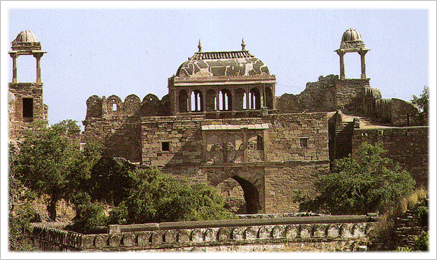
The Nagaur Fort, located in the heart of the town is said to the best example of
a Bhumi Durg (land fort) in Rajasthan. Protected by massive gates and ramparts on
all sides, this magnificent fort houses a number of palaces, temples, mosques, gardens,
fountains open terraces, and pleasure gardens dating back to the Mughal times. Handi
Rani Palace, Deepak Mahal, Amar Singh Mahal, Shah Jahani Mosque, Krishna Mandir
and Ganesh Mandir are some of the beautiful palaces within the fort.
The Nagaur Fort has Three Main Gates: Sireh Pol - The outermost gate has heavy wooden
doors fitted with iron spikes to prevent elephant charge. Beech Ka Pol - This is
the second gate of the impressive fort and Kacheri Pol - The last gate is known
so because it housed the judiciary of Nagaur in ancient times.
Tarkeen Dargah: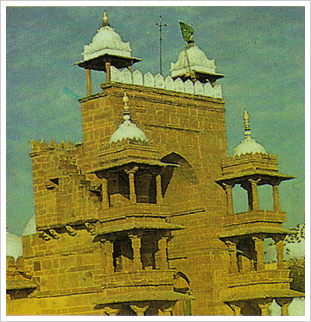
This is the dargah of Khwaja Hamiduddin Nagauri, who was also one of the chief disciples
of Khwaja Moinuddin Chisti of Ajmer. This is also a very sacred place for the Sufis.
Jain Temple in Glass:
A very sacred place for the Jain community, this temple is built of glass and is
indeed a great display of master craftsmanship.
Saiji ka Tanka:
It is the Samadhi of a renowned saint, inspires the liberation of the soul with
simplicity and truthfulness and a symbol of communal harmony.
Exquisite Chhatris (Cenotaphs):
The outskirts of the city houses some beautiful cenotaphs, the most outstanding
of which are the Sawan and Bhadon Cenotaphs which commemorate the seasons monsoon
and autumn respectively. Hardly surprising in a place which is dry and arid that
rainfall was much sought after.
There is also a cenotaph dedicated to Amar Singh, the king which reclaimed Nagaur
from the Mughals. 4km from the town in the village of Tausar is a cenotaph of the
Maratha General Appaji
Hamiddudin Nagauri's Tomb:
The most famous of the tombs is the mausoleum of Qazi Hamiddudin Nagauri. The mausoleum
is considered to be one of the finest in western Rajasthan. The gateway to the shrine
is magnificent and almost a monument in its own right. This Sufi saint came to Rajputana
from Baghdad. There is a mosque within the complex which is said to be in possession
of some unspecified holy relic brought by the Qazi (cleric) from Baghdad
The festival of Urs (commemoration of the death anniversary of a saint) is also
held here and attracts devotees to his dargah (shrine) from all over the country.
Sufi saints like Hamiddudin came to India before the Turkish conquest which began
in the latter half of the 12th century.
Unlike the mission of the invaders, the Sufis purpose was that of universal peace.
They were great spiritualists, and Hindus as well as Muslims were attracted to their
movement because adherents of other religions did not have to renounce their faith
to pray at their shrines. The Sufi saints were known for their tolerance and liberal
outlook.
How To Reach Nagaur
Fly Away: The nearest airport is at Jodhpur (137 km) from Nagaur.
On Tracks: Nagaur town is well connected by a broad gauge line with Jodhpur,
Jaipur, Bikaner and Delhi. Total length of railway line within the district is 384
km.
On Wheels: Regular buses operate from Nagaur to Ajmer, Jodhpur, Bikaner,
Jaipur and Delhi.
Where To Stay in Nagaur
Please visit our exclusive section on Hotels in Nagaur
to find the best accommodation in Nagaur.
Where To Shop in Nagaur
Nagaur is famous for wooden items, iron crafts and leather accessories.
|
|
@Copyright 2008-2014 RajasthanTour4U.com | Blog | Contact Us | Advertise | FAQs | Travel Links | Sitemap | |
|