 |
|
|
|
|
|
|
Agriculture Industry in Rajasthan
The Economy of the state of Rajasthan mainly depends on the agricultural sector
for it accounts for almost 22.5% of the state's economy. In the state of Rajasthan,
the total area that has been cultivated is around 20 million hectares and 20% of
the area out of this is irrigated.
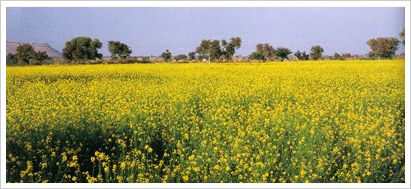
Rajasthan surprises most observers with its highly diversified agricultural produce.
The State is India's largest producer of oilseeds (rapeseed & mustard), seed spices
(coriander, cumin and fenugreek), coarse cereals and 'bajra' in India and accounts
for close to 70% of the countries production of guar. The State is major producer
of soybean, food grains, gram, groundnut and pulses.
Many kinds of fruits and vegetables are grown in Rajasthan. The agricultural farms
are mainly irrigated with the help of tanks and wells. This sector has given a major
boost to the Economy in Rajasthan.
Though there are vast tracts of the desert in western Rajasthan, the ecological
environment is semi-arid; in eastern Rajasthan, where rivers and a lush green cover
are present, there is more rain, and the seasonal crops are plentiful. In these
harsh climatic conditions, women tend to the cattle and their milking, while the
elderly or the young take them out to pastures for grazing.
In the past, when agriculture was a risky affair, it became necessary to raise cattle
for survival, a tradition that has continued to grow, turning Rajasthan into one
of the states that have benefited from the 'white revolution'. It is the men who
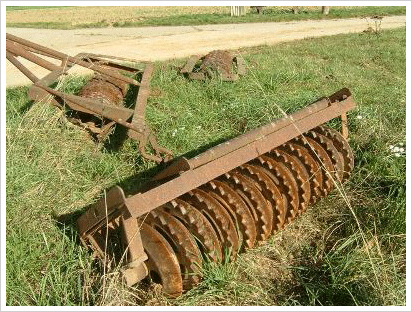
work in the fields. Since most have land holdings that are not too large, the use
of mechanized farming methods is still not in prevalence, though tractors are sometimes
hired at the time of sowing. For most part, the farmers use a method of ploughing
that dates back thousands of years to the Indus Valley Civilization. Camels, and
sometimes buffaloes, are used for pulling the plough.
Three important crops grown here are wheat, corn and millets, with the last being
used for baking breads in the villages, while those in larger towns show a preference
for wheat flour. Pulses are another important crop, since this forms the basis of
the lentils required for cooking meals. Sesame and groundnut are grown and are important
sources of cooking oil.
The land is still not used for growing vegetables other than crops of potatoes,
and more recently, tomatoes. However, the water of the Indira Gandhi Canal (Rajasthan
Canal) is now helping in the cultivation of a handsome crop of citrus fruits, including
tangerines, oranges and lemons.
Fresh vegetables have not formed a part of the traditional cuisine of the state
therefore it is still not being grown. Dehydrated vegetables - sangri and gwarphali
from the bean families and kakri from the cucumber family - can be eaten when fresh,
or stored for use in later months, and village diets still consume these.
However, in recent years, with transport communications between towns, the availability
of fresh vegetables in towns and cities has increased. The state also has large
cultivations of watermelons, which is the perfect way of quenching one's thirst.
|
|
@Copyright 2008-2014 RajasthanTour4U.com | Blog | Contact Us | Advertise | FAQs | Travel Links | Sitemap | |
|