New Delhi is the national capital of India. As a city it is famous for its culture,
tradition and quite interesting history. It is the third largest city in India and
the most preferred city in terms of investments, industries, living, healthcare
and career.
Delhi has always been a cosmopolitan city where one can find people from all parts
of India. The city (which is also a Union Territory) has opened itself to embrace
every new custom and tradition. The contrast between New and Old Delhi is very much
visible by the culture, lifestyle and tradition. Old Delhi still has the influence
of Mughals with monuments, mosques and forts all through the complicated streets.
Old bazaars and food are some of the specialties of Old Delhi, whereas New Delhi
is completely different with lifestyle and city's architecture having the influence
of British Rule in India.
Delhi is just not a city but it is an old book, a book which narrates the history
of India. The city was built and destroyed seven times and has been witness to events
which has brought India through the history books.
There are several tourist attractions in the city without which Delhi is not complete.
From Red fort, Lotus Temple and Chandni Chowk to Modern art Gallery, Purana Quila
and many more, Delhi boasts of an infinite range of touristy places. The Delhi Metro
is another remarkable achievement of the city in the recent years.
Tourist Attractions in Delhi
India Gate:
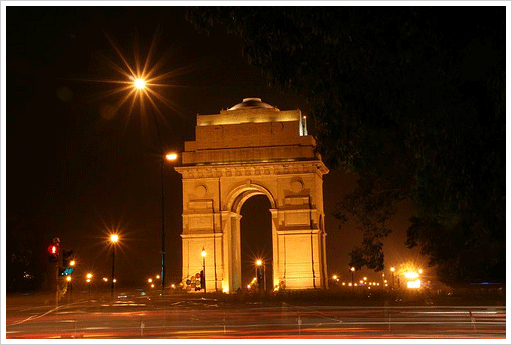
The Gigantic INDIA GATE is a fascinating and wonderful monument. You can enjoy the
lush green lawns of India Gate, which house the famous boat club and a children's
park. The lawns come alive in the evening with picnicking families and couples taking
a stroll. You will find little children run about playing with balloons and eating
ice-creams purchased from nearby vendors. The use of special lighting enhances the
beauty of the monument and it looks even more striking at night.
The 42 metre high, free standing arch, was designed by Luytens and built in 1911.
It was originally named All India War Memorial in memory of the 90,000 Soldiers
of the Indian Army who died in World War I. The names of the soldiers are inscribed
all along the walls of the arch. In 1971, an eternal flame was lit here to honour
the Amar Jawan (immortal soldiers). 'Amar Jawan Jyoti' or the flame of the immortal
warrior is burning under it since 1971. The eternal flame reminds the sacrifice
of these brave soldiers.
Purana Qila:
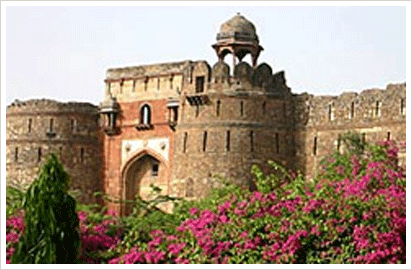
Purana Quila (translates as Old Fort) in Delhi was built on a small hill standing
on the banks of river Yamuna with its massive rubble walls and imposing gateway
houses.
The walls of the immense Qila tower down on the road that takes one to Pragati Maidan
from the height of 18m, and run on for about 2km. It has three main gates the
Humayun darwaza, Talaqi darwaza and Bara darwaza (which one uses to enter the fort
today). The double-storeyed gates are quite huge and are built with red sandstone.
of all the gates entry was forbidden from Talaqi (forbidden) darwaza, the northern
gate.
One of the most fascinating buildings, and also one of the few that still survive,
in the Purana Qila is the Qila-i-kuhna masjid. Sher Shah Suri built it in 1541.
This mosque is quite a place; its prayer hall measures 51.20m by 14.90m and has
five doorways with the 'true' horseshoe-shaped arches.
Akshardham Temple:
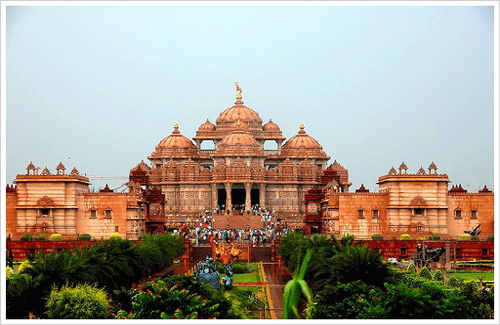
This temple truely represents the Hindu mythology and the Indian culture. It stands
on the banks of river Yamuna, covering an area of 100 acres.
This modern-day wonder has 234 embellished pillars, 20,000 statues and a number
of arches. The temple complex houses an IMAX theatre, exhibition halls and musical
fountains. The temple complex, surrounded by beautifully laid out garden, attracts
millions of tourists from far and wide. The temple is built in marble and red sandstone,
symbolising devotion and eternal peace.
Jantar Mantar:
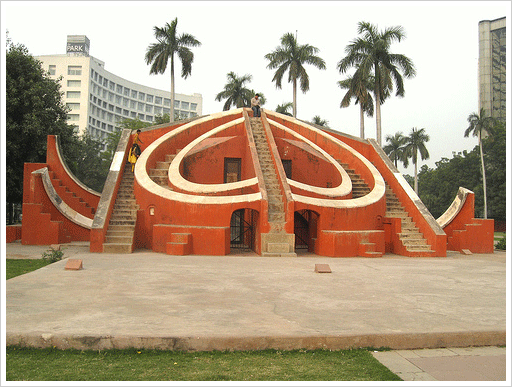
The Jantar Mantar Observatory, situtated near Cannaught Place, was built by the
Rajput King of Jaipur Sawai Jai Singh in 1724. It is believed to have been built
with masonry instruments for observing the movements of the stars and planets. The
name of this noteworthy astronomical observatory, Jantar Mantar means 'instrument
for calculation.'
There is a colossal Samrat Yantra at the periphery of Jantar Mantar. To the south
of Samrat Yantra there is an amazing instrument called Jai Prakash. The Jai Prakash
of Jantar Mantar in Delhi has two concave hemispherical structures and used for
determining the position of the sun and celestial bodies. Jantar Mantar is built
of brick rubble that is plastered in lime.
All the instruments found here can be used for various astronomical calculations.
Today the historical structure is encircled by new office buildings. The observatory
is still used by modern day scholars to ascertain the location of the heavenly bodies
in our universe.
The Delhi Jantar Mantar is open to public from 10 am to 6 pm. The entry to this
amazing astronomical observatory is free. As it is located at the city center adjacent
to the well know Connaught Place, you can easily reach Delhi Jantar Mantar without
much hassle.
Red Fort :
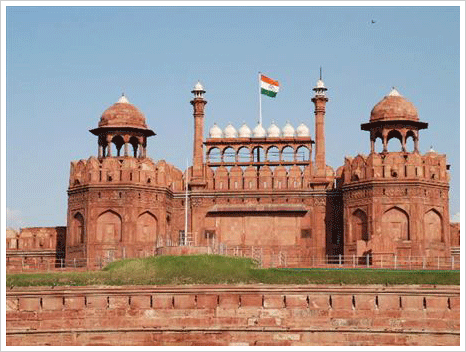
Built by the Mughal emperor Shah Jahan between 1638 and 1648, the masterpiece of
Red Fort has the distinction of being chosen as a site from where the prime minister
of India addresses the nation on the Independence Day.
This popular fort is also known as Lal Quila. The grand and imposing structure today
is a regular haunt of tourists from all parts of the world. This beautiful ancient
architecture is testimony to the grandness of supremacy of Mughal empire in India.
The complex houses Diwan-i-Am, Diwan-i-Khas, the Moti Masjid, the Shahi Burj etc.
The fort stands as dignified and grandiose as it did centuries ago.
Safdarjang's Tomb:
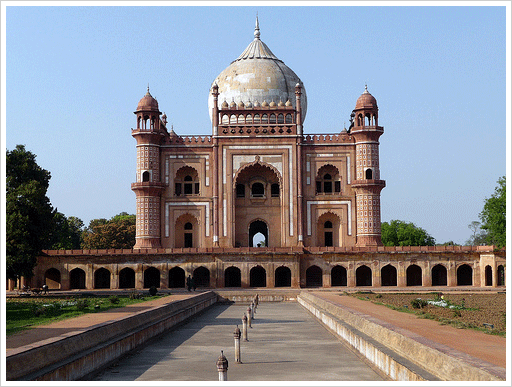
This tomb is the last enclosed garden tomb in Delhi in the tradition of Humayun's
Tomb. It was built in 1753-54 as the mausoleum of Safdarjang, the viceroy of the
Awadh under the Mughal Emperor, Mohammed Shah. It has several smaller pavilions.
Qutub Minar:
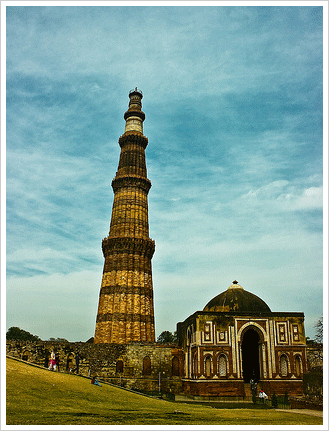
This magnificent structure in the southern part of the capital was built by the
Muslim King, Kutab-ud-din Aibak in 1199 AD. A part of it could not be finished at
once and was completed later by another Muslim King, Iltutmish.
In 1368, Feroz Shah Tughlaq rebuilt the top storeys and added a cupola. An earthquake
brought the cupola down in 1803, later on an Englishman replaced it with another
in 1829 but was removed some years later. Minar(tower)is 72.5 metres high and tapers
from 15 meter-diameter base to just 2.5 meter at the top. The tower has given distinct
stories, each marked by a projecting balcony. The first three stories are made of
red sandstone, the fourth and fifth of marble and sandstone.
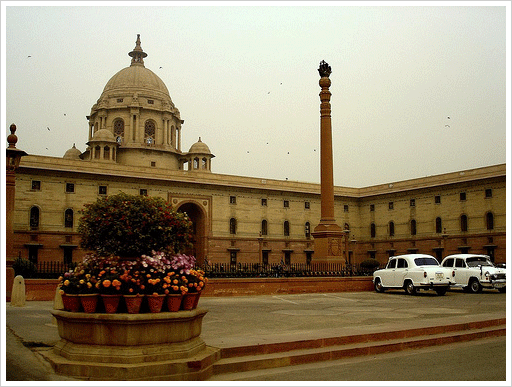
Parliament House:
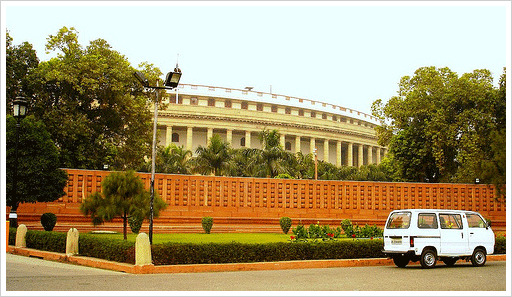
This marvelous piece of architecture can be admired only from outside on account
of security restrictions. The building close to President's House, is a circular
structure almost a kilometer in circumference, and was designed by the famed architect
Luytens. It is the seat of Indian Parliament.
Rashtrapati Bhawan:
This is the official residence of the President of the country; the building was
designed by Luytens. It was the official residence of the Viceroy when the British
ruled India. It has 340 rooms and an area of about 330 acres. The Mughal Gardens
within the complex are a treat for the eyes and are open to public during certain
periods of the year.
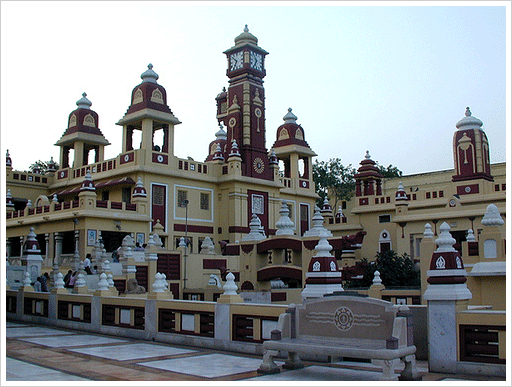
Birla Temple:
This temple was built by the industrialist Raja Baldev Birla in 1938. The temple
is an important prayer centre and contains idols of several deities. Mahatma Gandhi,
who inaugurated the temple, was also a regular visitor to it.
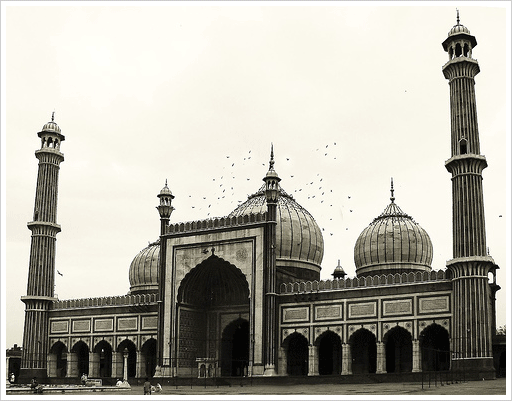
JAMA MASJID:
This is the country's largest mosque where thousands of Muslims offer prayers every
day. The structure was built in 1656, and it took over 14 years to complete. It
lies opposite to the Red Fort.
The flight of stairs and its large courtyard are marvels of architecture. It has
three gateways, four angle towers and two minarets standing 40 metres high and constructed
of alternating vertical strips of red sandstone and white marble. Broad flights
of steps lead up to the imposing gateways. The eastern gateway was originally only
opened for the emperor, and is now only open on Fridays and Muslim festival days.
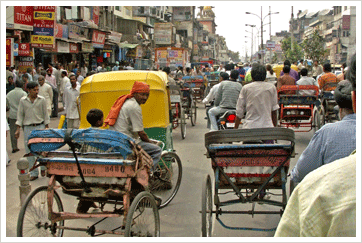
Chandni Chowk:
Chandni Chowk market was ancient Mughal commercial street and is today one of the
country's best known wholesale markets for textiles, electronic goods and many other
items. The entire area was designed by Jahanara Begum, Shah Jahan's favorite daughter
and was then inhabited by the well-to-do families of the time. In today's time,
this area is highly congested.
How To Reach Delhi
Fly Away: : The Delhi airport is the both an important domestic and international
link for the country. Delhi Airport has two terminals, Terminal 1 is domestic and
Terminal 2 is international Indira Gandhi International Airport at Delhi is connected
to all the important cities across the globe. Almost all the major airlines operate
here and there are 35 airlines which fly to major cities of the world like Air France,
Air Pacific, Aeroflot, American Trans Air USA Jet Airlines and many more. Palam Domestic
Airport connects Delhi to other cities in India.
On Tracks: You can take a train from Delhi to any part of India because of
the strong and efficient network of The Indian Railway which connects Delhi to all
parts of India. The city has three main stations at New Delhi, Old New Delhi, and
Nizamuddin. The New Delhi Railway Station, the main railway station is one of the
largest stations in India handling over three hundred trains every day.
On Wheels: Strong network of roads, national and state highways connects
Delhi with all parts of India. Here there are National Highways NH1,NH2,NH8,NH10,NH24.
Buses ply here at regular intervals and can be taken from the three Inter State
Bus Terminuses (ISBT), at Kashmere Gate, Sarai Kale Khan and Anand Vihar. You have
the options of taking Air conditioned, Deluxe and Ordinary coaches from here.
Where To Stay in Delhi
New Delhi being such an important tourist destination, the hotels come in all ranges and cater to all kinds of tourists, from budget to luxury travelers.
Where To Shop in Delhi
Delhi is a paradise for shoppers. Here you can buy almost anything from anywhere
in India. One of the best part of Delhi is that one gets every thing here which
can be sold and purchased under the sun. Delhi has thousands of good shops tidily
grouped together subject wise - antiques, handicrafts, European fashions, leather
articles, rugs and carpets, linen & fabrics, silks, jewelry, furniture etc.
Chandni Chowk was famous for the Fountains and the shops during the Mughal
period. Located opposite to the Red fort, the fountains of the Chowk have disappeared
but the shops still remain.
The Delhi Haat in Kidwai Nagar is a nice place to spend the day. The Haat
or the market has good eating joints and handicraft shops. In Connaught place or
Rajiv Chowk / Indira Chowk there are good departmental stores and Big Showrooms.
Jeweler shops at Dariba Kalan are famous for intricate jewelry, while Dilli
Haat is known for its amazing handicraft and handloom items. Connaught Place is
the centre of New Delhi and offers some of the latest items for sale. Then, there
is Sarojini Nagar and Janpath - the shopping places where you find the latest items,
at the most reasonable prices. In Delhi, you can find virtually everything - from
simplest Indian handicrafts to international designer labels.
|