 |
|
|
|
|
|
|
SariskaLocation and Area
On the main highway to Jaipur 21 miles south of Alwar, lies the Sarisla National
Park. Sariska is one of the few remaining pockets of forest in the Aravalli range
of hills and the area now covers 308 square miles is the core area.
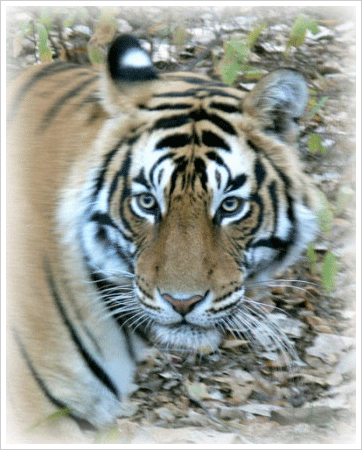
Sariska is the tiger land in Rajasthan which was bought under Project tiger in 1979.
It is prime tiger country. The forest is typical dry deciduous, dramatically changing
with the change in season.
Famous Species in the Park
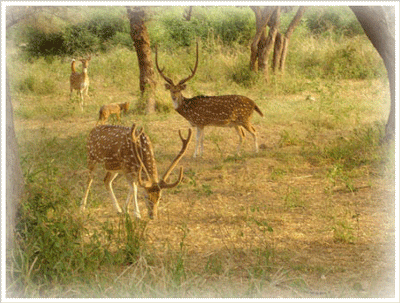
The terrain is undulating plateau lands and wide valleys. Besides tiger, herbivores,
spotted deer, sambar, blue bull, nilgai, chinkara, leopard can be commonly seen
and found in good density.
The avian world is also well represented with a rich and varied birdlife. These
include Peafowl, Grey Partridge, Bush Quail, Sand Grouse, Tree Pie, Golden backed
Wood Pecker, Crested Serpent Eagle and the Great Indian Horned Owl.
Tiger Reserve Project
In the pre-independence period the forests within the Reserve were a part of the
erstwhile Alwar State and maintained as hunting preserve for the royalty. After
independence, these were first notified as a reserve wherein it was unlawful to
hunt, shoot, net, trap, snare, capture or kill any kind of wild animals in 1955.
The reserve was upgraded to a Sanctuary in 1958. Later on, in view of the preservation
of wild animals in a better way few forest areas contiguous to the Sanctuary were
also incorporated.
The primary notification to declare part of the core as National Park was issued
in 1982. Final notification is pending in view of need of relocation of few villages
from the Park.
Places to See in Sariska
The forest is mainly hilly with two extensive plateaus, Kanakwari and Kiraska and
a wide Vally starting at the Baran Tal Gate and running south to Thana Gazi. At
the northeastern corner, just off the road between Alwar and Sariska, is the Siliseth
Lake where crocodiles are often seen. During the winter there are many migrant water
birds also.
Ancient Kankwari Fort is situated in the middle of the Reserve. Archaeological treasures,
Neelkanth and Garh Rajor of 9th and 10th century are ruins of Shiva and Jain temples,
contemporary of the world famous Khajuraho.
In spring the surrounding hillsides are filled with color as the flame of the forest
and other flowering trees bloom. In the summer, the park is parched and brown but
with the monsoon becomes lush and green. Among the undulating hills and wide valleys
of Sariska is rare combination of natural history and archaeology.
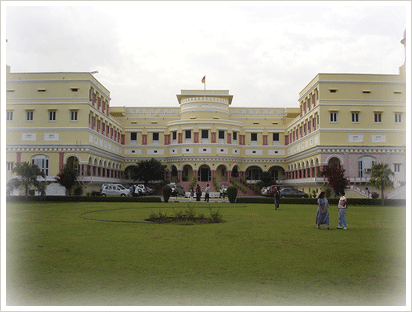
At Sariska, opposite the Baran Tal Gate of reserve, is a large palace built in 1902
by Jai Singh of Alwar as a base for elaborate shoots. The palace is now a hotel.
Sariska has good networks of metaled roads From thee main arteries forest racks
lead into side valleys. The forest department has provided many artificial water
holes on the roads which attract the animals and makes wildlife observation from
vehicles easy.
How To Reach Sariska Tiger Reserve
Sariska is well connected with the surrounding towns and it is not difficult to
access. Yet, it is advisable to take your own vehicle or hire a vehicle for the
entire trip.
The park is very easily accessible from Delhi too. It is a 3 hour journey via the
Daruhera - Alwar - Sariska route which is less than 200km.
It is also possible to go via the main Jaipur highway, by which the distance gets
extended to approximately 240km.
Best Time to Visit Sariska Tiger Reserve
Although due to the presence of monuments of religious importance located within
the park boundaries, the park authorities are compelled to keep the park open throughout
the year, still the best period is during the months of October to June.
|
|
@Copyright 2008-2014 RajasthanTour4U.com | Blog | Contact Us | Advertise | FAQs | Travel Links | Sitemap | |
|