Agra is world famous for being home to one of the Seven Wonders of the world - the
Taj Mahal. The city lies in the state of Uttar Pradesh, in North India, and this
region is home to no less than three designated World Heritage Sites, also including
the neighbouring ghost city of Fatehpur Sikri and the red-sandstone Agra Fort.
Agra was established as the Mughal capital in 1526 and is known for its chaotic
and vibrant marketplace (chowk), endless auto rickshaw touts, plentiful souvenir
vendors, historic temples and many grand, ancient monuments and tombs.
Tourist Attractions in Agra
Taj Mahal:
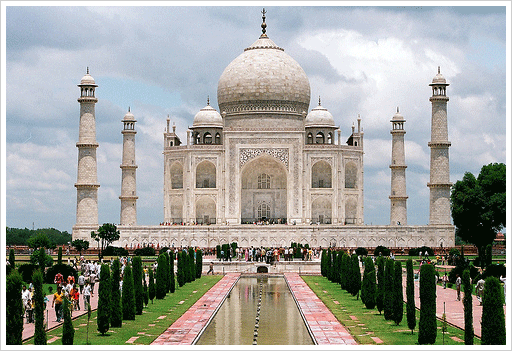
The beauty of the Taj Mahal cannot be expressed in words. Even as the world is caught
in the skirmishes of War & peace, Nuclear and Non-Nuclear; Taj has stood as the
epitome of love. This extravagant monument of love is one of the most visited and
most photographed places in the world.
TajMahal, built overlooking the River Yamuna, is visible from Agra Fort in the West.
It was built by Shah Jahan to enshrine the body of his favourite wife who died giving
birth to her 14th child, in 1631.
Fulfilling her wish to create an unforgettable monument in memory of their love
for each other; Shahjahan organised an international competition for finalising
the design of the desired structure, which took the shape of Tajmahal, Agra after
construction. Made by 28 rare, semi precious and precious stones, the Taj Mahal
in Agra India was designed by Ustad Ahmad Lahauri. It was erected in 22 years by
the hard labour of about 20,000 craftsmen
The Taj Mahal stands serene and perfect in the garden of cypresses and reflecting
pools on the banks of river Yamunna. Its pure white marble shimmers silver in the
moonlight, glows softly pink at dawn, and at close of day reflects the fairy tints
of the setting sun.
Agra Fort:
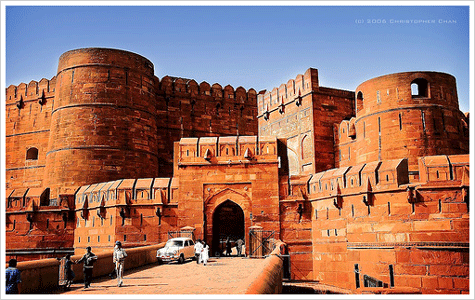
A little distance from Taj Mahal stands the important 16th century Mughal monument
known as the Red Fort of Agra.
The fort is built alongside the Yamuna river and stretches almost 2.5 km. It consists
of a wall built in red sandstone and several buildings inside. The wall has 2 gates,
the Delhi Gate and the Amar Singh Gate. You can only enter the fort via the Amar
Singh Gate.
It comprises many fairytale palaces such as the Jahangir Palace and the Khas Mahal,
built by Shah Jahan; audience halls such as the Diwan-i-Khas and Sheesh Mahal (The
Glass Palace), which, inlaid with thousands of mirrors was once the harem dressing
room. There are also two beautiful mosques including Shah Jahans Pearl Mosque (sadly
currently out-of-bounds).
The emperor Shah Jahan, who built the Taj, was imprisoned by his son Aurangzeb in
the Agra Fort where he had a view on the building erected for his deceased wife.
Shah Jahan is said to have died in the Musamman Burj, a tower with a beautiful marble
balcony. From there you probably have the best view on the Taj. Between the many
pavilions, you find small well maintained gardens.
Fatehpur Sikri:
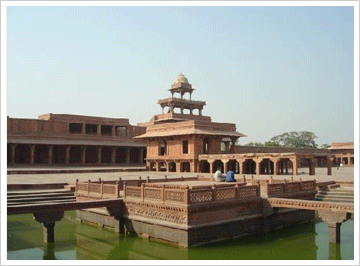
Fatehpur Sikri is one of the finest examples of Mughal architectural splendour at
its height. Though the city is in ruins, it is a place to visit if one comes to
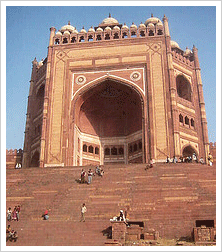
Agra. The sunset over the ruins is sight to cherish. Entrance to this mosque is
through the Buland Darwaza which was built in Gujrat and is 54 meter high. To the
North of the Mosque is the dargah of Shaikh Salim Chishti.
It was built under the personal supervision of the Emperor Akbar; he was childless
and, having tried all sorts of solutions to his plight, visited a Sufi saint, Sheikh
Salim Chishti, for help. Soon a son was born and, impressed and overjoyed, he started
building on the site where he had met the saint.
However due to a severe shortage of water the city was abandoned after only fifteen
years and the capital was relocated back to Agra. As a result Fatehpur Sikri stands
untouched and perfectly preserved; a complete medieval fortress of red sandstone,
with vast central squares, exquisitely carved multi-tiered pavilions, cool terraces
and formal gardens. Fatehpur Sikri is a 25 mile (40km) journey west of Agra, on
the way to Jaipur.
The Buland Darwaza :
The Buland Darwaza also known as the gate of victory is a grand gateway located
in Fatehpur Sikri near Agra. This triumphal arch was built by the Mughal Emperor
Akbar, when he defeated the king of Khandesh or Gujarat in 1573.
The name Buland Darwazameans 'High Door' and this victory arch rises to a height
of 40 meters or 175 feet. It is the most striking monument in Fatehpur Sikri and
can be seen from quite a distance. Rising impressively towards the sky, the Buland
Darwaza is approached by a series of steps. You will pass under the massive arch
of the Buland Darwaza when you enter the city of Fatehpur Sikri.
Jama Masjid:
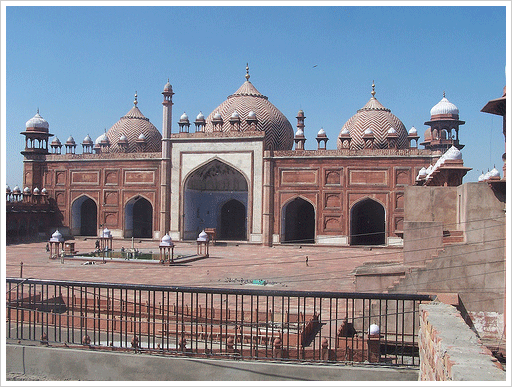
The Jama Masjid at Fatehpur Sikri is also known as the Jami Masjid. The mosque is
one of the largest in India. It was constructed in 1571 A.D. during the reign of
the Mughal Emperor Akbar the Great.
To the right of the mosque is the Jammat Khana hall and then the Zenana Rauza, or
the tomb of the women of the royal household. You can also have a look at the shrine
of the Sufi religious leader Sheikh Salim Chisti, which is an example of some very
amazing workmanship. The whole of Jama Masjid is exquisitely decorated with inscriptions,
inlaid geometric designs and colored tiles.A grand gateway known as the Buland Darwaza
leads you to the Jama Masjid.
Itmad-Ud-Daulah's Tomb:
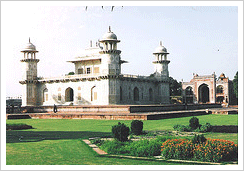
Itmad-ud daulah, one of the most beautiful of Mughal tombs, stands across the river
Yamuna from the Taj Mahal, nearly one and a half kilometers up-stream. It is considered
as one of the forerunners of the Taj. It is built of white marble. Inlaid semi-precious
stones and intricate carvings are its main features. Most of the features of this
architectural marvel are found to be replicated in the construction of the Taj.
The pure white and elaborately carved tomb of Itmad-ud-Daulah conforms to the Islamic
style of architecture. The use of arched entrances, octagonal shaped towers or minarets,
use of exquisitely carved floral patterns, intricate marble-screen work and inlay
work are all representative of the Islamic style. The absence of a dome and the
presence of a closed kiosk on top of this building and the use of chhatris (small
domed canopies, supported by pillars) atop the four towers (minarets) instead of
proper domes are reflective of local influence.
Excursions
Sikandra :
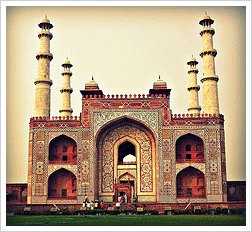
This beautiful tomb is situated at a distance of 10 km from Agra. It is the mausoleum
of Akbar the Great. It was started by Akbar and later completed by his son Jehangir
in 16-17th century. I will say it is an tomb equivalent to the Taj Mahal.
Akbar's tomb at Sikandra has a large arched entrance and green lawns, on which deer
can be seen grazing, surround the tomb. The entrance is decorated with marble inlay
work around the arch, and the inner surface of the dome of the tomb is decorated
with images of flowers, geometric designs and Islamic calligraphy.
A remarkable feature of this multistoried building is the presence of three-storey-minarets
on its four corners. These minarets are built in red sandstone with stunning inlay
work of marble. The mausoleum is surrounded by a beautiful garden, providing a tranquil
ambience to the last abode of this great ruler.
National Chambal Wildlife Sanctuary :
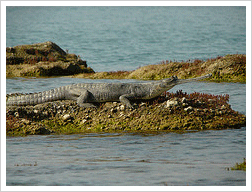
The National Chambal Sanctuary(about 70 km from Agra) in UP is a natural reservoir
for the marsh crocodiles, swimming eagerly and often prying for prey, at shore while
basing in the sun. To protect the animals from the harmful effects of modern civilization
and their subsequent replenishment, the National Chambal Sanctuary was set up in
Uttar Pradesh.
The large area of National Chambal park is shared by the three states of Rajasthan,
Madhya Pradesh and Uttar Pradesh. This sanctuary is famous for the rare gangetic
dolphin. The sanctuary houses many other inhabitants like mugger, gharial, chinkara,
samber, nilgai wolf and wild boar
The best time to visit the sanctuary is November to February.
How To Reach Agra
Agra can easily be accessed by flights, trains and road transport. Tourists planning
to travel to Agra can reach the city of the Taj by Air, Rail and Road in comfort.
Fly Away: : Agra has an airport where domestic flights from major cities
land. Both government and private airways operate to Agra. The Delhi Agra flight
is a short flight of 40 minutes. There are daily round trip flights from Delhi to
Agra, Khajuraho and Varanasi, with a return to Delhi. Agra airport is located 7
Km from the center of the city.
On Tracks: : Agra is a major railway junction on main broad guage routes
to the south, east and west. Agra's railway station is Agra Cantonment. There are
excellent train services from New Delhi. Shatabdi Express, Taj Express and Inter-city
Express from Delhi takes 2-3 hours to reach Agra.
On Wheels: : Agra is on the cross roads of national highways 2, 3 and 11
and is well connected to all parts of the country. 'Idgah' is the main bus terminal
in Agra. Most of the buses leaves Agra from here. Express and air-conditioned bus
services are available from Delhi, Jaipur, Lucknow, Gualior and Jhansi. Buses are
less expensive in comparison with train and air services.
Where To Stay in Agra
A wide range of hotels in Agra offer accommodation to these tourists. Being such
an important tourist destination, the Agra hotels come in all ranges and cater to
all kinds of tourists.
Where To Shop in Agra
Shopping in Agra is yet another interesting aspect of your Taj Mahal tour. Agra
was once the centre of arts and crafts in the Mughal period and even today one can
shop for the most exquisite handicrafts items in Agra. Agra is primarily popular
for its handicrafts items that span from beautiful marble tabletops to soft stone
lay work. Hand made leather items are also very popular and make a very good shopping
item to take back as souvenirs.
The major markets for shopping in Agra are near the Taj Mahal complex. These areas
include Sadar Bazaar, Kinari Bazaar and Munro Road.
The U.P State Emporium called Gangotri at the Taj Mahal Complex, offers a
choice of handicrafts under one roof. The Shilpagram, a crafts village is
a big hit with the tourists with its wide range of handicrafts on sale, directly
by the craftsmen themselves.
The Kinari Bazaar, also known as the old marketplace, near Jama Masjid, has
many small distinct trading areas that still retain the flavor of the Mughal era.
The Loha Mandi, Sabzi Mandi and the Nai-ki-Mandi are still worth visiting. Agra
is mainly famous for Marble, Leather, Rugs, Brassware.
|