 |
|
|
|
|
|
|
City Palace, Jaipur
The focal point of the walled city is the palace complex that lies in the heart
of the city and occupies the space of the central grid. The rest of the grids were
cut across neatly by wide lanes which divided the area into tidy, well laid-out
rectangles of commercial and residential use.
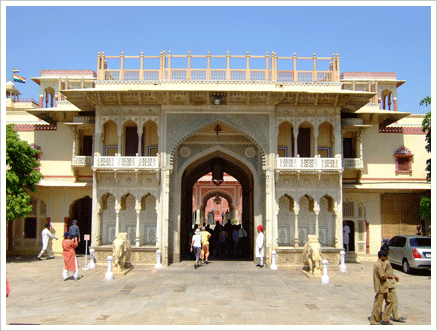
The city palace is an architectural marvel, with ornate gates, arches, balconies
and courtyard surrounded by a series of gardens and buildings over a vast expanse.
The City Palace complex is the most important landmark in the walled city with its
numerous outbuildings, courtyards, impressive gateways and temples. Occupying one-seventh
of the walled city area, the palace houses the seven-storeyed Chandra Mahal, Mubarak
Mahal, the Diwan-i-Am, and Diwan-i-Khas.
Diwan-i-Khas, a hall for private audience juxtaposed with Diwan-i-Am, for public
audience. Two huge sterling silver vessels Gangajali punctuate your attention. Built
in absolute symmetry, each 53 high vessels weight 345 kilograms. As history records,
Maharaja Sawai Madho Singh II in 1902, took these jars to England with Gangajal
for the coronation ceremony of Edward VII.
The Mubarak Mahal or Palace of Reception houses the Maharaja Sawai Man Singh Museum.
There are displays of regal costumes that include exquisite and precious fabrics,
rich embroidery and the voluminous clothes worn by the giant Maharaja Sawai Madho
Singh I, who ruled ruled from 1750 to 1768.
The Maharanis Palace interestingly, has a weaponry section with displays dating
as far back as the 15th century in a remarkable state of preservation.
The museum houses a rare collection of arms, carpets costumes, paintings and royal
paraphernalia. A notable exhibit is a pair of pure silver in the world. City Palace
is still the home of the erstwhile royal family, there are sections open to visitors.
Visiting Hours: 0930-1645 Hours except on holidays and Dussehra-Diwali
|
|
@Copyright 2008-2014 RajasthanTour4U.com | Blog | Contact Us | Advertise | FAQs | Travel Links | Sitemap | |
|