 |
|
|
|
|
|
|
Nahargarh Fort, Jaipur
Gracing the rugged ridge of the Aravalli Hills is the Nahargarh Fort build by Sawai
Raja Jai Singh in the second quarter of the eighteenth century. Jaipur was the capital
and the need to boost its defense was a necessity. This explains the presence of
the Nahargarh Fort.
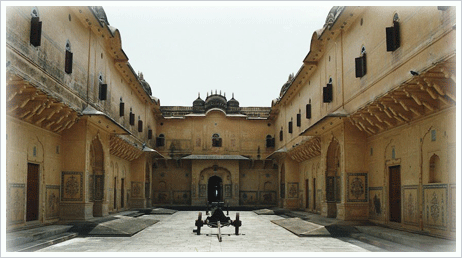
The Fort underwent many alterations and modifications during the reign of Sawai
Ram Singh II and Sawai Madho Singh II. They built a series of interconnected rooms
with cplorful corridors and hallways. Here Hawa Mandir and Madhevendra Bhawan geet
etched in your memory. The Nahargarh is a brilliant specimen of fort architecture.
There is a popular legend associated with the construction of the Nahargarh Fort.
While it was still under construction, the fort was visited by a spirit of a prince
known as Nahar Singh who would disrupt the work and cause delay.
Finally a "tantrik" was called to appease the spirit which agreed to leave but only
on the condition that the fort will be named after him. This is how the Nahargarh
Fort got its name.
Jaipur's Nahargarh Fort is counted as one of the major tourist attractions of the
Pink City. Situated about 6 km north-west of the City Palace, the Jaipur's Nahargarh
Fort offers spectacular views of the city along with the breathtaking view of the
Man Sagar Lake.
If you want to see where the royal picnicked then dont miss out on Nahargarh fort.
With a panoramic view of the Man Sagar Lake, The Pink City and the suburbs, the
Nahargarh Fort looks at its best at night, when it is dazzling lit. The cafeterias
inside the fort offer the finest drinks and snacks. Nahargarh Fort forms a remarkable
backdrop of Jaipur and offers a glittering view of the city lights.
However, the older parts of the Nahargarh Fort got wrecked with the times, but the
further additions to the Fort, are still charming and well-preserved. Nahargarh
Fort stands as a symbol of the Royal heritage and speaks of its majestic past.
Nahargarh Biological Park
Located in the vicinity of Nahargarh fort, outside Jaipur, the biological park is
spread over 7.2-sq-kms of the Nahargarh sanctuary (50-sq-kms). it consists of quartizite
and granite rocks, and the vegetation of the region is adequately represented through
tropical dry deciduous and tropical thorn forests.
-
The species of the area, some of which dissipated over the years, have been reintroduced,
so that today the park has Tiger, Leopard, Asiatic Lion, Sloth Bear, Caracal, several
species of Deer, Gharial, Crocodile and Otter in its wetlands, Pangolin Jackal,
Wild Dog, Wolf, Hyena, Jungle Civet and Fishing Cats, Ratel, Common and Desert Fox,
Wild Boar, Rhesus Monkey and Langur, and, of course, a host of avian species.
|
|
@Copyright 2008-2014 RajasthanTour4U.com | Blog | Contact Us | Advertise | FAQs | Travel Links | Sitemap | |
|