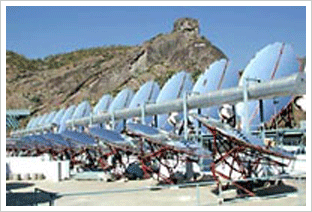
About Solar Energy
The solar power is now being used to generate the much wanted electricity using
the photovoltaic energy, converting the Sun's rays to generate electric power. These
photo cells are devices, made from silicon alloys, which produce electric energy
when the Sun light falls on it. The Suns rays are composed of photons, which contain
various degree of energy, and this energy corresponds to the different wave-lengths
of the solar spectrum.
When the sunlight strikes a photocell, the photons falling on it either gets absorbed,
reflected, or pass through. It is those photons that get absorbed produces electricity.
As the Sun's rays strike the surface of the photovoltaic cell, electron migration
takes place, and this creates imbalance of charge, which appears as a voltage potential
at the output. A large array of thee photovoltaic cells are used to produce enough
electricity to light up a small house. The Sun light is therefore a renewable energy
source, which could be harnessed to provide power.
Solar Energy in Rajasthan
India is located in the equatorial belt of the earth, thereby receiving abundant
radiant energy from the sun. In most parts of India, clear sunny day is experienced
250 to 300 days a year. The annual global radiation varies from 1600 to 2200 KWh/Sq.m.
which is comparable with radiation received in the tropical and sub-tropical regions.
The equivalent energy potential is about 6,000 million GWh of energy per year.
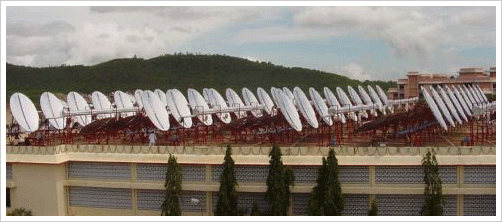 Solar Energy Plant in Mount Abu
According to the report maintained by the India Meteorological Department, the highest
annual global radiation is received in Rajasthan (Solar insolation ranging between
6-6.4 Kwh/m2/day in about half of Rajasthan). In Rajasthan, large areas of land
are barren and sparsely populated, making these areas suitable as locations for
large central power stations based on solar energy.
Rajasthan Government Initiatives and Incentives
The Government of Rajasthan supports development of both solar thermal and solar
photovoltaics (SPV) power generation. Government of Rajasthan is encouraging private
sector projects through fiscal and promotional incentives for the renewable energy
sector. Parallel efforts are underway in the area of solar PV in which pilot-scale
grid-connected solar PV power systems (25 KW to 100 KW) are under trial operations
in addition to stand-alone projects in remote unelectrified areas.
In Rajasthan, the State Government plans to establish a Solar Energy Enterprises
Zone (SEEZ) in the districts of Barmer, Jaisalmer and Jodhpur by offering a package
of incentives to private investors willing to develop various solar power technologies
including solar thermal, solar photovoltaics (SPV), solar chimney etc.
An International solicitation recently issued by Rajasthan has yielded two 50 MW
solar PV power stations as well as one solar chimney project (200 MW) to be operated
on an Independent Power Production (IPP) basis.
In Rajasthan, the Indian Government is about to complete a huge new power station
using hybrid systems. This fossil fuel/solar hybrid power plant is poised to generate
a huge 140 megawatts of electric power, out of which 40 megawatt will be produced
from a large array of solar parabolic troughs.
The technology, which is much more cost effective than photovoltaic cells, uses
large parabolic mirrors to focus the sunlight to heat a thermal media, like, gas
or steam, which in turn drives a turbine generator. The project cost runs to about
$1 million per megawatt and is still considered to be cheaper than the others.
In setting up a solar thermal plant in the state of Rajasthan, there are a few points
to be proved, and these include -
- The operational viability of the technology used
- Development of solar power energy for an expected significant reduction in operating
costs
- Contribute efficiently towards clean energy, and help to reduce greenhouse effect
in the long run.
- The operational viability of the solar energy thermal power plant is hoped to be
demonstrated through commercial power sales and delivery arrangements with the grid.
- The technical development of the system is planned to be achieved through technical
assistance and training.
- The power plant is a step forward to a long term program, for promoting the objective
focused on climate change.
Mathania Solar Hybrid Power Project
The whole world is greatly concerned about tremendous increase in demand of energy
and consequent depletion of convention energy sources like wood, coal oil etc. Burning
of fossil Fuels causes serious ecological imbalance and adversely effect on public
health, wild life rainfall etc, An obvious solution is utilization of Renewable
Energy Sources like solar, wind tide, geo thermal and biomass, available in abundance
in nature.
To demonstrate and commercialize solar thermal technology in India, Ministry of
Non-Conventional Energy Sources (MNES) is promoting megawatt scale projects such
as the proposed solar thermal plant at Mathania in Rajasthan.
Mathania is about 30 Kms from Jodhpur. Solar radiation available in this regions
is of the order of 6-6 .4 K wh/m2/ day which makes it a suitable location foe setting
up of large Central Power Station based on Solar Energy. The Main objectives of
the project are -
- To demonstrate that operational viability of solar thermal power generation
- Support solar power technology development and
- Help reduce greenhouse gas (GHG) global emissions in the longer term
This project has been envisaged as the first step in a long term program or promoting
solar thermal power in Rajasthan which would lead to development of similar systems
in the country.
Reliance to set up solar power project in Rajasthan
Reliance Industries is setting up its first solar power project of 5 MW capacity
at Khimsar in Nagaur district of Rajasthan.