Pushkar
About Pushkar
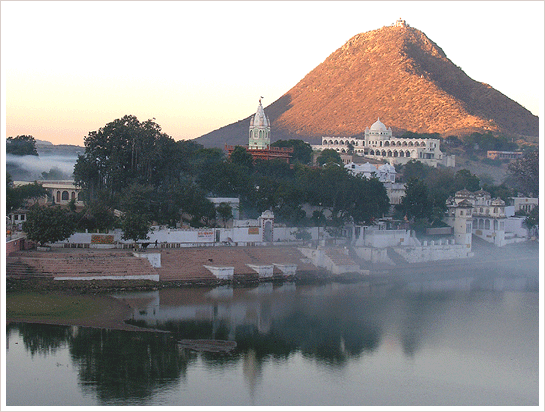
Pushkar, the soil of religious sentiments for Hindus, nestling in the Aravalli Range
of central Rajasthan, at the foot of Nag Pahar (Snake Mountain), that form a natural
border between Ajmer and Pushkar.
The echo's of Pushkar is popular across the world for offering religious prayers
and adventurous trails. Millions of pilgrims make pilgrimage just to witness the
town of Brahma, which is located in the heart of valley.
According to legends, Lord Brahma was once on his way to search the place on earth
to perform Holy Sacrifice. While discovering a place, a lotus petal fell from his
hand on the earth and suddenly water start floating from three places, one of them
is Pushkar.
It is the place of great divine, as Lord Brahma performed his Yagna in the valley
of Pushkar. Since than the Pushkar lake is an important pilgrimage spot for the
Hindu's across the world. The lake has 52 ghats and an array of temples along its
banks.
The best season to plan a visit to Pushkar is October-November, when the day of
Kartik Purnima, the Colorful Pushkar Fair is held.
Tourist Attractions in Pushkar
Pushkar Lake:
The picturesque Pushkar Lake is an important pilgrimage spot for the Hindus. It
has a mythological significance associated with it.
According to the myth, Lord Brahma was on his way to search for a suitable place
to perform a 'Yagna' (a fire sacrifice), in the meanwhile, a lotus fell from his
hand on the earth and water sprouted from three places - one of them being Pushkar
where Lord Brahma performed his yagna
...more on
Pushkar Lake in Pushkar
Temples in Pushkar
Brahma Temple:
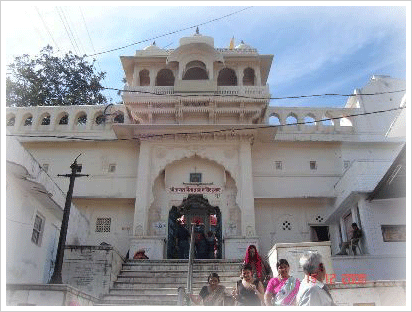
Pushkar is best known for its Brahma Temple built in the 14th century standing on
a high platform near Pushkar Lake. This is the only temple in the world where Lord
Brahma - Creator of the Universe, is worshipped.
A hans (goose-the official carrier of Brahma) spans the gateway to the temple which
is crowned with a red spire.
...more on
Brahma Temple in Pushkar
Warah Temple:
The Warah temple houses an image of lord Vishnu in the incarnation of wild boar.
The temples of Brahma and Warah are considered equally important.
This ancient temple believed to be constructed by King Anaji Chauhan (1123-1150)
...more on Warah Temple in Pushkar
Savitri Temple:
Savitri Temple in Pushkar is a temple of world recognition. Savitri Temple is highly
acclaimed by the tourists as well as by the locals Savitri Temple is the temple
dedicated to the first wife of Lord Brahma
...more on
Savitri Temple in Pushkar.
Mahadeva Temple:
The 19th century Mahadeva temple with its five-faced statue of Mahadeva is made
entirely of white marble. This Hindua temple is remarkable for its elegance of structure,
and is perhaps the finest of all temples in and around Ajmer and Pushkar.
Gayatri Temple:
The Gayatri temple on the other side of Pushkar is in honour of the wife who sat
by Brahmas side in Savitris absence during Brahmas ceremonial sacrifice. Legend
says that Gayatri was an untouchable and to purify her she was put into the mouth
of a cow and taken out from the other end.
To reach the Gayatri Hindu temple the best route to take is from behind the bus
stand and walk up a hill. Both the Savitri and Gayatri temples are closed so to
say during lunch hours and the best time to go is either before noon or in the
evening.
Raghunath Temples:
Two Raghunath temples exist in Pushkar; one is the old one and the other is relatively
new. The Old Raghunath temple was built in 1823 and houses images of Venugopal,
Narasimha (Vishnus fourth incarnation) and Lakshmi, the goddess of wealth.
But theres a bit of a problem for foreign tourists visiting these two temples because
of one little sign which says "Foreigners not allowed." These are probably the only
binary temples in India where such segregation exists.
Naga Hills:
Naga Hill or the Snake Mountain as it means, stands as a divider between the Pushkar
Lake and the city of Ajmer. The mountain is famous for Panch Kund and the cave of
saint Agastya and it is believed that the 4th century poet & playwright Kalidas
composed Abhigyanam Shakuntalam here.
Here goes an interesting belief that the Naga Hill is the oldest hill in the world
and that it was a few million feet high some thousand years ago. Moreover it is
said that by the time Kalayuga ends, the hill will sink down to the earth!
On top of the Naga Hill is a tank called the Naga Kund, which is connected to an
interesting Hindu myth. It is said that those who come here on the 5th day of Shravan
(July/August) have their wishes fulfilled with the benevolence of Vatu - grandson
of Brahma,also a great source of attraction.
How To Reach Pushkar
Fly Away: The nearest airport from Pushkar is Jaipur (145 kms). Jaipur is
well connected to all the major cities which include Delhi, Mumbai, Kolkata, Jodhpur,
and Udaipur. Recently, flights to Dubai have also started from Pushkar by Indian
Airlines.
On Tracks: The nearest railway station for Pushkar is Ajmer (11 kms), which
is on the Broad Gauge and hence connected to all the metro cities of India. There
are daily trains from Delhi in morning (Shatabdhi Exp).
On Wheels: Pushkar is 11 km from main Ajmer bus stand. Rajasthan Roadways
run very comfortable deluxe buses from Jaipur. There are buses from Jaipur to Ajmer
every 15 minutes, some nonstop. The roads are very good, and it takes around 3 hrs
from Jaipur. You can also come by hire private cars.
Where To Stay in Pushkar
Please visit our exclusive section on
Hotels in
Pushkar to find the best accommodation in Pushkar.
Where To Shop in Pushkar
Pushkar's narrow main bazaar is lined with an assortment of absorbing little shops.
Here you'll come across everything from late'60s-timewarp clothing to Rajasthani
turbans, from statues of Ganesh to the novels of Salman Rushdie.
Particularly good buys include costume jewellery, glass lamps, embroidered fabrics
such as wall hangings and shoulder bags, Rajasthani puppets and traditional music.
Much of the stock comes from the Barmer district south of Jaisalmer and other tribal
areas of Rajasthan.
There are number of bookshops in the main bazaar selling a tremendous range of secondhand
novels, and they'll usually buy them back for around 50% of what you pay.