Jaipur
About Jaipur
One of the major tourist destinations of India, Jaipur India is given a world wild
title, as the Pink City due to the pink wash applied to its buildings. Travel to
Jaipur - the capital city of Rajasthan, it is an abode of extensive boulevard and
beautiful gardens.
Jaipur India was founded by Sawai Jaisingh II, in 1727 AD, still preserves its glory
of rich history and culture. The past comes alive in its impressive forts, majestic
palaces and in its royal building which for centuries were the abodes of royal families.
Rajasthani jewelry, art and fabrics maintain an ageless feature and are surely a
treasure-trove for the shoppers. These exquisite items are of great demand in the
international market. Jaipur Tourism with its romantic grace takes one to an era
of kingship and heritage.
Travel to Jaipur, one of the most treasured destination of Rajasthan. Your Jaipur
travel will enable you to explore the forts and palaces of the city. Jaipur travel
will involve sightseeing tour to City Palace, Amber Fort and Hawa Mahal.
The city of Jaipur is multifaceted and offers innumerable attractions to people
coming from all across the world. It is a pristine jewel in the sands of Rajasthan,
the city is well known for its marvelous architecture and town planning. The city
offers a perfect mix of culture which needs to experience on your Rajasthan tour.
Tourist Attractions in Jaipur
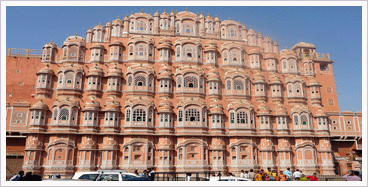
The Hawa Mahal or the 'Palace of Winds':
The construction of Hawa Mahal is credited to Maharaja Sawai Pratap Singh and dates
back to 1799. The Hawa Mahal or the Palace of Winds was a thoughtful effort to enable
the ladies of the royal household to look at the outside world.
It was a welcome respite for the ladies of the royal household who had to follow
the purdah system.
...more on Hawa Mahal
in Jaipur
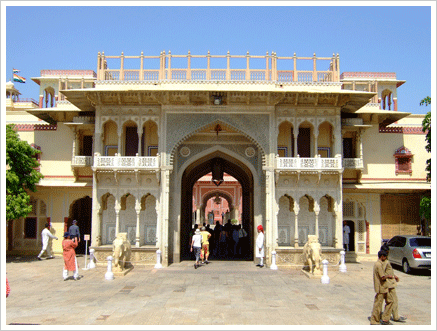
City Palace:
The City Palace located at the heart of the city best exemplifies the cultural legacy
of the royal past. The palace is a blend of Mughal and Rajasthani architecture.
While a part of the palace is still occupied by the royal family, there are sections
open to visitors.
...more on City
Palace in Jaipur
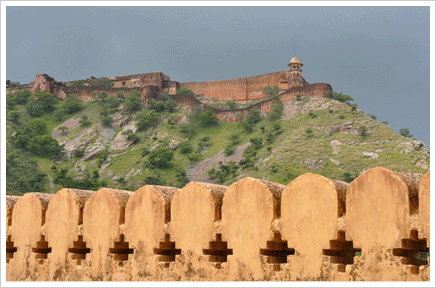
Jaigarh Fort:
Jaigarh Fort is one of the few intact forts in the state of Rajasthan. The fort
located some 15 kms from the city centre of Jaipur is one great attraction for the
tourists.
Jaigarh Fort was built by Sawai Jai Singh in the year 1726. It was built primarily
to enhance the defense of the Amber and the newly built city, at that time - Jaipur.
It is because of this that the fort stands established towards the boundary of the
city.
...more on Jaigarh Fort in Jaipur
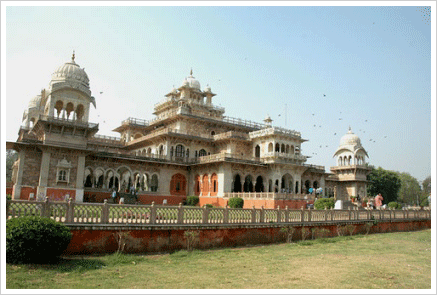
Albert Hall:
Central Museum or the Albert Hall lies in the Ram Niwas Garden. It is a vast and
verdant garden housing a zoo, a greenhouse, an aviary, a museum and a sports ground.
Maharaja Sawai Ram Singh II built it in 1868 as a relief project for his famine
struck subjects.
The Albert Hall has been modeled on the Victoria and Albert Museum in London and
is afine example of Indo-Saracenic style of architecture. The hall was named after
Albert, the consort of Queen Victorias husband. Alberts son the Prince of Wales
(later Edward VII) laid the foundation stone in 1876. It was designed and devised
by Colonel Sir Samuel Swinton Jacob (1841-1917).
The Albert Hall has been converted into the Central Museum which proudly displays
Rajasthans art and culture and outlines the Rajput morality with these lines: "A
Rajput puts his life at risk if he is forced to abjure his faith, if he is deprived
of his lands, and if his womenfolk are molested."
It now houses an exquisite collection of metal ware, decorative wares, miniature
portraits, sculptures, paintings, natural history specimen, an Egyptian mummy among
various other objetart. Rajasthani village life is also displayed through costumes,
pottery, brassware and woodwork.
The Durbar Hall, usually locked, houses several stunning carpets including the magnificent
Persian Garden Carpet, one of Indias finest art treasures. It was made in Kerman,
Persia in 1632 and represented the garden of paradise based on a quadrangular design.
The museum also has some melancholic specimens on display like a horse skeleton,
a human skeleton, and a stuffed cobra. Sometime back the Ravindra Manch with an
auditorium, a modern gallery and an open-air theatre has been added to the museum
to promote cultural events.
Visiting Hours: 0930-1630 Hrs. Closed on Fridays
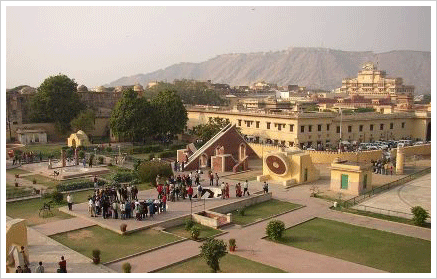
Jantar Mantar:
Between 1727 and 1734 Maharajah Jai Singh II of Jaipur constructed five astronomical
observatories in west central India. The observatories, or "Jantar Mantar" as they
are commonly known, include multiple buildings of unique form, each with a specialized
function for astronomical measurement.
These structures with their striking combinations of geometric forms at large scale
have captivated the attention of architects, artists, and art historians world wide,
yet remain largely unknown to the general public.
Jai Singh named his observatory Jantar Mantar, which is actually pronounced, as
'Yantra Mantra', yantra for instrument and mantra for formula.
A huge sundial known as "Samrat Yantra" or 'Prince of Dials', meant to measure exact
time of the day within half a second and the declination of the sun and other heavenly
bodies dominates it.
The observatory consists of fourteen major geometric devices for measuring time,
predicting eclipses, tracking stars in their orbits, ascertaining the declinations
of planets, and determining the celestial altitudes and related ephemeredes. Each
is a fixed and 'focused' tool.
The Samrat Jantar, the largest instrument, is 90 feet high, its shadow carefully
plotted to tell the time of day. Its face is angled at 27 degrees, the latitude
of Tour of Jaipur. The Hindu chhatri (small domed cupola) on top is used as a platform
for announcing eclipses and the arrival of monsoons.
Each instrument Built of local stone and marble and carries an astronomical scale,
generally marked on the marble inner lining; bronze tablets, all extraordinarily
accurate, were also employed. Thoroughly restored in 1901, the Jantar Mantar was
declared a national monument in 1948.
Visiting Hours : 0930-1630 Hrs.
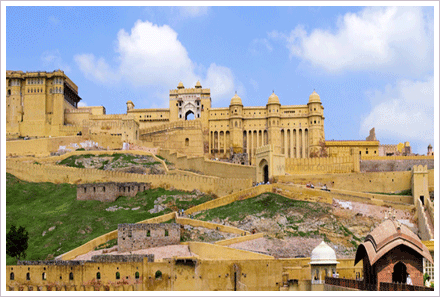
Amber Fort:
The Kachchawahas ruled from Amber, 11 km from Jaipur, for seven centuries. With
a history so old, it is not unexpected that there is a lot of the past that can
be traced in its archaeological history. While many of the early structures have
either disappeared or ruined, those dating from the16th century on are in a remarkable
state of preservation.
...more on Amber Fort in Jaipur
Nahargarh Fort:
Gracing the rugged ridge of the Aravalli Hills is the Nahargarh Fort build by Sawai
Raja Jai Singh in the second quarter of the eighteenth century. Jaipur was the capital
and the need to boost its defense was a necessity. This explains the presence of
the Nahargarh Fort.
...more on Nahargarh
Fort in Jaipur
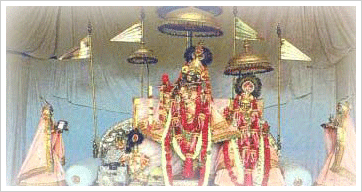
Govind Dev Ji Temple:
A Part of City Palace complex, this Krishna Temple is highly revered by the erstwhile
royal family. The image brought from Vrindavan, is housed within the sanctum of
this spire less temple, the patron deity of the royal family is very religiously
worshipped by most of the Hindus in the city and near by areas.
The image is unveiled seven times daily for 'AARTIES' and BHOGS offered in the silver
wares, consisting of sweets mostly.
...more on
Govind Dev Ji Temple in Jaipur
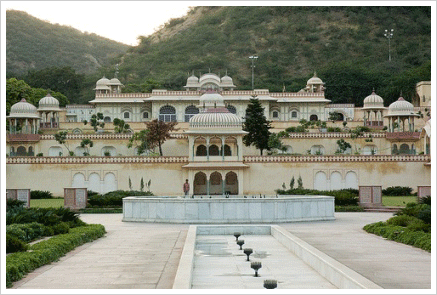
Sisodia Rani Bagh:
Constructed by Raja Sawai Jai Singh, the founder of Jaipur, in 1728, Sisodia Rani
Ka Bagh was built as a gift by the imperial groom to his Sisodia Queen from Udaipur
who was a Sisodia descendant.
Situated at a distance of 10 kilometers from the main Jaipur city, Sisodia Rani
Ka Bagh lies on the Jaipur-Agra highway. Adorned in typical Mughal style, Sisodia
Rani Ka Bagh is a multi-tiered garden that is a storehouse of elegantly painted
pavilions, several watercourses and fragile water fountains.
It mainly depicts the theme based on the legends of eternal lovers - Lord Krishna
and his soul love Radha. The gardens plea to the visual and aesthetic tastes of
the visitor with its multi-tiered gardens, most elegant and stylish fountains and
watercourses, painted pavilions and galleries and most striking murals of Lord Krishna
in all sorts of poses taken from his lifetime.
The royal maidens and ladies of Jaipur used it as a well-liked and private summer
move away in the 17th and the 18th century. It is one of the largest and most well
designed gardens situated in the southeastern corner of the walled city.
Bm Birla Planetarium:
The Birla Planetarium is at the BM Birla Science & Technology Center, near Statue
Circle. The Planetarium offers unique audio-visual educational and entertainment
with its modern computerised projections system.
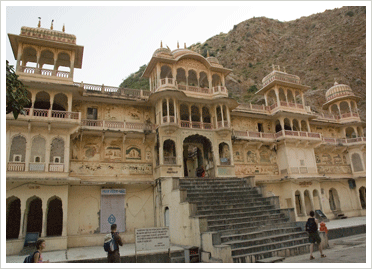
Galta Ji:
Galta is a pretty little pilgrim spot located just beyond Sisodia Rani-ka Bagh on
Agra Road. This is the sacred spot where one sage Galav is supposed to have lived
and meditated. As such the place is much known for its pilgrimage holidays and is
visited mainly for its temples.
The Temple of Galtaji, which lies in a picturesque gorge amid low hills, has a huge
complex. This one is also built of pink stone, with a profusion of pavilions having
rounded roofs. The walls and pillars have exquisite carvings and paintings.
The whole complex is so beautiful that it is more of a visual treat than a place
for worship. The temple, however, has a large daily attendance.
...more on
Galta Ji in Jaipur
Birla Temple:
A small palace, this is a replica of a Scottish castle, and perches on a hilltop.
Once occupied by Maharaja Madho Singh's son who was confined here, it was also for
a while home to Maharani Gayatri Devi. Entry is prohibited.
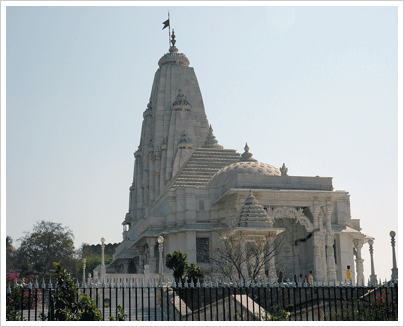
At the foot of Moti Dungri fort is the Birla Lakshmi Narayan Temple. It is a large,
modern marble edifice. Stained glass widows depict the scenes from Hindu scriptures.
...more on Birla Temple in Jaipur
Kanak Valley:
Not so old but definitely an exquisitely land scaped gardens with beautifully carved
temple in beige stone, which is a vast complex with terrace sites all around and
intricately carved marble columns and lattices, Located in the foothills of Nahargarh
hills on the way towards Amer.
This complex is a popular spot for picnic and film shoots. It should be definitely
visited on the way to the three garland forts of Jaipur- Nahargarh, Jaigarh and
Amber. The greenery after the monsoons give this whole place a feel of heavenly
sensation, with Jal Mahal in the background.
Visiting Hours: 0800 - 1700 Hours for garden and 0800-1900 Hours for the temple.
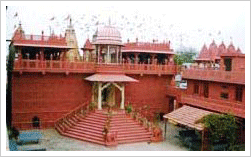
Jain Temple:
The most beautiful temple in Sanganer is the ancient Shri Digamber Jain temple.
The temple has fine carvings as those of the magnificent Delwara temples of Mount
Abu. Built in various phases with sky-high shikharas (spires), the temple represents
an old style of architecture.
The last phase was probably built in the 10th century. The beautiful nij-mandir
(inner temple) is a stone shrine with three pinnacles. In the centre is an idol
of Parshwanath with 7 serpent hoods. All around it, are carvings of lotuses, creepers
and elephants pouring water from pitchers held in their trunks. But the main idol
is that of Adinath, installed in the shrine behind this.
How To Reach Jaipur
Fly Away: The Jaipur Airport also known as Sanganer Airport is well connected
with all the major cities of India like Delhi,Mumbai,Kolkata,Chennai. There are
direct flights to Delhi, Mumbai, Jodhpur, Udaipur, and Ahmedabad. The airport is
at a distance of 15km from the city. The Domestic Airlines all, operate here and
there is one international flight to Dubai.
On Tracks: You have the trains like the Pink City Express which leaves Delhi
at 6 a.m. and reaches Jaipur at 11 am and also Chetak Express, Jaipur-Delhi Services.
Further special trains like the Shatabdi Express and Intercity Express also ply
regularly to Jaipur .If you want to travel in luxury then Palace on Wheels is the
right choice for you.
On Wheels: Jaipur has good Road Network of Jaipur connecting it to all parts
of India. Delhi-Jaipur national highway is an excellent roadway. There are national
highways NH8 AND NH11 passing through Jaipur. It takes five hours to reach Jaipur
from Delhi. Presence of good bus services from Delhi, Agra and other important north
Indian cities to Jaipur has made the city a convenient tourist destination. In Jaipur
you have regular bus service of AC and Deluxe Coaches.
Where To Stay in Jaipur
Find Best Deals and Discounts on
Jaipur Hotels
Where To Shop in Jaipur
Your Jaipur travel is incomplete if you don't enroll yourself in shopping expedition.
There are number of shopping bazaars from where you can shop the best of products.
Tripolia Bazaar, Johari Bazaar, Kishanpol Bazaar and Nehru Bazaar are some of the
famous market places of Jaipur.
All these bazaars are famous for something or other. Nehru Bazaar is quite famous
for Mojri footwear, Tripolia Bazaar is quite famous for ironware and brassware,
Bapu Bazar for textiles, perfumes and camel skin shoes and M.I Road for emporiums
that offer anything from jewellery, brass work, textiles, blue pottery to excellent
quality wood work.