 |
|
|
|
|
|
|
Wildlife in Rajasthan
A considerable portion of Rajasthan lies in the desert region yet this has not deterred
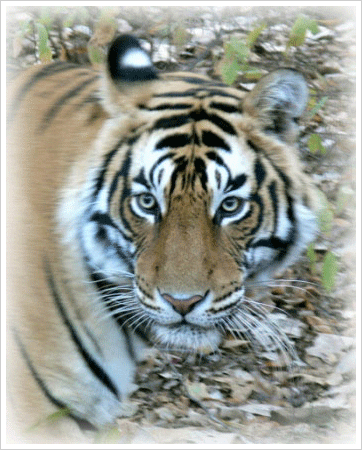
wildlife from flourishing there. From the majestic Tigers to the elegant peacocks
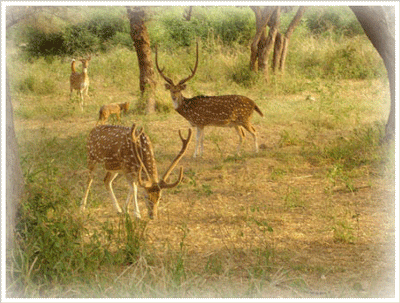
and extremely endangered Black Bucks - animals birds and reptiles are found there
in plenty. There are quiet a number of wildlife species typical to the desert region
found in some of parks as well.
Some popular wildlife sanctuary of Rajasthan have been listed below:
Darrah Wildlife Sanctuary | Desert National Park | Keoladeo Ghana National Park | Kumbhalgarh Wildlife Sanctuary | Mount Abu Sanctuary |
Ranthambore National Park | Sariska
Wildlife Sanctuary | Sita Mata Wildlife
Sanctuary
Darrah Wildlife Sanctuary, Kota
Kota is a little different from other towns of Rajasthan. In fact, it is not just
a little different but very, very different from the rest of Rajasthan. Kota has
an interesting blend of the old and the new. The choice of the foremost tourist
attraction is between the fort, wildlife sanctuary and the mighty Chambal, Rajasthans
only perennial river.
If you interest lies in wildlife then drive 50km towards the south of Kota. The
drive through a hilly area will take you to Darrah wildlife Sanctuary....more on
Darrah Wildlife Sanctuary
Desert National Park, Jaisalmer
Rajasthan is an abode of many wildlife sanctuaries and National Park, however none
of them is similar to the Desert National Park. The park is widely different from
a usual park and actually for a novice, the park has little importance. Nonetheless,
the Desert National Park has an important role to play in maintaining the ecological
balance of the region. This is one of newer sanctuaries and was established in the
year 1980....more on Desert National
Park
Keoladeo Ghana National Park, Bharatpur
Keoladeo Ghana National Park or Bharatpur Bird Sanctuary is one of the best bird
preserves in the world. The park was created by the erstwhile Maharaja - Suraj Mal,
in the 18th century. The sanctuary was created so as to supply a regular stock of
waterfowls to the royal kitchen.
The park was accorded the status of a sanctuary in the year 1956 and in 1982 declared
as a national park. The sanctuary supports a large number of water birds, including
many rare species....more on Bharatpur
Bird Sanctuary
Kumbhalgarh Wildlife Sanctuary, Udaipur
This wildlife park has imbibed its name from fort Kumbhalgarh. This is a beautifully
located sanctuary near the majestic fort of Kumbhalgarh that overlooks this 578
sq km sanctuary. The landscape here changes with the season as the Aravalli hills,
which remain barren for most of the year, turn green during rains and provide shelter
to sloth bear, leopard, flying squirrel.
It is also the only sanctuary where the Indian wolf is breeding successfully....more
on Kumbhalgarh Wildlife Sanctuary
Mount Abu Sanctuary, Mount Abu
The quaint little hill station Mount Abu is set amidst verdant hills and and picturesque
landscape. It is located at the southern western end of the princely state of Rajasthan.
At a distance of about 185 km from Udaipur, the hill station is famous for several
temples, Nakki Lake and Wildlife Sanctuaries.
The sanctuary located in Mount Abu was declared as a protected area in the year
1960 and ever since then this sanctuary which is spread over the gorgeous Aravalli
range of mountains has been attracting not only domestic tourists but also tourists
from overseas....more on Mount Abu
Sanctuary
Ranthambore National Park, Sawai Madhopur
The Ranthambore National Park is bound by the rivers Chambal, in the south, and
Banas, in the north. It was established as a sanctuary in 1959 and included in the
very first phase of Project Tiger in 1972.
In 1981 Ranthambore was awarded National Park status. It is characterized by rocky
plains, flat hilltops, gentle slopes and precipitous cliffs. It is mainly covered
by dry deciduous forests. Ranthambore is virtually an island rich in flora and fauna
in an ocean of villages, farmland and over grazed arid land.
Opening Time: The park is open from 1st October till 30th June....more on
Ranthambore National Park
Sariska Wildlife Sanctuary, Alwar
Sariska National Park, located some 37 kms from the disrict of Alwar, is a great
place to spend exciting and adventurous vacations. Lined up by a number of hills
of Aravali, the region is bifurcated into many narrow valleys that criss cross at
many places. Sariska National Park used to be the hunting grounds for the royal
family of Alwar.
Tiger is one of the many species people come looking for. Sariska, like Ranthambore
National Park is home to the diurnal tigers. Although, their number is less nowadays,
but encounters do take place....more on Sariska National
Park
Sita Mata Wildlife Sanctuary, Udaipur
Ensconced in the midst of Aravalli's, surrounded by lush forests and crystal lakes
Udaipur offers a natural habitat for several wild animals, birds, reptiles and rodents.
There are few wildlife reserves in Udaipur but each wildlife forest is a natural
beautific jewel that shines on the glistering Udaipur map that is a bright mosaic
of wondrous marble palatial monuments.
Among the important wildlife reserves in Udaipur are the Sita Mata Wildlife Reserve
and the Kumbhalgarh Wildlife Reserve.....more on
Sita Mata Wildlife Sanctuary
|
|
@Copyright 2008-2014 RajasthanTour4U.com | Blog | Contact Us | Advertise | FAQs | Travel Links | Sitemap | |
|