Chittoragh
About Chittorgarh
The Chittaurgarh is known as one of the old city of colorful Rajasthan. The forts
and palaces of Citttaur are glorious tales of valor and sacrifice in India.
Its is the soil of great martyrdom, the Rajputs, who have seen the battle field
from close quarters and have witnessed number of deaths in the Warfield. The brave
Rajputs proved that they would rather embrace death than bow before a foreign power.
Thousands of Rajputs warriors shed their blood to protect there motherland from
enemies hand, who try to conquer their land.
Chittaurgarh is located in the south east of Rajasthan, near the Madhya Pradesh
border. It is little far from rest of the destination points in the royal state
of Rajasthan. It is about 588 Km far in the south west area from Delhi (National
capital of India) and 113 Km from Udaipur by Road.
Tourist Attractions in Chittoragh
Chittorgarh Fort:
According to legends, Bhim, one of the pandava hero, is credited with the original
construction of the fort. Most of the Chittaur attractions are settled inside its
magnificent fort.
This bewitching fort has crinkled labyrinthine of over 1 km, which leads through
all the massive gates. The fort looks massive in structure with the number of gateways
inside it.
...more on Chittorgarh
Fort in Chittorgarh
Vijay stambh (Victory Tower):
The most imposing monuments in Chittor are the dual towers that stand as a grim
reminder of the jaded grandeur of Chittor. Vijaystambha or Victory Tower was erected
by Rana Kumbha from 1457-58 after he defeated the combined armies of Malwa and Gujarat.
The tower is 122 feet high and its summit spans an area of more than 17 feet. Nine
storeys ascend into the sky from the 35 feet broad base on a 42 feet broad platform.
Each of the nine storeys have doorways leading into colonnaded balconies.
Designed by an architect called Jaita in the Jain revivalist style, the tower is
built of quartz and compact limestone abundantly found in Chittor.
The colonnaded top storey has a statue of a kanya (young girl) surrounded by gopis
(milkmaids) in dancing postures playing various musical instruments. Black marble
tablets in this floor contain shlokas (verses) tracing the genealogy of Chittor
rulers.
However, most of the slabs have been defaced and only one is still in its original
condition. The fifth floor contains relief of the builders of the tower, and a simple
staircase which leads right up to the top connects all the storeys.
Rana Kumbha's Palace:
Rana Kumbha was the one who officially built Chittor, and his palace is the oldest
monument within the fort walls. The palace was built from 1433-68 in plastered stone,
and the entrance is through Suraj Pol which directly leads into a courtyard.
On the right of Suraj Pol is the Darikhana or Sabha (council chamber) behind which
lies a Ganesha temple and the zenana (living quarters for women). A massive water
reservoir is located towards the left of Suraj Pol.
Ruined houses towards the south of the palace may have been used by lesser nobles,
or were probably used by palace attendants. Below the central courtyard is a subterranean
chamber where Rani Padmini committed jauhar with the rest of the women of Chittor
when Alauddin Khilji besieged the fort.
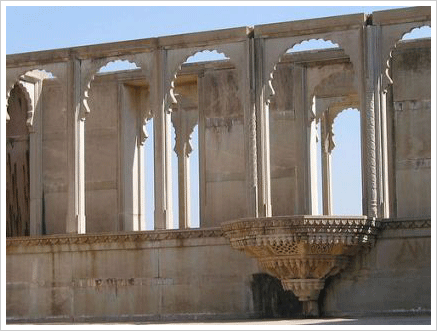
But perhaps the most remarkable feature of the palace is its splendid series of
canopied balconies. The complex also houses stables for elephant and horses, but
is now in ruins.
Padmini Palace:
Padmini Palace is a compact three storeyed white building, but what is seen today
is a 19th century reconstruction of the original. The palace is surrounded by water,
and the inevitable chhatris (pavilions) crown its roofs.
This was perhaps the forerunner of the concept of jagmahals (palaces surrounded
by water), and it was from here that Akbar carried off huge bronze gates and installed
them in Agra. Close by is Bhimlat kund, an artificial tank dedicated to the strongest
of the Pandava brother, Bhima.
Government Museum:
The magnificent Fateh Prakash Mahal has been converted into a museum, which houses
rare and rich collection of sculptures from fort and the temples.
The other important places are, the temple of Tulja Bhawani (the tutelary goddess
of the scribes), temple of Annapurna, the Naulakha Bhandar or Nine Lakh treasury,
Singar Chaori, depicting inscription dating back to 1448 AD, Sat-bis-Deori, the
old Jain temple, etc.
Kalika Mata Temple:
Bappa Rawal built the Kallika Mata temple sometime during the 8th century for Surya,
the Sun god. Alauddin Khilji destroyed it in the first sack of Chittor, but Rana
Hammir rebuilt it as a Kali temple in the 14th century.
The temple consists of five chambers, all devoid of their original roofs. The walls
of this temple are plain but the cornices are decorated with lotus symbols. The
inner sanctums walls depict the Sun god Surya in nichs surrounded by consorts
and angels.
The moon god Chandra is also shown in sculptures in the walls which rise up into
a flat ceiling supported by quadrangular pillars, also intricately carved and bracketed
at the top. The doorframe of the inner sanctum has four ornamental bands with Surya
forming the central theme of its carvings.
The entire frame is flanked by an elaborate panel in which are carved figures of
deities around a main figure of the sun god. The temple still retains the flavor
of the Gupta style of architecture, and an inscription within the edifice informs
us that it was built by king Manabhanga.
How To Reach Chittoragh
Fly Away: Udaipur is the nearest airport. Daily flight form Delhi, Mumbai,
Jaipur and Lucknow are available to Udaipur.
On Tracks: Chittaurgarh has rail links with Ahmedabad, Chittaurgarh, Udaipur,
Jaipur, Kota, Alwar and Delhi.
On Wheels: Rajasthan Roadways run very comfortable deluxe & air conditioned
buses from Jaipur to Chittaurgarh. It is also connected by road to Delhi, Mount
Abu, Chittaurgarh, Bundi and Udaipuri.
Where To Stay in Chittoragh
Please visit our exclusive section on
Hotels in Chittorgarh
to find the best accommodation in Chittorgarh.
Where To Shop in Chittoragh
A city of bravery and sacrifice, Chittorgarh is also known for its some unique shopping
items. Chittorgarh shopping destinations offer an interesting experience to the
tourists.
A Chittorgarh shopping guide will include the following items for which the city
is quite famous for Metal Ware, Fabrics, Thewa jewelry (gold designs embedded in
glass), Colorful leather jutis (embroidered camel leather shoes), Akola fabrics
(painted with vegetable dyes), Wooden painted toys (from Bassi village)
Some of the famous shopping places of Chittorgarh, Rajasthan are: Sadar Bazaar,
Rana Sanga Market, New Cloth Market, Fort Road Market, Gandhi Chowk, Station Circle