 |
|||||||||||
|
|
|||||||||||
|
|
Forts and Palaces in Rajasthan
Much of the popularity of Rajasthan is attributed to its magnificent forts and palaces.
These forts, built by the famous Rajput kings, feature architectural brilliance,
legends of the past, historical events and offer glimpses of the bygone days. The
forts make up the key tourist attractions in the state. Many of them are located
on hill tops overlooking the towns below. The forts exist as store houses to a number
of other attractions.
Some popular forts and palaces of Rajasthan have been listed and given below:
Amber Fort | Chittorgarh Fort | City
Palace, Jaipur | City Palace, Udaipur |
Hawa Mahal | Jaigarh Fort | Jaisalmer
Fort | Jalore Fort
| Junagarh Fort |
Kumbhalgarh Fort | Lake Palace | Lalgarh
Palace | Lohagarh Fort
| Meherangarh Fort |
Nahargarh Fort | Ranthambhor Fort |
Samode Palace | Taragarh Fort
| Umaid Bhawan Palace |
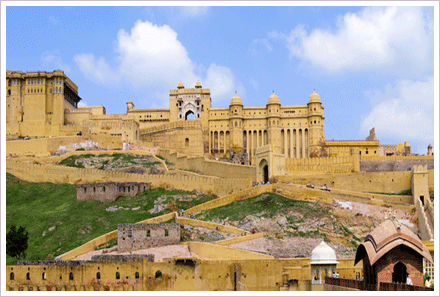
Amber Fort, Jaipur
The Kachchawahas ruled from Amber, 11 km from Jaipur, for seven centuries. With
a history so old, it is not unexpected that there is a lot of the past that can
be traced in its archaeological history. While many of the early structures have
either disappeared or ruined, those dating from the16th century on are in a remarkable
state of preservation.
Amber as it exists now is the handiwork of three of the kingdom's rulers that include
Man Singh, and Jai Singh I and II....more on Amber Fort
in Jaipur
Chittorgarh Fort, Chittorgarh
Chittorgarh The town of the brave, known for its massive fort atop a hill, which
can be singled out for its glorious past. The fort has a chequered history, it has
witnessed some of the bloodiest battles in history, three great Sakes and some of
the most heroic deeds of valour, which are still sung by the local musicians.
The Fort A standing sentinel to the courage and valour of Chittorgarh, it stands
tall over a 180 meter high hillock covering a massive area of 700 acres....more on
Chittorgarh Fort in Chittorgarh
City Palace, Jaipur
The focal point of the walled city is the palace complex that lies in the heart
of the city and occupies the space of the central grid. The rest of the grids were
cut across neatly by wide lanes which divided the area into tidy, well laid-out
rectangles of commercial and residential use.
The city palace is an architectural marvel, with ornate gates, arches, balconies
and courtyard surrounded by a series of gardens and buildings over a vast expanse....more
on City Palace in Jaipur
City Palace, Udaipur
City Palace complex is actually a conglomeration of buildings added by various Maharanis,
the palace manages to retain a surprising uniformity of design. Building was started
by Maharana Udai Singh II. The palace is surmounted by balconies, towers & cupolas
and there are wonderful views over the lake and the city from the upper terrace.
Main entrance is from northern end through the Baripol of 1600 and the Tripolia
Gate of 1725, with its eight carved marble arches....more on
City Palace in Udaipur
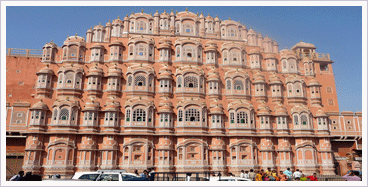
Hawa Mahal or the 'Palace of Winds', Jaipur
They could see, but could not be seen. At Hawa Mahal, you could relive the bygone
era of concealed freedom. As you look below at the street you realize the architectural
marvel that Hawa Mahal is.
For even while the women of the royal family could not participate actively, the
intricately latticed 365 Jharokhas made it possible for them to partake of the
festivities, without being noticed....more on
Hawa Mahal in Jaipur
Jaigarh Fort, Jaipur
A little out of the city you can journey into the lives of the Maharajas. Move on
to battles, weaponry and valour, an indispensable armour of the kings. Perched atop
a hill Jaigarh Fort or the Cheel ka Teela is a spectacular fort.
Jaigarh Fort is one of the few intact forts in the state of Rajasthan. The fort
located some 15 kms from the city centre of Jaipur is one great attraction for the
tourists....more on Jaigarh Fort in
Jaipur
Jaisalmer Fort, Jaisalmer
Like various other cities of Rajasthan, in Jaisalmer too you will find different
facets of its own glorious heritage. Though you can find historical monuments scattered
all over the city, the living Jaisalmer Fort, immense in size, will immediately
command your attention.
If you visit the fort at the crack of down, the beauty of the Jaisalmer Fort would
mesmerize you. As the early morning rays dawn on the fort, they cast a midas touch....more
on Jaisalmer Fort in Jaisalmer
Jalore Fort, Jalore
The main attraction of Jalore is its fort, which was one of the 'nine castles of
Maru', under the Parmaras in the 10th century. Jalore retains an impressive fort
which has been known over history as the Sonagir or the 'golden mount'.
It is situated in south of Jalore 1200 feet over the mountains. A zig zag way leads
to the fort upon the mountain where on each step the height goes on increasing....more
on Jalore Fort in Jalore
Junagarh Fort, Bikaner
The impregnable fort, which has the distinction of remaining unconquered. Raja Rai
Singh (1571 - 1611 A.D.) one of the most outstanding generals of Emperor Akbar,
built this impressive fort, with embellishments in the form of palaces and Luxurious
suites added by subsequent Maharajas.
This fort has a 986m-long wall with 37 bastions, a moat and two entrances. The Surajpol
or the 'Sun Gate' is the main entrance....more on
Junagarh Fort in Bikaner
Kumbhalgarh Fort, Rajsamand
84 km from Udaipur, Maharana Kumbha built Kumbhalgarh Fort in the 15th century.
It is the second most important fort in Rajasthan after the Chittaurgarh Fort. Crowning
the Aravalli Hills, the fort is not so easily accessible with seven great gates
that stand guarding its entrance. Just 6 kms, from the Kumbalgarh Sanctuary, this
mighty fort boasts of some great temples and the Badal Mahal or the Cloud Palace,
which gives scenic view of the city....more on
Kumbhalgarh Fort in Rajsamand
Lake Palace, Udaipur
Lake Palace or Jag Niwas is regarded as one of the most beautiful palace of the
world, the mere sight is mesmerizing as this white wonder arises out of the turquoise
waters of lake Pichola. Built in 1746, by Maharana Jagat Singh II on the island
of Jag Niwas, as a summer resort.
This cool haven is a marvel in stone and is the best example of Mughal- Rajput architecture.
The courtyards lined with columns, spectacular terrace gardens, foliage and fountains
all add to its striking architecture....more on
Lake Palace in Udaipur
Lalgarh Palace, Bikaner
The beautiful city is dotted with the some of the most exotic monuments that adorns
the beauty of the city that is centuries old. The city is known for its numerous
forts and palaces that narrate the story of princely legacy of the state. The Forts
and Palaces in Bikaner in India are one of the major attractive propositions of
the city that allures the tourists to the city. One such marvelous creation of the
city that has been the cornerstone of attraction of the city is the Lalgarh Place,
Bikaner....more on Lalgarh Palace
in Bikaner
Lohagarh Fort, Bharatpur
While most visitors to Bharatpur now visit the area for the nearby bird sanctuary,
the Lohagarh Fort is still the focal point of the town. The fort takes its name
from its supposedly impregnable defenses. Its ingenious design gave it an awesome
reputation.
The Lohagarh Fort, true to its name stood solidly in front of many British attacks,
and frustrated them to ends. It faced the British onslaught four times and after
a long siege they had to withdraw, but Lord Lake, however was successful in capturing
it in 1804....more on Lohagarh Fort
in Bharatpur
Meherangarh Fort, Jodhpur
One of the largest forts in India, the Meherangarh fort is the pride of Jodhpur.
Situated on a 150 m high hill, this magnificent fort was founded in the year 1469
by Rao Jodha. The fort has seven gates, some of which still stand as a witness to
the battles fought by the armies of Jodhpur.
Burnished red sand stone, imposing, invincible and yet with a strange haunting beauty
that beckons. Much has been written about the Citadel of the Sun, for truly, it
is one of the most impressive in all Rajasthan....more on
Meherangarh Fort in Jodhpur
Nahargarh Fort, Jaipur
Gracing the rugged ridge of the Aravalli Hills is the Nahargarh Fort build by Sawai
Raja Jai Singh in the second quarter of the eighteenth century. Jaipur was the capital
and the need to boost its defense was a necessity. This explains the presence of
the Nahargarh Fort.
The Fort underwent many alterations and modifications during the reign Sawai Ram
Singh II and Sawai Madho Singh II. They built a series of interconnected rooms with
cplorful corridors and hallways....more on
Nahargarh Fort in Jaipur
Ranthambhor Fort, Sawaimadhopur
The history of Sawai Madhopur revolves around the Ramthambhor fort. Surrounded by
Vindhyas and Aravalis, amidst vast and arid denuded tracts of Rajasthan, lies the
oasis of biomass in an ecological desert.
The strength and inaccessibility of the fort was a challenge to the ambitions of
the rulers of the ancient and medieval India, particularly those of Delhi and Agra.
The eminent ruler of the fort was Rao Hamir who ruled around 1296 AD....more on
Ranthambhor Fort in Sawaimadhopur
Samode Palace, Jaipur
The fort is an old fortified residence of the Nathawat clan from Chomu that served
as the Prime Ministers of the Jaipur Royal Court is located some 40km North West
of Jaipur and 264 km from Delhi in the range of Aravali.
This magnificent fort is as charming and romantic in itself, and exhibits grandeur,
good taste, class and elegance. The way to the fort's main entrance is through the
inside of the village, which can be covered from the highway by a camel safari,
with the locals welcoming the guests with smiles and thrilling expressions....more
on Samode Palace in Jaipur
Taragarh Fort, Ajmer
Rajasthan has always been known for its royal palaces, forts and sand dunes. So
discussing one of the prime attractions of the forts of Rajasthan we have the Taragarh
Fort of Ajmer. This is a rare example of the architectural genius in the medieval
period.
Taragarh or the 'Star Fort', this 12th century fort stands on a hill top and situated
three kilometers and a steep 1 and a half hour climb beyond the Adhai-Din-Ka-Jhonpra
Mosque. As it is situated on a height, it commands a spectacular view over the city....more
on Taragarh Fort in Ajmer
Umaid Bhawan Palace, Jodhpur
Constructed of marble and pink sandstone this immense palace is also known as the
Chhittar Palace because it uses local Chittar sandstone. Begun in 1929, it was designed
by president of the British Royal Institute of Architects for Maharaja Umaid Singh
and took 15 years to complete.
It is a splendid example, of Indo-colonial and art deco style of the 30s. The construction
of this palace is certainly unique and it took almost 5000 men to build this massive
structure....more on Umaid Bhawan
Palace in Jodhpur
|
||||||||||
|
@Copyright 2008-2014 RajasthanTour4U.com | Blog | Contact Us | Advertise | FAQs | Travel Links | Sitemap | |
|||||||||||