 |
|
|
|
Exclusive Rajasthan
Rajasthan TourismInformation & MediaTourist Resources |
Brahma Temple, Pushkar
Just 11 km northeast of Ajmer is Pushkar, a small town sacred to the Hindus. The
sanctity of the lake for Hindus is equal to that of Mansarovar in Tibet. According
to tradition, a bath in its waters is as essential as pilgrimages to Badrinath,
Dwarka and Puri, the traditional at least once in a lifetime places of pilgrimage.
The Padma (lotus) Puran (sacred legend) describes Pushkar as the place where Brahma,
Lord of Creation killed a demon with a lotus. The petals fell at three spots where
lakes emerged. Pushkar is the most important of them, for Brahma performed a yagna
here on the full moon of Kartik (October/November). His consort, Savitri, could
not be present on the occasion, so Brahma hastily married a Gurjar girl, Gayatri.
When Savitri appeared she was furious. She cursed all those present, and said that
Brahma would be worshiped at Pushkar only.
Epics, religious texts, coins and inscriptions bear evidence to the sanctity of
Pushkar. Over the centuries it grew into a temple town, and today there are as many
as 400 temples in Pushkar. Pushkar is a maze of temples, ashrams and one is never
far from the sound of worship, from asceties and devotees. The most important temple
is Brahma Temple.
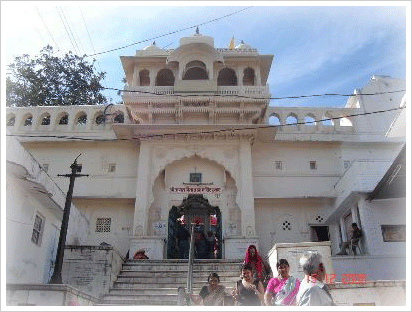
Pushkar is best known for its Brahma Temple built in the 14th century standing on
a high platform near Pushkar Lake. This is the only temple in the world where Lord
Brahma - Creator of the Universe, is worshipped.
A hans (goose-the official carrier of Brahma) spans the gateway to the temple which
is crowned with a red spire. Marble steps lead up to the temple where a silver turtle
lies embossed in the floor facing sanctorum.
An interesting feature is the coins studded in the floor, placed by devotees to
commemorate the births and deaths of their loved ones. There are images of the peacock
- the vehicle of Brahma's consort Saraswati on the walls.
The temple houses a statue of Lord Brahma in a palthi (seated) position. The temple
also comprises of an image of Lord Vishnu, life sized dwarpals (door men) and Garuda
pillars (a mythical bird, in gold).
|
|
@Copyright 2008-2014 RajasthanTour4U.com | Blog | Contact Us | Advertise | FAQs | Travel Links | Sitemap | |
|
|
|
|
|
|
|
|
Brahma Temple, Pushkar
Just 11 km northeast of Ajmer is Pushkar, a small town sacred to the Hindus. The
sanctity of the lake for Hindus is equal to that of Mansarovar in Tibet. According
to tradition, a bath in its waters is as essential as pilgrimages to Badrinath,
Dwarka and Puri, the traditional at least once in a lifetime places of pilgrimage.
The Padma (lotus) Puran (sacred legend) describes Pushkar as the place where Brahma,
Lord of Creation killed a demon with a lotus. The petals fell at three spots where
lakes emerged. Pushkar is the most important of them, for Brahma performed a yagna
here on the full moon of Kartik (October/November). His consort, Savitri, could
not be present on the occasion, so Brahma hastily married a Gurjar girl, Gayatri.
When Savitri appeared she was furious. She cursed all those present, and said that
Brahma would be worshiped at Pushkar only.
Epics, religious texts, coins and inscriptions bear evidence to the sanctity of
Pushkar. Over the centuries it grew into a temple town, and today there are as many
as 400 temples in Pushkar. Pushkar is a maze of temples, ashrams and one is never
far from the sound of worship, from asceties and devotees. The most important temple
is Brahma Temple.
Pushkar is best known for its Brahma Temple built in the 14th century standing on
a high platform near Pushkar Lake. This is the only temple in the world where Lord
Brahma - Creator of the Universe, is worshipped.
A hans (goose-the official carrier of Brahma) spans the gateway to the temple which
is crowned with a red spire. Marble steps lead up to the temple where a silver turtle
lies embossed in the floor facing sanctorum.
An interesting feature is the coins studded in the floor, placed by devotees to
commemorate the births and deaths of their loved ones. There are images of the peacock
- the vehicle of Brahma's consort Saraswati on the walls.
The temple houses a statue of Lord Brahma in a palthi (seated) position. The temple
also comprises of an image of Lord Vishnu, life sized dwarpals (door men) and Garuda
pillars (a mythical bird, in gold).
|
|
@Copyright 2008-2014 RajasthanTour4U.com | Blog | Contact Us | Advertise | FAQs | Travel Links | Sitemap | |
|