 |
|
|
|
|
|
|
Temples - Pilgrimage in Rajasthan
Rajasthan is a vibrant land of color and royalty. Rajasthan resound the pure and
beautiful melodies of hymns, sung with love and devotion. The land is bestowed with
a rich culture and heritage that spreads all around. The religious places in Rajasthan
are not only places of worship but also monuments of great artistic beauty.
Religious Places in Rajasthan evoke a pure feeling of harmony and dignity. A number
of tourists across the globe visit these places and get mesmerized by its charm
and aura. The grand architectural edifices make one feel that eternity has been
preserved by mortal men, who have built stunning architectural wonders to act as
places of worship.
There are many religious places in Rajasthan which should not missed while you are
touring Rajasthan. It will give you an insight to the rich culture and heritage
of India.
Some popular temples and pilgrimage of Rajasthan have been given below:
Birla Temple | Brahma Temple | Dargah
Sharif | Dilwara Jain Temple |
Eklingi Temple | Galta Ji | Govind Dev
Ji Temple | Jain Temple |
Kaila Devi Temple | Karni Mata Temple |
Lodurva | Mehandipur Balaji Temple |
Nasiyan Temple | Osian Temple | Salasar
Balaji | Savitri Temple
| Shri Mahavirji Temple | Shrinath ji Temple | Suryanarayan Temple |
Warah Temple
Birla Temple, Jaipur
Moti Doongri is a small palace which is a replica of a Scottish castle. Once occupied
by Maharaja Madho Singh's son who was confined here, it was also for a while home
to Maharani Gayatri Devi. The entry is prohibited in here.
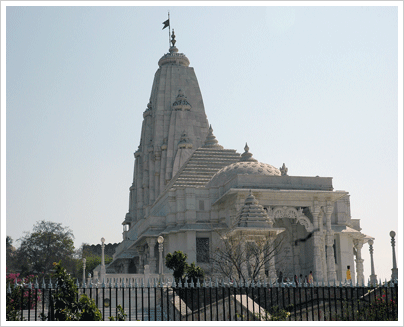
At the foot of Moti Dungri fort is the Birla Temple. This temple forms one of the
major attractions of Jaipur. This Temple looks stunning, when it is brightly lit
in the night. The enormous temple was built during the year 1988, by Birla Group
of Industries, one of the business tycoons of India....more on
Birla Temple, Jaipur
Brahma Temple, Pushkar
Just 11 km northeast of Ajmer is Pushkar, a small town sacred to the Hindus. The
sanctity of the lake for Hindus is equal to that of Mansarovar in Tibet. According
to tradition, a bath in its waters is as essential as pilgrimages to Badrinath,
Dwarka and Puri, the traditional at least once in a lifetime places of pilgrimage.
The Padma (lotus) Puran (sacred legend) describes Pushkar as the place where Brahma,
Lord of Creation killed a demon with a lotus. The petals fell at three spots where
lakes emerged....more on Brahma
Temple, Pushkar
Dargah Sharif, Ajmer
Situated at the foot of a hill and in the old part of town, this is one of the most
important places in india for muslim pilgrims. The Dargah is the tomb of a Suffi
saint, Khwaja Muin-ud-din Chishti, who came to Ajmer from Persia in 1192 and died
here in 1236.
Construction of this shrine was completed by Humayun and the gate was added by the
Nizam of Hyderabad. Akhbar used to make the pilgrimage to the Dargah from Agra once
a year.
As you enter the courtyard, the mosque, constructed by Akhbar, is on the right.
The enormous cauldrons are for offerings that are customarily shared by families
involved in the shrine's upkeep.
In the inner court there is another mosque built by Shah Jahan. Constructed of white
marble, it has 11 arches and a Persian inscription running the full length of the
building. ...more on Dargah Sharif in Ajmer
Dilwara Jain Temple, Mount Abu
Rajasthans only hill station and a major pilgrim centre, Mount Abu is located in
the south-western corner of Rajasthan.
The hill retreat is a divine splendour in stone. In Mt Abu all roads will lead you
to the Dilwara Jain Temples made out of intricately carved marble, dedicated to
Jain Tirthankars....more on
Dilwara Jain Temple, Mount Abu
Eklingji Temple, Udaipur
The temple at Eklingji is one of the prime pilgrimage destinations in Rajasthan.
Eklingji has been the deity of the royal Mewar family since the time of Bappa Rawal,
founder of the Mewar dynasty.
Eklingji is famous for its 108 temples complex. It is also known as Kailashpuri
or the abode of Shiva. As one of the most revered destinations of the Rajasthan,
Eklingji is a temple that needs to be explored during your visit to Udaipur....more
on Eklingji Temple, Udaipur
Galta Ji, Jaipur
Galtaji is a holy pilgrimage of India, located 10 kms away from Jaipur in Rajasthan.
Situated along side a natural spring, this temple stands on a ridge and provides
a breathtaking view of the city. It is a temple dedicated to the Sun God, the only
one of its kind in this area.
The Temple of the Sun God built by Diwan Kriparam is the most important shrine of
Galtaji....more on Galta Ji,
Jaipur
Govind Dev Ji Temple, Jaipur
The original Govind Devji Deity was found about 450 years ago by Rupa Goswami. Govindevji
was removed from Vrindaban when the Muslim emperor Aurangzeb tried to destroy it.
The original Deity is now in Jaipur, in Govind Devji temple right outside the King
of Jaipur's palace.
The Great Grand Son of Lord Shri Krishna. He asked his Grand Mother as to how Lord
Shri Krishna looked like; Then He made an image as per the description given by
her. She however, said that not all but the Feet of that image looked like those
of Lord Shri Krishna....more on
Govind Dev Ji Temple, Jaipur
Jain Temple, Ranakpur
This 15th century temple also called Adishwar Temple, built by Sheth Dhanna, is
the largest and most complex Jain temple in India.
This four-faced temple is designed in form of a Nalinigulm Vimana(heavenly aircraft),
with three storeys along with several pavilions accomodated on the temple base itself.The
temple has 29 halls, 80 domes & pavilions include 1,444 pillars - each of them intricately
carved....more on Jain Temple in Ranakpur
Kaila Devi Temple, Kaurali
Legend has it that the ruling family of Karauli are descendants of Lord Krishna.
They are considerd head of the Yaduvanshi Rajputs; their family history is rich
with tales of valour and glory. Raja Gopal Das of Karauli ruled from 1533 to 1569.
Karauli, a holy city 160 km from Jaipur and 103 km from Sawai Madhopur, was founded
in 1348. It is also the venue for the famous Kaila Devi fair. The Pale red sandstone
of Karauli is well kown....more on
Kaila Devi Temple, Kaurali
Karni Mata Temple, Bikaner
One of the most renowned temple near Bikaner is Karni Mata Temple, situated in a
small town named as Deshnok, located 30 km in the south from Bikaner on Jodhpur
road. This beautiful town is known for the shrine of Karni Mata.
According to legends, Karni Mata once blessed Rao Bika (founder of Bikaner) to establish
his kingdom here and will always be safe from enemies. This temple is unique in
its own way, scores of Rats are venerated here and the shrine is like a home for
them. ...more on Deshnok in Bikaner
Lodurva, Jaisalmer
Lodurva 16 kms from Northwest of Jaisalmer, Lodurva is an important spot of the
Jain community with some magnificent Jain temple.
Lodurva, the ancient capital of Bhatti Rajputs was once a flourishing city but lost
most of the splendour when the Bhattis shifted their capital to Jaisalmer. The Jain
Temples, rebuilt in the late 1970s, are the only reminders of the city's former
magnificence....more on Lodurva,
Jaisalmer
Mehandipur Balaji Temple, Dausa
The Mehandipur Balaji Temple is situated in the Dausa district. Basically Shri Mehendipur
Balaji Temple is Lord Hanuman Ji's Temple. According to legend, the present-day
forms of the "Divine Trinity" found in the Mehandipur Dham appeared around one thousand
years ago in a valley amidst the hills of the Aravali Range....more on Mehandipur Balaji Temple,
Dausa
Nasiyan Temple, Ajmer
The Jain temple at Nasiyan an ornate 19th century Jain temple is dedicated to the
first Tirthankar, Rishabdeoji. Tour the aesthetic and pleasing Jain temple at Nasiyan
that is also known as the Red Jain Temple due to the color of the stone. The temple
was constructed in 1865 A.D.
The two-storied structure of Nasiyan Temple is divided into two parts, where one
is the worship area comprising the idol of Lord Adinath and the second is the museum
including a hall....more on Nasiyan
Temple, Ajmer
Osian Temple, Jodhpur
Osian, the name that reminds you of a desert Oasis was a flourishing trading center
dating back to 8th century under the Pratihara dynasty. One of the favorite tourist
spots, Osian has a gamut of 16 temples richly chiseled and exhibiting the typical
Rahasthani architecture. Tour to Osian offers you a glimpse of the rich cultural
heritage of Jodhpur....more on Osian Temple in Jodhpur
Salasar Balaji, Churu
Salasar houses the famous Balaji Temple which attracts a large number of devotees
from all over India. Shri Hanumanji, the famous Hindu deity of vigour and loyality,
having been pleased by the devotion and worship of Shri Mohan Das Mahraj, appeared
in the form of astatue on Saturday, Shrawan Sukla Navami, V.S. 1811 at Asota village.
The statue was brought to Salasar where the temple was built. Later, the devotees
added more buildings to the main temple....more on
Salasar Balaji, Churu
Savitri Temple, Pushkar
The holy city of Pushkar is also called the city of temples. There are more than
400 hundred temples in Pushkar but the main attraction being the temple of Savitri
and Lord Brahma. This otherwise sleepy town echoes with hectic activity during the
Pushkar Camel Fair and festival.
According to the Hindu mythology Savitri is the first wife of Lord Brahma. When
He was all set to start a Yagna on earth in the place of Pushkar (determined by
drooping a lotus flower), Savitri's presence was the prerequisite....more on
Savitri Temple, Pushkar
Shri Mahavirji Temple, Chandanpur
Abour 110 km from Sawai Madhopur, on the banks of the Gambhir river, is the temple
of Shri Mahaveerji.
Shri Mahavirji Temple is a Jain temple devoted to the 24th Jain Tirthankar. This
Digember Jain pilgrimage centre is 90 Kms by rail from Sawai Madhopur on the Delhi-Mumbai
Broad gauge route. The main temple is in side in inclosure known as katla....more
on Shri Mahavirji Temple,
Chandanpur
Shrinath ji Temple, Nathdwara
Nathdwara, means the gate of God. It is the most renowned pilgrim of India. Nathdwara
is located on the banks of Benas river just 48 kms ahead of Udaipur. Nathdwara is
also famous for the Pichhwai paintings - the most famous Rajasthani art. This art
portrays the Lord Shrinathji & their activities.
The temple has a story behind its establishment. According to the legend, the image
of Lord Shrinath ji was enshrined in Vrindavan (land of Lord Krishna), but to protect
the idol from the destructive rage of Aurangzeb....more on
Shrinath ji Temple, Nathdwara
Suryanarayan Temple, Ranakpur
Ranakpur Temples are acclaimed world-wide for their intricate and superb architectural
style. These temples form one of the five major pilgrimages of the Jains.
The Jain Temples of Ranakpur are certainly creditable for their splendid architecture.
This temple is wholly constructed in light colored marble and comprises a basement
covering an area of 48000 sq feet. There are more than 1400 exquisitely carved pillars
that support the temple....more on
Suryanarayan Temple, Ranakpur
Warah Temple, Pushkar
Pushkar, located 11 km northwest of Ajmer in the state of Rajasthan, is one of the
most important pilgrimages in the country. The town is considered to be sacred by
the Hindus because of the presence of some 400 temples, which encircle the lake.
Pushkar The Pilgrim City is a picturesque town. Its Known for its Temple and Lake,
the Nag Pahal (Snake Mountain) which forms a part of chain of the Aravali range
of mountains stands between Ajmer and Pushkar....more on
Warah Temple, Pushkar
|
|
@Copyright 2008-2014 RajasthanTour4U.com | Blog | Contact Us | Advertise | FAQs | Travel Links | Sitemap | |
|