Lakes and Rivers in Rajasthan
The state of Rajasthan is primarily known for its magnificent forts and palaces.
However, there are quiet a few lakes and rivers that quietly make their presence
felt among the tourists because of their pristine beauty, opportunity for water
sports and also for useful purpose. While some of the lakes are a gift of nature
to Rajasthan, others have been carved out in the earth's surface by the efforts
of man.
Lakes in Rajasthan
Ana Sagar Lake, Ajmer
Ajmer is located 80 miles (130 km) west of Jaipur, in a picturesque valley surrounded
by the hills of the Aravalli range. Ajmer was established in the early seventh century
by Ajaipal Chauhan. He named the place Ajaimeru, the invincible hill, because here
he built Indias first hill fort, Taragarh.
Ajmer was a Chauhan stronghold till 1194. The only remains of their times are the
fort and the beautiful Anasagar Lake, built in 1150 by Anaji.
...more on Ana Sagar Lake, Ajmer
Fateh Sagar Lake, Udaipur
Fateh Sagar, a beautiful lake, which lies to the north of Lake Pichola, was constructed
in 1678. The Lake lies just besides the entrance to Moti Magri Hill.
Built in 1678 by Maharana Jai Singh, Fateh Sagar Lake got its name from Maharana
Fateh Singh, who later made additions to it. Talking about the statistics of Fateh
Sagar, the lake extends to the length of 2.4 km, 1.6 km. in width and deep to the
extent of 11.5 meter. During the monsoons, the lake covers the total area of around
1 sq km.
...more on Fateh Sagar Lake,
Udaipur
Gadsisar Lake, Jaisalmer
A short walk beyond Tazia tower is Gadsisar, an artificial lake that was an important
source of water in the past. A natural decline was enlarged to catch every drop
of rain and, in a season of drought, Gadsisar was the mainstay of Jaisalmer.
A lake might be a relief here. After all the sand, Gadsisar Lake is one of the major
tourist attractions. Just leave the madding crowd behind and venture towards the
outskirts and you will find yourself next to the famous Gadsisar Lake.
...more on
Gadsisar Lake, Jaisalmer
Jaisamand Lake, Udaipur
The City of Lakes as it is known, is located in the central part of the fascinating
erstwhile kingdom of Mewar. The Sisodia dynasty, Suryavanshi by descent, ruled Mewar
for several years. Udaipur is known in history to have refused to pay obeisance
to the mighty Mughals and hence was engaged in constant battles with the Mughals.
After the death of Udai Singh, his valiant son Maharana Pratap took over the royal
reins.
...more on Jaisamand Lake, Udaipur
Nakki Lake, Mount Abu
Rajasthans only hill station is also a major pilgrim centre for the Jain community.
Mount Abu is located in the south-western corner of Rajasthan. Although a part of
Aravalli range, it is detached completely from it by a narrow valley and the highest
point Guru Shikhar. Mount Abu owing to its good rainfall, has the richest vegetation
in Rajasthan, a wide variety of trees and shrubs can be viewed as one drives up
to Mount Abu.
...more on Nakki Lake, Mount
Abu
Pichola Lake, Udaipur
One of the most romantic cities in all of Rajasthan, Udaipur is better known as
the City of Lakes. The marble palaces, the beautiful gardens and the placid blue
lakes enhance the beauty of this city.
Maharana Udai Singh must have certainly been captivated by the charm of this pristine
lake, that he founded the city of Udaipur here by enlarging the lake.
...more on
Pichola Lake, Udaipur
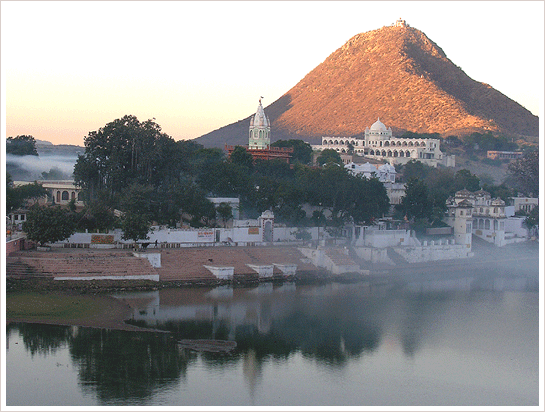
Pushkar Lake, Pushkar
Pushkar is a fantastic fusion of history and mythology that makes it worth the travel.
Located just 11 km west of Ajmer, Pushkar is sacred to the Hindus. The lake at Pushkar
is believed to have been created by Lord Brahma himself and has the same sanctity
for Hindus and Mansarover in Tibet.
The holy lake is an attraction by itself at Pushkar and has immense significance
for the followers of Hinduism. According to legends, the consecrated lake formed
with the touch of Brahmas lotus petal, is believed to have miraculous healing and
purifying powers.
...more on Pushkar Lake,
Pushkar
Rajsamand Lake, Rajsamand
Not very far away from Udaipur, on the way to Kumbhalgarh lies a place called Rajasmand.
The place is known for its scenic Rajasmand Lake which was built by Rana Raj Singh
in the year 1660 AD.
Built in the 17th Century, it is approximately 1.75 miles wide, 4 miles long, and
60 feet deep. The lake was built across the Gomati, Kelwa, and Tali Rivers, with
a catchment area of approximately 508 square kilometers.
...more on
Rajsamand Lake, Rajsamand
Sambhar Lake, Jaipur
Sambhar is a small town, famous for the largest saline lake in India. Due to this
fact, Sambhar is also known as Salt Lake City. Various rulers of Jaipur and Jodhpur
have owned the lake in their ruling periods. In 1870 A.D. it was leased to the British.
Sambhar lake is situated at a distance of 65 km from Jaipur on Phulera rail-route.
The lake is a major source for salt production. The lake is divided by a 5-km long
dam made of stone,190 sq km in extent at full capacity.
...more on
Sambhar Lake, Jaipur
Siliserh Lake, Alwar
Siliserh lies just 13 km from Alwar, on the road to Jaipur and is a popular picnic
spot. It was built as a summer retreat and is a delightful little palace set in
a picture- postcard location. Overlooking a tranquil lake and surrounded by hills,
Siliserh is the place you should head to for a quiet and peaceful holiday.
The enchanting Siliserh Lake was built in 1845 AD by Maharaja Vinay Singh for his
Queen Shila . The lake was built by constructing an earthen dam between two hills
to store the water of a small tributary of river Ruparel.
...more on
Siliserh Lake, Alwar
Rivers in Rajasthan
Banas River
Banas River is the only river that has its entire course in Rajasthan. It originates
in Khamnor hills of Rajsamand district and flows past Bhilwara, Tonk and Sawaimadhopur
districts. It finally joins Chambal river near Khandhar (Sawaimadhopur district).
It's main tributaries are Berach, Kothari, and Khari.
Chambal River
Chambal River,the old mythological name of this largest river is Charmawati. It
originates from Manpur near Mhow in Madhya Pradesh. It enters Rajasthan near Begun
(in Chittorgarh district) and flows past Kota, Sawaimadhopur and Dholpur districts
over a length of 376 kms. Chambal finally enters UP and meets Yamuna river. The
main tributaries of Chambal are Kali Sindh, Banas and Parbati.
Gambhir River
Gambhir River originates in the hills near Karauli village in Sawai Madhopur District.
It flows from south to north up to Kanjoli village (Toda Bhim), then towards northeast
up to village Mertha of Roopbas Block, before entering Uttar Pradesh. The river
again enters Rajasthan near Catchapaura village in Dholpur District and forms the
boundary between UP and Rajasthan. It then enters Mainpuri District in UP to finally
joins River Yamuna.
Luni River
It originates in the Pushkar valley of the Aravalli Range, near Ajmer and end in
Little Rann of Kutch (Gujarat). The Luni flows through the Marwar region to empty
into the Rann of Kutch
Mahi River
Mahi River originates in Amoru in Madhya Pradesh and flows past Dungarpur and Banswara
districts. Som " Jakham, its main tributaries. Mahi River Basin is located in South-Eastern
Rajasthan Mahi River Basin extends over parts of Banswara, Chittorgarh, Dungarpur
and Udaipur Districts.
Parbati River
Parbati River originates from the northern slopes of Vindhan range in Madhya Pradesh
and enters Rajasthan in Kota district where it meets Chambal. Parbati River Basin
is located in eastern Rajasthan, It lies between the Gambhir Basin in the west and
the Chambal Basin in the east. Its northern edge borders the Yamuna River Basin
in Uttar Pradesh.