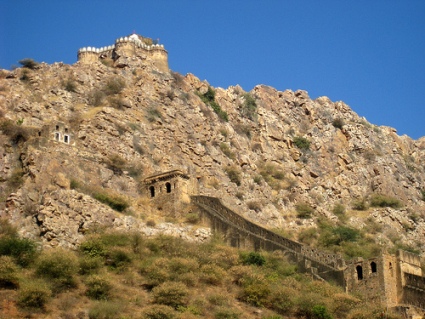
Posts Tagged rajasthan forts

The Fort of Mukundgarh – Jhunjhunu

The fort of Mukundgarh - Jhunjhunu

The fort of Mukundgarh - Jhunjhunu

About Mukundgarh

Mukandgarh is a city and a municipality in Jhunjhunu district in the Indian state of Rajasthan. It is part of Shekhawati region. It lies a few km from Nawalgarh.

Mukundgarh Fort
Mukungarh has a 300-year-old magnificent fort, which is now converted into a resort hotel, with all modern amenities.

There are havelis of Kanoria, Ganeriwal and Saraf, which are a fine example of fresco paintings.

Mukundgarh Fort is a heritage property, a grand construction and has amazing detailing of the famous Shekhawati frescoes on the walls. The hotel offers beautifully furnished rooms with a view of the fort’s courtyard or the green vegetation beyond.

The Ganeriwal Haveli Mukundgarh In Rajasthan India is stunning right from the intricately carved façade to courtyard walls; visitors will notice vibrant frescos and murals. Narrative murals depicting scenes from local legends, the life of Lord Krishna, etc. are to be frequently seen at the Ganeriwal Haveli Mukundgarh.

It has a few mosque and many temples. The iron scissors, textiles and brassware made here are of extremely good quality. Also worth a visit are Shiv Temple, Gopinath temple and Venugopal temple.

Chhatris at Mukundgarh, Jhunjhunu

Chhatris at Mukundgarh, Jhunjhunu

About Jhunjhunu

Jhunjhunu is very rich in presenting the glorious ancient monument as the Temples, Mosques, Forts, Palaces and Tombs.

Wells, Stepwells, Cenotaphs and Havelies of excellent fresco-paintings which speak with full throated ease about the glorious past of Jhunjhunu.

They are the master pieces of art and architecture, Shekhawati region offers many resorts of beauty to the tourist.

Tags: , , , , , , , , , , , ,

The Fort Of Achalgarh – Tourist Attractions Near Mount Abu, Rajasthan

The Fort of Achalgarh - Mount Abu Excursions

The Fort of Achalgarh - Mount Abu Excursions

Mount Abu is a ramification of the great Arawali hills which intersect Rajasthan from end to end, forming a line running north-east and south west.

Perched on the chaotic masses of rocks stands Achalgarh, an ancient fort of Rajasthan.  Achalgarh in Hindi literally means an immovable fort.

Rana Kumbha of Mewar built this majestic fort in the 14th century. The fort is situated nearly six miles from Abu surrounded by lofty peaks of the Aravalis. It provides a fine view of Guru Shikhar, the highest peak of the Aravalis in Rajasthan.

Major Attractions and Monuments of Achalgarh

The chief attraction of the fort is a Jain temple of Shanti Nath built in 1513 A.D which is ascribed to Kumarpal Solanki, the ruler of Gujrat. The last remains of this ruler were cremated in front of the  Achaleshwari temple. The Chamunda temple, Bhartari Gupha, Revati Kund, Gomati Kund, Bhrigu Ashram and the temple of Kumbheswari, are places of historical and architectural importance.

It also houses another amazing temple of Achaleshwar Mahadev built in 1412 A.D. The Shanti Nath Jain Temple is having a gold plated image. These two Jain temples stand in ancient Jain style of architecture.

The statues of Rana Kumbha and his son Uda, and Sawan Bhadawa are also very interesting. Adinath temple has 14 images of miniature size made of ‘Panch Dhatu’. The temple is a double storeyed one. The Donjon of Achalgarh which with the interior works of the most remote antiquity. There are a ruins of a granary, the Bhandar of Kumbha Rana, coated within with a very strong cement plaster. On the most elevated knoll to the east are the remains of an alarm tower which still bears Kumbha’s name.

The Hanumanpole and the Champapol are two gateways of the fort.

Near the fort a little below there is situated remarkable temple of Achaleshwar, built in 813 A.D. Numerous ancedotes are in vague about the power of this divinity, which is God Shiva. A big tank 900 X 240 feet known as Mandakini Kund has many fables at its credit. There is an inscription of Phalgun 1266 A.D. The statue is of white marble. 5 feet in height and with the exception of the sculptured figure on the column of Badob, is the finest piece of sculpture.

We would be writing about the pride of Rajasthan tommorrow. Wish to know what it is ? Sorry, We wont tell you. You need to come back again and check out tommorrow about the very finer details of the kinds, types and colors.. shhhhh!!

Tags: , , , , , , , , , , ,

The Fort of Ajmer – Taragarh Fort

The Fort of Ajmer - Taragarh Fort

The Fort of Ajmer - Taragarh Fort

The massive Taragarh Fort of Ajmer, one of the oldest forts of Rajasthan, was constructed by Raja Ajaipal Chauhan.

Location and Geography

The fort is situated on the crest of a hill 2855 feet above the sea level and 1300 feet from the plain.  It is also known as the Garh Beetali and spread over 32 hectares with about 32 tanks.

The curtain wall encloses avast space. The embattled parapet built of huge stone blocks is 20 feet thick at the base.  Round towers are built at every declivity in the hill sides. Its principal strength lies in ruggedness and acclivity of the hill upon which it is situated. Passing through a rugged land full of hills of small eminence, a narrow tress over both sides of the narrow rocky ascent present a lovely sight.

Attractions and Monuments of Taragarh Fort

The massive fort surrounded by a thick stone wall has six gates with the main gate named ‘Laxmi gate’ surmounted with exquisitely carved stone elephant. The second gate known as ‘Phuta Darwaja’ is as strong and solid as main gate. The second line of defense starts with the embattled parapet on both sides of this gate. Other gates named ‘Bhawani Pol’, ‘Hathi Pol’, ‘Arkat ka Darwaja’ are thrown across the ascent.

Many bastions have been raised in the crenelated rampart wall called Ghenga Darwaja, Gugandi, Nakarchi ka burj, Bandra Burj, Imali ka burj and Fateh Burj etc. Here is situated the holy Dargah of a great martyr and saint Hazrat Meeran Sahib Khing Sawar. The magnificent fort is known for its water harvesting system with several massive stone reservoirs that were used for water storage.

The Taragarh fort has a special place in the history of Ajmer as it was an important military hub during the Mughal reign in the region. This grand fort served as a sanatorium during the British domination in this region.

The fort was the key to Rajputana and for this very reason was attacked many a times. From Roshan Ali, Sahabuddin Gauri to Bahadur Shah and Sher Shah, several armies invaded the fort. The fort was convereted to sanitorium for European troops during the British Raj.

We complete our post on Taragarh fort here and promise to come back as usual !!

Tags: , , , , , , , , , , ,

The Fort of Alwar – Bala Quila

The Fort of Alwar - Bala Quila

The Fort of Alwar - Bala Quila

Bala Quilia or Alwar fort stands atop hill which is situated in enchanting atmosphere of the Arawalis.

Location and Architecture

The adjoining areas are full of dense forest growth and provides a great view of the city from its watch towers. This fort is said to have been constructed by Hasan Khan Mewati in 1492 A.D after passing several hands.

The fort extends 5 km from north to south and 1.6 km from east to west. It is 595 mtrs above see level and 304 mtrs above the city.  The circumference of the fort spreads in 7 miles.

It has 15 large and 51 small towers with 446 loopholes for musketry.  Stupendous towers have been raised at various points in the rampart. The Kabul burj is really imposing the Nogaja and the Hawa Bangla burj also attract attention.  The fort can be entered from six gates namely Jai Pol, Laxman Pol, Chand Pol, kishan Pol, Andheri Pol, Suralj Pol.

Attractions of Bala Quila

There are many things of interest in the fort, the Nikumbh palaces being the fine specimens of the Hindu architecture. These old palaces are simple, unadorned and stupendous. Salim Sagar built by Chandakaji is one of the attractions, another one is Surajmahal whose bowshaped roofs and elegant balconies represents the amalgamation of Indo-Muslim art.

The Sitaram Temple built in 1932 is a fine structure. The middle portions of Cenotaph in the fort is constructed with white marble interspersed with black marble pieces. The base and small corner built in red stone gives a magnificent look. There is a lot of history, attacks and rulers involved with Bala Quila and the details would require volumes of text books.

I would end my post about this fort here and would come back tomorrow with another of the gigantic walls. So just keep coming in here to know more and more about our state Rajasthan.

Tags: , , , , , , , , ,

The Fort of Bikaner – Junagarh Fort

The Fort Of Bikaner - Junagarh Fort

The Fort Of Bikaner - Junagarh Fort

Raja Rai Singh (1571-1611), one of Akbar’s most outstanding generals, built the impregnable unconquered Fort of Bikaner or more famously known as Junagarh Fort. Bikaner city was founded by Rao Bika, the son of Rao Jodha of Jodhpur, a prince of Rathore clan.

Location and Architecture of Junagarh Fort

The fort forms a quadrangle with the perimeter of 986 m. A thirty feet deep moat surrounds the outer part with the embattaled walls, hanging over it.  There are two entrances, facing east is the main entrance known as ‘Karan Pol’. Next to it, is the sun gate or ‘Suraj Pol’. The gate is built in the usual style, two great semi-circled towers joined by a portal under which a gate is opened.

Black stone slabs in the walls here eulogize Raisingh’s deeds of valour and gives a chronological record of the clan of the Rathors. Two life size statues of elephants flank the facade of the entrance.

Attractions and Monuments

The fort contains many palaces, pavilion and temples made of red sandstone and marble with kiosks and balconies. Inside the fort there are attractive palace section with beautiful paintings and carvings in courtyards, towers, balconies and windows. There is also a Rajput weapon collection, an important part of the museum located in the fort.

The palace of Raja Raisingh is the oldest building in the fort together with the Suraj Pol, the Karkhana Kallan, the Har Mandir, the Choubara, Hazari Darwaja and Rani Niwas. Most of them are built in yellow sand stones. Anoop Mahal, Rang Mahal, Anand Vijay Mahal with thin columns, arches and screens are noteworthy elegant monuments.

A board court decorated by exquisite panels intervenes between Anoop Mahal and Rai Niwas. This hall which served as Diwan-e-Khas has vermilion and gold gesso decoration, glass mosaics, lace-like mirror and stucco work. Phool Mahal is also nicely decorated with glass work.

Gang Niwas is a spacious durbar hall with a carved wood ceiling. The interior of this hall is decorated with richly carved red sand stone.

The fort journey has been really breath taking, though everything good comes to an end. Dont worry, we are not ending our forts series here, we have some unknown forts in Rajasthan which are equally important from Rajputana history. In the coming days, we will present some forts from Rajasthan which might  not have been accounted in the books of history but have always stood between the Rajasthan Dynasty Kings and their Enemies protecting the rulers from the outsiders.

Tags: , , , , , , , , , , , ,

The Fort of Chomuhagarh, Rajasthan

The Fort of Chomuhagarh - Solid Gates

The Fort of Chomuhagarh - Solid Gates

Location and Geography

The fort of Chomuhagarh is situated 21 miles from Jaipur in the north west and perhaps stands next only to Bharatpur fort on account of abnormal depth and breadth of the ditches which surround it from four sides. The fort also known by the name of Dharadhargarh holds unique position in Rajasthan among the ground forts. All precautions had been taken by the builder in erecting this fort at Chomu.

The present site of the fort was selected by Baba Venidas, a brahmin in the service of the father of Karan Singh, the Rao of Chomu. Accordingly in 1595 A.D., Rao Karan Singh of Nathawat clan who ruled over Hadota started the building of the fort, which took two years to complete.

Architecture and Attractions of Chomuhagarh

Rao Karan Singh had only built female apartment protected by the rampart wall between two corner bastions of the fort side. The bunch of the trees still survives growing over the rampart walls and revives the memory of the builder of the fort. The trees of Kair and Kheri covered it from the view and due to its erection at a strategically important site, cannon balls passed over the fort without harming the structure.

The rampart walls of the fort are very massive with slight forward projection at the top having bastions at each end. A vast solid ditch surrounds the rampart wall, the width of which being 80 feet. In olden times the ditch remained full of water. In the northern side of the spacious enclosure stands a temple erected by the Kamadars of Nathavatas in 1756 A.D.

The construction of the rampart wall at the top resembles the leaf of the lotus having embrasures and holes in it. Every leaf has such five loopholes through which discharge of bullets and arrows landed on the onrushing armies.

The entire town is situated bounded by the circumvallation which closely resembles the rampart wall, which has a slight curvature at every gate providing safeguard for the gate and concealing it from the fort. The entire wall stands intact pierced by four huge gates, Baori, Pijala, Holi and Rawan.

The fort has two moderately built gates, the first Dhruvapol, facing the west was erected by Krishna singh. The other gate through which the inner portion is reached, is known by Ganeshpol, and was erected by Rao Raghunath Singh. Krishna Niwas, Ratan Niwas, are prominent among a cluster of places which all represent Indo-Muslim style of architecture.

Some walls have been dug in the moat and water is drawn up by an indigenous system. From this portion the water is again lifted up by a huge rope working on a pulley. The wells being in the bed of the ditch receive ample supply through parcolation, even in the dry weather.

Tags: , , , , , , , ,

The Fort of Kota

Kota Fort, Rajasthan

Kota Fort, Rajasthan

About Kota City

Kota, situated on the eastern bank of the Chambal at a distance of 120 miles from Ajmer stands enclosed by a massive wall on the southern extremity of which the fort lies on a moderate eminence. The city of Kota is surrounded by huge rampart wall of unusual height, sixty to seventy feet on three sides. Chambal, the boon of Rajasthan which flows western side forms a natural unsurpassable moat to the fort as well as to the city.

Geography and Architecture of Kota Fort

The fort is situated on the southern extremity of the rampart walls on the land of moderate eminence, was built by Madhosingh in 1631 A.D. These massive and vast embattled wall of Kota Fort stands pierced with six gates among which Surajpol , Kishorpur, Palanpol, Kaithunipol are very imposing.

The main gate in the castle is built in the usual style and flanked by projecting balconies. The bastions to the southern side are massive, huge and vast while those erected to the north are marked by their rather slender form and upward height. These were erected in this particular way to afford special protection againest the enemy attack .

A circle of these bastions is formed here and it gives this portion the shape of a fort within fort.The space between the series of towers stands duly protected by the embattled wall crowning the palaces. Some towers connected with the ramparts are also thrown along the way of the fort.

Attractions of Kota Fort

The Kota Fort is known for its Durbar Hall which has beautiful paintings and mirror work and has doors of ebony and ivory. There are exquisite miniature paintings housed within the Durbar Hall. The Maharajas of Kota later abandoned the fort and build various palaces.

The palaces of kota situated within the four walls of the Castle stands as an admirable mixture of Indo-Muslim style of architecture. The small turrents, cupolas and minarets, slightly projecting eaves, balconies, canopy like roofs of the palaces, all put together present a charming picture over looking the purple water of the fast flowing turbulent Chambal below.

Tags: , , , , , , , , ,

The Fort of Jhalawar- Gagron Fort

The Fort of Jhalawar - Gagron Fort

The Fort of Jhalawar - Gagron Fort

The Gagron fort stands majestically on the crest of a hill at the confluence of the Kalisind and the Ahurivers. The former surrounding it from three sides provides an unsurpassable barrier.

Location and Architecture

The valley near Gagron is full three miles wide, the soil fertile and the scenery highly picturesque. The forest of each side echoed with screams of the peacocks, the calls of partridge, and the note of jungle cock who was crowing his motives as the sun gladdened hi retreat.

The fort of Gagron situated among such natural environs is regarded as one of the most important forts of Rajasthan. The fort was constructed by the Dod Rajputs in whose possession it remained up to the 12th century, A.D. The fort is also called Dodgarh after its founder.

The pecularity of the fort is its natural defence consisting of mountainous ranges covered with forests through which gushes out the on-rushing water of the rivers. It present a bold and striking object.

The parrots of Gagron are famous allover Rajasthan. The Mosque of Mithashah built in hindu style of architecture contains an inscription in persian. The inscription pertains to the Rao of Bikaner who was the Mughal Governor of the fort. Another inscription denotes the construction of a cenotaph by Main Ishan.

The icons of Durga, Ganesha and Shiva are erected in a temple built in the ancient style. This fort has been a central place place of activity and it’s solidity of natural defenses baffled the Zeal of the invader.

According to Tod, a traveler, “Independent of ancient association, there is a wild grandeur about Gagron, which makes it well worthy of visit and the views from the north side must be still finer than from ather point.” The turbulent kalisind forces its passage from the rocky mountains and dains forest to the valley of great depth below and presents a very beautiful sight.

Tags: , , , , , , , , ,

The Fort of Bharatpur- Lohagarh Fort

Lohagarh - Bharatpur Fort

Lohagarh - Bharatpur Fort

Bharatpur, the city is famous for its historical fort. Suraj Mal, Badan Singh’s Son, and perhaps the greatest ruler of this area, started work on the Bharatpur fort in 1732 A.D. This fort known as Lohagarh or the Iron Fort, took sixty years to build and is still the focal point of the town.

Architecture and Geography

Two huge mud walls one round the other intervened by formidable moat, 150 to 200 feet broad and 50 feet deep surrounds the fort. These moats were filled with water of the Sujan Ganga Nahar, which received supplies from the Kohini Bundh nearby. The marvel lies in the planning of this fort that made it invincible.

The fort has eight bastions and towers and two gates – one in the north is called Ashtadhati and the other to the south is called Lohia gate.

Attractions and Monuments in Lohagarh Fort

There are several places of attraction in the fort, the most prominent being Mahal Khas, Kothi Khas and Kishori Mahal. The museum in the fort contains inscriptions and other exhibits of historical importance. The durbar khas, Silah Khana, the temples of Bihariji and Mohanji are other places of interest.

The impregnability of the fort lies in its mud walls and deep ditches which are far from being fordable. The ditches with its abnormal depth and breadth take the form of rivers.

A bridge built on several gateways leads to the main entrance to the fort. The main gate of the fort is imposing and noted for its solidity. Huge massive round towers of nearly 60 to 80 feet in height stand on both side of the gate connected by a portal. The top of the towers and gate is crowned with parapet with embrasures.

Your trip to Bharatpur would be termed incomplete without a visit to the bird paradise or the Keoladeo Ghana National Park. The recommended tourist season for Bharatpur is mainly between October and March when the birds from Northern Hemisphere fly to India to avoid winter sufferings.

Tags: , , , , , , , ,

The Fort of Ranthambore

The fort of Ranthambore is perhaps the greatest stronghold of Rajasthan. It has an unrivaled historical past full of thrilling deeds of bravery and sacrifice.

Location and Architecture

The fort is situated on an isolated rock 1578 feet above the sea level. The rocky terrain around Ranthambore is full of dense forests. The historic fort is 12.8 km from Sawai Madhopur which is 360 km from Delhi and 132 km from Jaipur. The hill on which the fort stands is one of the highest and rises principally by sheer precipices all around which in themselves constitute sufficient defence.

Attractions of Ranthambore Fort

The curtain walls and the gates are built of dressed stones, coursed but roughly bonded. The main gate of the fort called ‘Bada Darwaja’ is a massive tall structure with projected balconies and is particularly formidable. A stairway rises from the ground level to this gate which is flanked on which sides by huge bastions.

The embattled rampart walls were unusually thick made of stone blocks. Bhairava, Dhikuli and Markati yantras were set on the fort-walls to shower big stones on the besiegers.

There were five big deep tanks in the fort which were kept ready full of water. The fort is approachable through a narrow and sinuous path and is not visible until the end of valley is reached through a series of gateways.

The Ranthambore Fort

The Ranthambore Fort

Scattered about within the fort are temples, shrines, tombs, walled enclosures and court yards, notable among these are the Ganesh Temple, Laxminarayan temple, Brahma and Raghunath temple and the Jain temple.

There are two large sized rooms known as ‘Johara-Bohra’ which were used to store grain. The mausoleum of Pirsadruddin is built on the bank of Ranihar tank. Hamir Mahal, Supari mahal and Badal mahal stands in a dilapidated condition. On the eastern side there is a stream of water named ‘Gupta Ganga’ which flows under ground.

Three huge cenotaphs stands in the front each resting on thirty two red stone pillars. Five big tanks and and several fountains make abundance of water here.

Traditions are eloquent in describing many interesting anecdotes regarding the fort. Dancers sing songs of its glory on ceremonious occasions. It is described as ‘Ranat-Bhanwar’.

Ranthambore is considred the wildlife gateway of Rajasthan, the National Park is the place where you will find the wild animals experiencing their natural habitat. If you wish to find more on Ranthambore National Park, do visit this site. You will find a lot of information about Ranthambore, tourist places, accommodation and other information on Ranthambore.

Tags: , , , , , ,