Posts Tagged junagarh fort

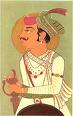
Rao Bika – Founder and King of Bikaner

Rao bika Personal Profile:
Rao Bika was the founder of the city Bikaner in Rajasthan. He was the son of Rao Jodha, founder of the city and principality of Jodhpur.

In 1465, provoked by a stray comment by his father, Rao Bika left Marwar (Jodhpur) to create his own kingdom. His mother Rao Jodha supported Bika. He left Marwar accompanied by his uncle, Rawat Kandhal, who provided politico-strategic advice and a small contingent of Rathore warriors (500 soldier and 100 cavalrymen).

He met with Mata Karni:
During his travel, Bika stopped at Deshnoke where he met with the mystic Karni Mata. She gave him her blessings for his success. Rao bika got encouraged by her support and took advantage of the internal rivalries of the Jat clans and by 1485 build a small fort called Rati Ghati at the site of the city which today bears his name. .

Establishment of Bikaner:
In 1488 he began the building of the city itself. In the beginning the neighbouring Bhati chiefs were suspicious of the new growing power in their vicinity. Karni Mata, who had become the kuladevi of Rao Bika brought the rivalry to an end by inspiring Rao Shekha – the powerful Bhati chief of Pugal, to give the hand of his daughter in marriage to Rao Bika. .

In 1488 what Rao Jodha died, Rao Bika attempted to claim the heirlooms promised him, only for his brothers to refuse his request. In a surprise attack he stormed Mehrangarh Fort but left his brothers unharmed and departed with only the promised heirlooms (among which were a sandalwood ’Pugal’ throne, a royal umbrella, a sword and a horse of ’divine origin’).

Bika’s grandfather Raimnal through palace intrigues had been drugged with opium and tied to his bed with his own turban and murdered. Remembering this Rao Bika had a special short lightweight bed made so his feet hung over the edge. The idea being that if the same thing happened to him he would still be able to stand up and fight with it on his back. This bed is today on display in the Phul Mahal in Junagarh Fort in Bikaner.Rao Bika died in 1504. .
Tags: , , , , , , , , , , ,

Shri Sardul Museum and Anup Library in Lalgarh Palace, Bikaner

Shri Sardar Museum in Lalgarh Palace, Bikaner

Shri Sardul Museum and Anup Gallery in Lalgarh Palace, Bikaner

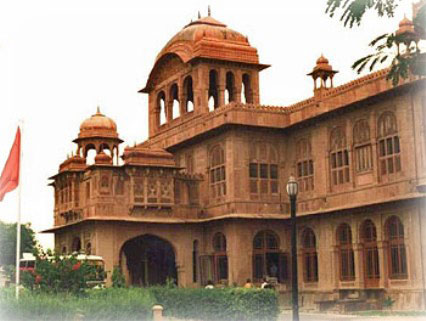
The Lalgarh palace in Bikaner city is an imposing red sand stone palace and was built by Maharaja Ganga Singhji in the memory of his father, Maharaj Lall Singhj in 1902 A.D.

Some time back it was converted to a Palace Hotel by the Welcome-Sheraton Group of hotels.

The intricate dexterous carving on the red sand stone is a hallmark of great craftsmanship. The lush green sprawling lawns with dancing peacocks and beautiful bougainvilleas adorn the palace. This rambling palace is built round an open garden court overlooked by ladies apartment windows.

Shri Sardul Museum and Anup Library

Some Part of Lallgarh Palace has been converted as a Museum containing a large numbers of items used and collected by Maharaja Ganga Singh and his successors. Old photographs, trophies, shikar objects early cameras and movie projectors and weapons used by Maharaja Karni Singh the great sportsman are on view here.

The Anup Library contains an extremely rare and valuable collection of Sanskrit manuscripts brought back from the Deccan by Raja Anup Singh in the 17th century. These rare specimen, counted among the best, are inscribed on parchments or engraved on copper, gold and silver plaques.

Other Tourist Attractions in Bikaner

Bikaner is also well known for the famous and impregnable Junagarh Fort which is made from red sandstone and encircled by a moat around which the modern city of Bikaner and consists of several palaces and apartments in a remarkable state of preservation.

One of the other Famous attraction of Bikaner is Karni Mata Temple which is also known as Rat Temple is at a distance of 30 Km from Bikaner.

The unique thing about the temple is the thousand of rats that come here  and worshipped by the devotees.

Tags: , , , , , , , , ,

Fort Museum in Junagarh, Bikaner – Fine Collections of Antique Weapons

Junagarh Museum - Antique Collection of Weaponry

Junagarh Museum - Antique Collection of Weaponry

The famous “Fort Museum” in Junagarh, Bikaner surely gives its visitors a great chance to peep into the history.  Ganga Mahal, the imposing hall of Junagarh Fort now houses the Museum.

Huge Collections of Rajput Weaponry

You will be amazed to see a huge collection of diabolic pistols, swords and weapons, each an exquisite work of art in this museum. Swords with ivory and crystal handles, some in shape of lions and other shapes can also be seen here. Cold and silver howdahs, jhulas, kis and a first world war biplane are also on view.

You should also visit the Diwan-i-khas, which houses an intricately carved mammoth sandalwood throne placed along with three massive arches.

Other important objects include a pair of drums belonging to jamblioji, the saint who predicted the foundation of the dynasty by Rao Bika for 450 years. Photographs and items of personal use by Maharaja Ganga Singh and miniatures are also on view.

 Junagarh fort was built under the supervision of Karan Chand the prime minister of Raja Rai Singhji, the sixth ruler of Bikaner, who ruled from 1571 to 1611 AD. Construction of the walls and associated moat commenced in 1588 and were completed in 1593.

Other Attractions of Junagarh Fort

Junagarh Fort, Bikaner

Junagarh Fort, Bikaner

The Junagarh fort in Bikaner encloses a number of temples, pavilions and 37 palaces. Each of the palaces are a work of art with carved windows, kiosk, hanging balconies and towers.

The Moon palace, the Flower palace, the Karan Mahal, and the Anup Mahal are all unique in their own rights. Each of the rooms of the Junagarh fort including the Rang Mahal, Ganga Niwas, Vijai Mahal, and Dungar Niwas are now living museums of the glorious past and grandeur.

Amongst the temples, Har Mandir is the most important and beautiful. The royal family worshipped their gods and goddesses here for long.

Tags: , , , , , , , , , , , , ,

The Fort of Bikaner – Junagarh Fort

The Fort Of Bikaner - Junagarh Fort

The Fort Of Bikaner - Junagarh Fort

Raja Rai Singh (1571-1611), one of Akbar’s most outstanding generals, built the impregnable unconquered Fort of Bikaner or more famously known as Junagarh Fort. Bikaner city was founded by Rao Bika, the son of Rao Jodha of Jodhpur, a prince of Rathore clan.

Location and Architecture of Junagarh Fort

The fort forms a quadrangle with the perimeter of 986 m. A thirty feet deep moat surrounds the outer part with the embattaled walls, hanging over it.  There are two entrances, facing east is the main entrance known as ‘Karan Pol’. Next to it, is the sun gate or ‘Suraj Pol’. The gate is built in the usual style, two great semi-circled towers joined by a portal under which a gate is opened.

Black stone slabs in the walls here eulogize Raisingh’s deeds of valour and gives a chronological record of the clan of the Rathors. Two life size statues of elephants flank the facade of the entrance.

Attractions and Monuments

The fort contains many palaces, pavilion and temples made of red sandstone and marble with kiosks and balconies. Inside the fort there are attractive palace section with beautiful paintings and carvings in courtyards, towers, balconies and windows. There is also a Rajput weapon collection, an important part of the museum located in the fort.

The palace of Raja Raisingh is the oldest building in the fort together with the Suraj Pol, the Karkhana Kallan, the Har Mandir, the Choubara, Hazari Darwaja and Rani Niwas. Most of them are built in yellow sand stones. Anoop Mahal, Rang Mahal, Anand Vijay Mahal with thin columns, arches and screens are noteworthy elegant monuments.

A board court decorated by exquisite panels intervenes between Anoop Mahal and Rai Niwas. This hall which served as Diwan-e-Khas has vermilion and gold gesso decoration, glass mosaics, lace-like mirror and stucco work. Phool Mahal is also nicely decorated with glass work.

Gang Niwas is a spacious durbar hall with a carved wood ceiling. The interior of this hall is decorated with richly carved red sand stone.

The fort journey has been really breath taking, though everything good comes to an end. Dont worry, we are not ending our forts series here, we have some unknown forts in Rajasthan which are equally important from Rajputana history. In the coming days, we will present some forts from Rajasthan which might  not have been accounted in the books of history but have always stood between the Rajasthan Dynasty Kings and their Enemies protecting the rulers from the outsiders.

Tags: , , , , , , , , , , , ,