Posts Tagged bikaner attractions

Harasar Haveli in Bikaner – Offers Great Hospitality in Traditional Rajput Manner

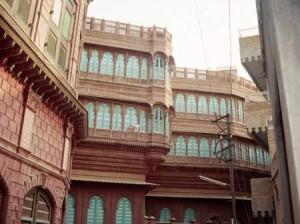
Situated in Bikaner, Harasar Haveli was the residence of Army Minister of the former princely State of Bikaner – Late Colonel Rao Bahadur Thakur Jeoraj Singh.

Harasar Haveli in Bikaner

Harasar Haveli in Bikaner

He was the ruling chief  (Thakur) of the Thikana of Harasar, which was granted to him as an additional field by Maharaja Ganga Singhji of Bikaner.

Heritage Hotel of Bikaner

This Harasar Haveli was converted to a  heritage hotel of Bikaner in 1997 by Kanwar Visvajeet Singh,  the grandson of Thakur Jeoraj Singh. Now this haveli provides great hospitality in a traditional Rajput manner for their guest.

Harasar Haveli Features

Harasar Haveli has Rooftop giving a commanding view of the Junagarh Fort, Lallgarh Palace and of other prominent landmarks of the city, up to the sand dunes surrounding Bikaner. Every evening, folk dance and music performances by gypsies are arranged along with dinner.
Tags: , , , , , , , , , , ,

Daga Chowk Haveli Cluster in Bikaner, Rajasthan – Exquisite Carvings and Drawing Rooms

Daga Chowk Havelis, a cluster of havelis, is located in Bikaner, Rajasthan. A unique feature about these havelis is that they are spread out like the scattered clouds and are beautifully adorned with carvings of flowers.

Daga Chowk Havelis Features

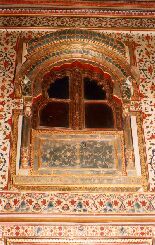
Exquisite Carvings on Jharokhas

The artistic and exquisite carvings on Jharokhas resemble projected pieces of valuable ornaments.

The walls are all flowery and take the viewer in a world of nature and its infinite spelendours. They look like projected pieces of priceless jewelery.

Executive Drawing Rooms

It is believed that Daga family,  the founders of Daga chowk Havelis had a fascination for deevankhanas. The deewankhanas or drawing rooms gave prestige to the family.

The precious murals preserved in these havelis reveal old and contemporary face of Indian painting.  They are a treasury of art and a matter of pride. They even demonstrate the increasing English influence of those time.

Love for Nature

The creators of havelies had great love for nature which is quite indicated from the haveli designs. Leaves and flowers decorate every jharokha giving it an astonishing and pleasant natural effect. Jali or stone with small holes create unbounded beauty.

Tags: , , , , , , , , , ,

Rikhji Bagri ki Haveli in Bikaner – Adorned With Arched Entrances and Charming Jharokhas

Situated near Mohta chowk at Bikaner, Rikhji Bagri ki Haveli is a small haveli with arched entrances and charming Jharokhas.

Rikhji Bagri ki Haveli, Bikaner

Rikhji Bagri ki Haveli, Bikaner

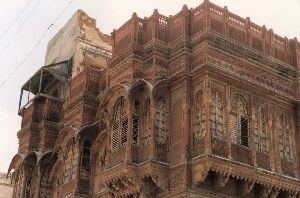
The carvings display the tiniest details in the most delicate manner. It has poetry written on stone.

Such artistic exterior is unparallel and perhaps does not exist anywhere on earth.

The other and much better known havelies including the great patwa havelies fade when the carving of this haveli show off the minutest details in a most delicate manner.

Havali Attractions

Be it a peacock, an elephant, a flower or a pot, every thing is natural living and just enchanting in this Haveli.

The more you look at them the more joy you get out of the view. It is a beauty for ever, eternal and irreplaceable. If dreams are cast in stones or if stones can sing they would be like the exterior of Rikhji bagri ki haveli.

Arched entrances and captivating jharokhas look more beautiful because of the flowers embossed on them which are more beautiful than the real flowers in this Rikhji Bagri ki Haveli

Tags: , , , , , , ,

Rampuria Havelis Cluster in Bikaner, Rajasthan – Famous for Exquisite and Minute Carvings

Bikaner is situated in the north-west region of Rajasthan and it can legitimately boast of some unique architectural marvels of India. Apart from Junagarh fort in Bikaner, Jain temples like Bhandasar temple, Neminath temple, Adeshwar temple are adorable.

rampuriahaveli

Havelis in Bikaner

Bikaner is also famous among tourists for marvelous mansions which are a wonder in home architecture.  Aldous Huxley a famous English writer, visited these havelis reportedly said “They are the pride of Bikaner”.

The havelis are located in narrow lanes in the old city. Some of the havelis worth a visit are: the Rampuria Group of Havelies, Rikhji Bagri ki haveli, Daga Chowk havelies, haveli of Bhairondan and Kothari Sampatlal Agarwal haveli.

Rampuria Havelies in Bikaner

The most famous cluster of havelies is the Rampuria Group of Havelies. These havelis are built by Balujee Chalva under instructions from Rampuria family. Rampuria havelis are many in number and are big in size and located at nearly adjacent positions make great impression like the patwa havelies of Jaisalmer.

The interior scheme of decoration of these havelies is very different. The Rampuria havelies are built of dulmera stone, which are red in color. Exquisite and minute carvings come naturally to the havelis’s stones. The Rampuria havelies are decorated with golden work of the highest quality.

They have dankhanas (Drawing Room) which take us to the mughal and rajput period of amalgamation and synthesis. Another interesting feature is that Rampuria havelies have diverse exterior and each haveli has a pattern of its own.

Tags: , , , , , , , , , ,

Ganga Golden Jubilee Museum in Bikaner – Explore Royal Treasure of Rajasthan

Ganga Golden Jubilee Museum was founded by his Majesty Ganga Singh, on the occasion of his golden jubilee in 1937, when he completed fifty years of his reign. A big celebration was held and dignitaries from overseas graced the festivity.

At first the museum was housed in a sand stone building near the Lalgarh palace in Bikaner, but it was rather a small building and was shifted to a new building in the Civil lines in 1954. Then it was handed over to the state government of Rajasthan.

The exhibits are splendid master pieces of  Harappan civilization, Gupta and Kushan era and sculptures of the late classical time.

Principal Sections of the Museum

Historical Mughal Farmans

The History of Bikaner contains a colourful record of war adventures. More than half a dozen rulers lost their lives while participating in the imperial campaigns of the Mughals.

Various ‘Farmans’ bearing original Imperial seals, issued by the Emperors – Jahangir, Shah Jahan, Aurangzeb and Shah Alam, are preserved in this museum.

Exquisite Collection Miniatures Paintings

An exquisite collection of Rajasthani miniatures paintings of almost all the sub-schools of Rajasthan such as Bikaner, Bundi, Mewar, Jaipur, Jodhpur etc. are on view here.

Finest Collections of Early Terracotta Art

The museum has one of the finest collections of early terracotta art, in the country. These belong to the early Gupta period and were discovered in 1017 AD by Dr. L. P. Tessitori from the ancient Theris of Rang Mahal, Badopal, Pir Sultan-Ki-Theri located between Suratgarh and Hanumangarh of the old Bikaner state.

Sculptures Section

The sculpture of Jain Saraswati (11th-12th Century) is a unique piece of marble of four feet eight inches in height. Discovered from village Pallu (Ganganagar), it is a peerless example of medieval Indian sculpture.

Lacquer Work

The museum has a fine collection of superb lacquered works, a craft special to Bikaner entirely done by the artisans, called Ustas (Ustaads), on wood, metal, glass, stone, leather and ostrich egg shells.

Wood And Stone Carvings

Bikaner stands almost unsurpassed in wood and stone carvings. A teak wood table and a wooden casket, a model of the Gajner Palace (Bikaner), a typical ‘Ikka’ (horse drawn cart) and chariot with minutest details are on view in the museum.

Tags: , , , , , , , , , ,

Shri Sardul Museum and Anup Library in Lalgarh Palace, Bikaner

Shri Sardar Museum in Lalgarh Palace, Bikaner

Shri Sardul Museum and Anup Gallery in Lalgarh Palace, Bikaner

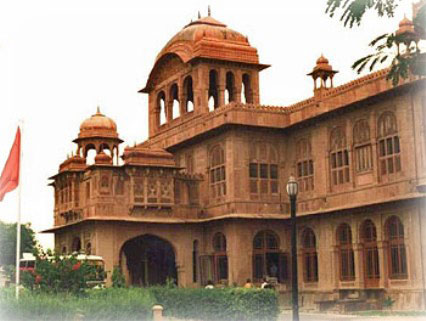
The Lalgarh palace in Bikaner city is an imposing red sand stone palace and was built by Maharaja Ganga Singhji in the memory of his father, Maharaj Lall Singhj in 1902 A.D.

Some time back it was converted to a Palace Hotel by the Welcome-Sheraton Group of hotels.

The intricate dexterous carving on the red sand stone is a hallmark of great craftsmanship. The lush green sprawling lawns with dancing peacocks and beautiful bougainvilleas adorn the palace. This rambling palace is built round an open garden court overlooked by ladies apartment windows.

Shri Sardul Museum and Anup Library

Some Part of Lallgarh Palace has been converted as a Museum containing a large numbers of items used and collected by Maharaja Ganga Singh and his successors. Old photographs, trophies, shikar objects early cameras and movie projectors and weapons used by Maharaja Karni Singh the great sportsman are on view here.

The Anup Library contains an extremely rare and valuable collection of Sanskrit manuscripts brought back from the Deccan by Raja Anup Singh in the 17th century. These rare specimen, counted among the best, are inscribed on parchments or engraved on copper, gold and silver plaques.

Other Tourist Attractions in Bikaner

Bikaner is also well known for the famous and impregnable Junagarh Fort which is made from red sandstone and encircled by a moat around which the modern city of Bikaner and consists of several palaces and apartments in a remarkable state of preservation.

One of the other Famous attraction of Bikaner is Karni Mata Temple which is also known as Rat Temple is at a distance of 30 Km from Bikaner.

The unique thing about the temple is the thousand of rats that come here  and worshipped by the devotees.

Tags: , , , , , , , , ,

Fort Museum in Junagarh, Bikaner – Fine Collections of Antique Weapons

Junagarh Museum - Antique Collection of Weaponry

Junagarh Museum - Antique Collection of Weaponry

The famous “Fort Museum” in Junagarh, Bikaner surely gives its visitors a great chance to peep into the history.  Ganga Mahal, the imposing hall of Junagarh Fort now houses the Museum.

Huge Collections of Rajput Weaponry

You will be amazed to see a huge collection of diabolic pistols, swords and weapons, each an exquisite work of art in this museum. Swords with ivory and crystal handles, some in shape of lions and other shapes can also be seen here. Cold and silver howdahs, jhulas, kis and a first world war biplane are also on view.

You should also visit the Diwan-i-khas, which houses an intricately carved mammoth sandalwood throne placed along with three massive arches.

Other important objects include a pair of drums belonging to jamblioji, the saint who predicted the foundation of the dynasty by Rao Bika for 450 years. Photographs and items of personal use by Maharaja Ganga Singh and miniatures are also on view.

 Junagarh fort was built under the supervision of Karan Chand the prime minister of Raja Rai Singhji, the sixth ruler of Bikaner, who ruled from 1571 to 1611 AD. Construction of the walls and associated moat commenced in 1588 and were completed in 1593.

Other Attractions of Junagarh Fort

Junagarh Fort, Bikaner

Junagarh Fort, Bikaner

The Junagarh fort in Bikaner encloses a number of temples, pavilions and 37 palaces. Each of the palaces are a work of art with carved windows, kiosk, hanging balconies and towers.

The Moon palace, the Flower palace, the Karan Mahal, and the Anup Mahal are all unique in their own rights. Each of the rooms of the Junagarh fort including the Rang Mahal, Ganga Niwas, Vijai Mahal, and Dungar Niwas are now living museums of the glorious past and grandeur.

Amongst the temples, Har Mandir is the most important and beautiful. The royal family worshipped their gods and goddesses here for long.

Tags: , , , , , , , , , , , , ,

The Fort of Bikaner – Junagarh Fort

The Fort Of Bikaner - Junagarh Fort

The Fort Of Bikaner - Junagarh Fort

Raja Rai Singh (1571-1611), one of Akbar’s most outstanding generals, built the impregnable unconquered Fort of Bikaner or more famously known as Junagarh Fort. Bikaner city was founded by Rao Bika, the son of Rao Jodha of Jodhpur, a prince of Rathore clan.

Location and Architecture of Junagarh Fort

The fort forms a quadrangle with the perimeter of 986 m. A thirty feet deep moat surrounds the outer part with the embattaled walls, hanging over it.  There are two entrances, facing east is the main entrance known as ‘Karan Pol’. Next to it, is the sun gate or ‘Suraj Pol’. The gate is built in the usual style, two great semi-circled towers joined by a portal under which a gate is opened.

Black stone slabs in the walls here eulogize Raisingh’s deeds of valour and gives a chronological record of the clan of the Rathors. Two life size statues of elephants flank the facade of the entrance.

Attractions and Monuments

The fort contains many palaces, pavilion and temples made of red sandstone and marble with kiosks and balconies. Inside the fort there are attractive palace section with beautiful paintings and carvings in courtyards, towers, balconies and windows. There is also a Rajput weapon collection, an important part of the museum located in the fort.

The palace of Raja Raisingh is the oldest building in the fort together with the Suraj Pol, the Karkhana Kallan, the Har Mandir, the Choubara, Hazari Darwaja and Rani Niwas. Most of them are built in yellow sand stones. Anoop Mahal, Rang Mahal, Anand Vijay Mahal with thin columns, arches and screens are noteworthy elegant monuments.

A board court decorated by exquisite panels intervenes between Anoop Mahal and Rai Niwas. This hall which served as Diwan-e-Khas has vermilion and gold gesso decoration, glass mosaics, lace-like mirror and stucco work. Phool Mahal is also nicely decorated with glass work.

Gang Niwas is a spacious durbar hall with a carved wood ceiling. The interior of this hall is decorated with richly carved red sand stone.

The fort journey has been really breath taking, though everything good comes to an end. Dont worry, we are not ending our forts series here, we have some unknown forts in Rajasthan which are equally important from Rajputana history. In the coming days, we will present some forts from Rajasthan which might  not have been accounted in the books of history but have always stood between the Rajasthan Dynasty Kings and their Enemies protecting the rulers from the outsiders.

Tags: , , , , , , , , , , , ,