Posts Tagged sculptures

Ganga Golden Jubilee Museum in Bikaner – Explore Royal Treasure of Rajasthan

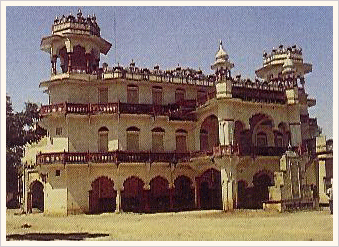
Ganga Golden Jubilee Museum was founded by his Majesty Ganga Singh, on the occasion of his golden jubilee in 1937, when he completed fifty years of his reign. A big celebration was held and dignitaries from overseas graced the festivity.

At first the museum was housed in a sand stone building near the Lalgarh palace in Bikaner, but it was rather a small building and was shifted to a new building in the Civil lines in 1954. Then it was handed over to the state government of Rajasthan.

The exhibits are splendid master pieces of  Harappan civilization, Gupta and Kushan era and sculptures of the late classical time.

Principal Sections of the Museum

Historical Mughal Farmans

The History of Bikaner contains a colourful record of war adventures. More than half a dozen rulers lost their lives while participating in the imperial campaigns of the Mughals.

Various ‘Farmans’ bearing original Imperial seals, issued by the Emperors – Jahangir, Shah Jahan, Aurangzeb and Shah Alam, are preserved in this museum.

Exquisite Collection Miniatures Paintings

An exquisite collection of Rajasthani miniatures paintings of almost all the sub-schools of Rajasthan such as Bikaner, Bundi, Mewar, Jaipur, Jodhpur etc. are on view here.

Finest Collections of Early Terracotta Art

The museum has one of the finest collections of early terracotta art, in the country. These belong to the early Gupta period and were discovered in 1017 AD by Dr. L. P. Tessitori from the ancient Theris of Rang Mahal, Badopal, Pir Sultan-Ki-Theri located between Suratgarh and Hanumangarh of the old Bikaner state.

Sculptures Section

The sculpture of Jain Saraswati (11th-12th Century) is a unique piece of marble of four feet eight inches in height. Discovered from village Pallu (Ganganagar), it is a peerless example of medieval Indian sculpture.

Lacquer Work

The museum has a fine collection of superb lacquered works, a craft special to Bikaner entirely done by the artisans, called Ustas (Ustaads), on wood, metal, glass, stone, leather and ostrich egg shells.

Wood And Stone Carvings

Bikaner stands almost unsurpassed in wood and stone carvings. A teak wood table and a wooden casket, a model of the Gajner Palace (Bikaner), a typical ‘Ikka’ (horse drawn cart) and chariot with minutest details are on view in the museum.
Tags: , , , , , , , , , ,

Jhalawar Govrnment Museum – Houses Rare Manuscripts, Paintings, Coins and Sculptures

Jhalawar has rocky but water-laden verdant landscape, unlike much of Rajasthan. It lies in the south-eastern region of Rajasthan at the edge of the Malwa plateau.

With some exquisite pre-historic cave paintings, massive forts, thickly wooded forests and exotic wildlife variety, Jhalawar boasts of rich historic as well as natural wealth.

About Jhalawar Government Museum

The Government Museum is situated in the old Garh Palace near the Bhawani Natya Shala. It was established in 1915  and is one of the oldest museums of Rajasthan.

It houses rare manuscripts, paintings, coins, sculptures and statues of various gods and goddesses are specially noteworthy. The sculptures and architectural fragments of the 8th century city of Chandravati and sculptures and epigraphs from Jhalarapatan region fill its galleries. There are many paintings and manuscripts and various other artifacts from the area.

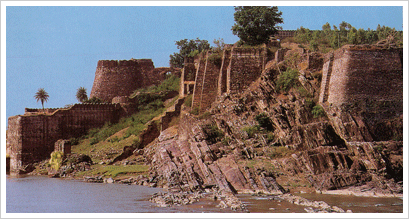
Gagron Fort in Jhalawar, Rajasthan

Gagron Fort in Jhalawar, Rajasthan

Most of the idols recovered form various ruins have been added to this collection. The Ardhnarishvara  Natraj, from this museum, was displayed in Moscow, during the Festival of India celebrations.

Jhalawar Government Museum opens at 10:00 Am and closes at 4.30 Pm daily except Fridays and government holidays.

Other Tourist Attraction in Jhalawar

Jhalawar is also well known for the famous and impregnable Gagron Fort, Bhawani Natya Shala and Jhalarapatan which is 6 kms away from Jhalawar. The city of Jhalawar is also called  “the city of bells”.

Tags: , , , , , , , , , ,

Udaipur Archaelogical Museum, Ahar – Favorite Haunt of Archaeologists and Research Scholars

About 3.2km from the Delhi Gate in Udaipur City, is Ahar, a favorite haunt of archaeologists and research scholars.

According to history this town was founded around 950AD by Rawal Allat of Mewar. He built the city on the ruins of the Harappan site of Tambavati Nagri, the city of the ancestors of King Vikramaditya before he shifted to Ujjain.


Cenotaphs at Ahar near Udaipur City

Cenotaphs at Ahar near Udaipur City

The Museum at Ahar has a varied collection of findings from excavations at the mound of Dhulkot.  The major attractions of the museum are the skin scrubber, seals and grain pot from 1st century BC, animal figures, stone weights and balls.

20 Different Royal Cenotaphs of Famous Mewar Maharajas

The Ahar Museum is also home to around 20 different royal cenotaphs of famous Mewar maharajas (maharanas), including the Hindi king of Maharaja Amar Singh, who was in power in the early 17th century. Each of these Indian leaders were cremated here during grand ceremonies.

The work of art attached to these cenotaphs are something to look out for. Whenever tourists visit Udaipur they should definitely go and visit the magnificent Ahar Museum, Udaipur for a lifetime experience.
Read the rest of this entry »

Tags: , , , , , , , , , ,

Dungarpur Government Museum – Prominent Collection of Charming Sculptures

Rajmata Devendra Kunwar State Museum, Dungarpur

Rajmata Devendra Kunwar State Museum, Dungarpur

Rajmata Devendra Kunwar State Museum and Cultural Centre in Dungarpur district was opened to the general public in the year 1988.

Royal Family Gifted Personal Collection for the Museum

In the late 1970, Dungarpur Royal family decided to gift their personal collection for the museum.

Both the brothers Maharawal Lakshman Singh and Dr. Nagendra Singh gifted their entire personal collection of charming sculptures, historically important inscriptions and metal images. The family also gifted land for building of museum, where it stands now.

Prominent Sculptural Specimens of Museum

Displayed in three galleries, the collection in the museum include 197 images of gods and goddesses, 23 inscriptions, metal images, coins and objects related with tribal culture of the region and throws light on the history of Vagad Pradesh, which spreads over present area of Dungarpur, Banswara and Kherwara.

The prominent sculptural specimens are Mahsasur – Mardini (16th -17th centuary A.D), Vinadhar Shiva in black Stone (6th- 7thcentury A.D) Kumari, a female figure discovered from Aamjhara, a beautiful image of Gajlaxmi (17th – 18th century A.D) and Navgraha in a single stone piece.

The museum also has a panel of portraits of the erstwhile Maharajas of Dungarpur State and photographs of palaces, temples and monuments from the many phases of the land’s history.

Timing : 10 A.M. to 4.30 P.M
Closed On : Friday and Gazetted Holidays

Tags: , , , , , , , , , , , , ,

Government Museum of Kota – Rich Collection of Rare Coins, Manuscripts and Paintings

Kota Museum - Rare Collection of Coins, Paintings and Scriptures

Kota Museum - Rare Collection of Coins, Paintings and Scriptures

Housed in the Brijvilas Palace Kota, the museum  displays a rich collection of rare coins, manuscripts and a representative selection of  Hadoti sculpture. Especially noteworthy is an exquisitely sculptured statue brought here from Baroli. The museum was formerly located in Hawa Mahal in Jaipur but was later shifted to Brij Vilas Palace.

Different Sections of Museum

Archaeological Section
The archaeological section of the museum consists of various sculptures, some dating back to the Gupta period (4th century). Sculptures worth mentioning are Shesh Sayi Vishnu from Badoli (Chittaurgarh), Jain image of Vardhaman from Baran and a dancing pair from Ramgarh.

Inscription Section

A few inscriptions are displayed in the museum. Yupa pillars from Badwa are very important specimens of 3rd century A. D. showing the popularity of Vedic rites.

Coins Section

Coins discovered from various sites of kota region are preserved in the numismatic section. Most of the coins belong to the Mughal period and a few of them to the rajput period.

Painting Section

The Painting section has several miniature paintings of Bundi, Kota, Nathdwara and Jaipur schools. Paintings of Shrimad Bhagawata of the early 17th century are most attractive from the point of view of workmanship.

Manuscript Section

Various Sanskrit manuscripts can be seen in the manuscript section. They include Vedic, Astronomical and Astrological works. Some Hindi manuscripts are also preserved.

The Gita and the Bhagawata written in the minutest letters on paper scroll are worth mentioning from the calligraphic point of view.

Local Arts & Craft of Hadoti Region

Arms, several kinds of handicrafts, costumes, etc, are also displayed in this section. A panoramic view of the cultural aspects of Kota region is available in this section through photographs, charts, maps etc.

Timing : 10 A.M to 4.30 P.M
Closed On: Friday and Gazetted Holidays

Tags: , , , , , , , , , , ,

Government Museum – Epicenter of Lohagarh Fort, Bharatpur

Government Museum in Lohagarh Fort, Bharatpur

Government Museum in Lohagarh Fort, Bharatpur

Bharatpur Government museum is located at the center of the famous Lohagarh Fort in Bharatpur city.

The Museum houses a rich collection of archaeological wealth of the nearby areas as from the old Bharatpur State.

The huge palatial building Kachahari Kalan, once the administrative block of the rulers of Bharatpur state, was converted into a Museum in 1944. Later on, the Kamra Khas (personal chamber) building on the first floor was added to the museum.

It exhibits sculptures found during the excavation of old villages e.g. Noh, Mailah, Bareh, Bayana etc. ranging from the Kuslian period. Weapons Used in battles in the medieval period by the jat rulers, paintings, manuscripts, zoological specimens, local art and craft and carvings on sandal wood and ivory etc.

The Art gallery of the museum has specimens of miniature paintings on leaves of the peepal tree, mica and old lothopapers alongwith the paintings of the Maharajas of Bharatpur.

On the Upper story one section consists of various types of guns and miniature canons used during 18th century A.D. called ‘Chaddre’. These miniature canons – two sets of eleven each, were used by Maharaja Sawai Jawahar Singh in the battle while passing through the Jaipur territory on his return from a pilgrimage to Pushkar.

This museum primarily consists of 581 stone sculptures, 10 inscriptions, 120 terracottas, 13 metallic objects, 670 coins, 1966 weapons, 196 miniature paintings and 861 local art & crafts.

Different Sections of  Museum

The Whole museum has been divided in to the following sections:

  • Archaeology
  • ArmourtArts
  • Crafts and Industry
  • Children Gallery
  • Miscellaneous

Timing and Fees

The museum remains open from 10.00 am to 4.30 pm. The museum closed on Friday and Gazetted Holidays. The entry fee is Rs. 3.00 for Adults, Rs. 1.00 for Students and Monday free.

Tags: , , , , , , , , ,

Fateh Prakash Palace Museum, Chittorgarh – A Showcase of Sculptures of Medieval Era

Fateh Prakash Museum, Chittorgarh

Fateh Prakash Palace Museum, Chittorgarh

Fateh Prakash Palace Museum, Chittorgarh  is located inside Chittorgarh Fort.  A big segment of the famous Fateh Prakash Palace was transformed into this museum in the year 1968 in order to preserve and highlight the heritage of Chittorgarh region.

Showcase  Sculptures of Medieval Era

The museum showcases a wide variety of things, specially sculptures. Significant among these sculptures is a statue of Ganapati that dates back to 8-9th century. Indira and Jai Ambica statues from the medieval era are also the proud possessions of this museum.

Section of  Fateh Prakash Palace Museum

Different section of this Museum devoted to daggers, weapons and armoury consists of helmets, axes, old shields, knives, farsa and uniforms of soldiers.

This museum also houses clay models of local tribes along with their traditional outfits. This entire splendid museum is divided in several sections like Coins, Art Gallery, Weapons and Tribal Life, Archaeology and Wood Crafts of Bassi village.

The collection includes objects of stone age, 632 sculptures, 2061 coins, 125 paintings and 318 arms & weapons, 2 inscriptions, 55 terracotta figures, 18 metallic objects and 70 objects of art & craft.

This museum remains open from 10.00 am to 4.30 pm. Visitors coming to Chittorgarh Fateh Prakash Palace Museum on Monday can enjoy a free entry.  This place remains closed on Friday and gazetted holidays.

Tags: , , , , , , , , , , , ,