Posts Tagged bikaner

Goga Ji – Rajasthani Lok Devta

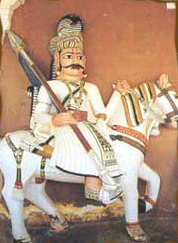
Gogaji, also known as Gugga, is saint and folk deity of Rajasthan. He was son of Raja Jewar Singh of Bhagar Desh. His mother Bachal worshiped his Guru Gorkhnath ji for 12 years and by the blessing of Guru Gorkhnathji, Gogaji was born. Gogaji was a Chauhan Rajput.

Early Days

Rani Bachal has a twin sister (Rani Kachal) who deceived her for getting guru Gorakhnath’s blessings but Gogaji’s mother got Gugal candies from guru Gorakhnath (a herb to treat people of infertility) and also distributed that herb among villages including a mare. The mare gave birth to a blue horse that Gogaji rode. Early days of Gogaji were spent at village Dadrewa, situated on Hissar-Bikaner highway in the Churu district. Around 900 AD they were rulers of this area and at the same place a fair is simultaneously held here in his memory.

Gogaji’s as peer for Muslim and saint for Hindus

When Gogaji came to know about Rani Kachal deceived his mother, he killed the sons of Rani Kachal and told his mother. Rani Bachal got angry and instructed him not to show his face. Gogaji went to guru Gorakhnathji and asked him what to do. Gorakhnathji through his Chimta from Gorkhtilla and land got slide and Gogaji took Samadhi at that place with his horse. Before getting Samadhi Gogaji read calma so that he also called Muslim peer.

Annual procession

Every year Gogaji fair held in memory of that popular hero. Some people also worship him as a snake-god. It is believed that Gogaji want into Samadhi at the place now known as Goga Medi and thousands of devotees gather to pay homage at this memorial annually in the month of Bhadrapada during the Gogaji fair which last for three days. Gogaji is famous as Goga Veer among Hindus and Jahar peer in Muslims.
Tags: , , , , , , , , , , , ,

Rao Jodha – Famous Ruler of Jodhpur

Rao Jodha (28 March 1416 – 6 April 1489) was a Rajput ruler of Mandore, Rajasthan.

The son of Rao Ranmal, Rao Jodha secured the throne of Mandore in 1427. Rao Ranmal was the administrator of Mewar and assisted Maharana Mokal.

Successfully Captured Mandore

Rao Jodha has a long story behind the capture on Mandore. After death of Maharana Mokal, his son Rana Kumbha decided to end the power sharing arrangement. Rao Jodha, while escaping to Chittor with 450 horsemen, suffered a heavy loss of his warriors near Chittor. He managed to reach Chittor but only with seven people army.

He fought many battles with Rana Kumbha’s forces to capture Mandore. In this process, he won many of the outlying forts near Mandore. Finally in 1453, he made a surprise attack on Mandore and captured it with relative ease.

After Rao Jodha captured Mandore, Jalore and Bundi, Ajmer and Sambhar were also submitted to him by their respective rulers. Rao Jodha’s son Rao Bika established Bikaner, which has now become one of the prominent towns of Rajasthan.

Forts Constructed by Rao Jodha

Rao Jodha started construction of some famous forts in Jodhpur. He wanted to move his capital to a safe hill place. In 1959, he established a new city of Jodhgarh at Chidia-tunk, a high rocky ridge, nine km to the south of Mandore. He also started the construction of famous Mehrangarh fort, situated on a 125 m high hill which was completed by Maharaja Jaswant singh.

Death and Succession

Rao Jodha died at a age of 73 on 6 April 1489. He had 24 sons and was succeeded by his son Rao Satal. After his death, his brother Rao Suja became the king of Jodhpur.

Tags: , , , , , , , , , , , , , , , ,

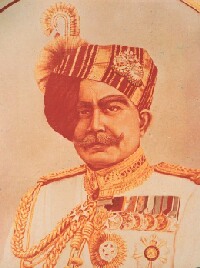
Maharaja Ganga Singh – Founder of Chief Court in Bikaner and Ganga Canal

GangasinghjiPersonal Profile

Shri Ganga Singh ji was born on October 3, 1880. He was the third and youngest son of Maharaja Sri Lal Singh. .He was a ruler with modern reformist vision of the princely state of Bikaner in present-day Rajasthan, India.

His education and Training

Shri Ganga Singh ji was initially educated privately, then at Mayo College, Ajmer from 1889 to 1894. After that, he went under the guidance of Thakur Pratap Singh Ji “CHURU” for administrative training, learning administrative work from that of Patwari to that of Prime Minister.

He took military training in Deoli in 1898 and got attached to the Deoli Regiment, which had the reputation of being one of the finest Regiment in India under the command of Lt. Col. Bell. During the first World War, he commanded the Bikaner Camel Corps which served in France, Egypt and Palestine.

Contribution for the Society

As a ruler, he established a Chief Court in Bikaner and presided over by a Chief Judge. Bikaner was the first State in Rajasthan to take such a step. A life insurance and Endowment Assurance Scheme was introduced for the benefit of the employees. Also, facilities of a saving bank were made available to the people. He was one of the first rulers to introduce through legislation a Sharda Act by which child marriages were stopped.

Singh constructed the Ganga Canal. He inspired people to come and settle in this new Command area. A large population settled than there. He successfully dealt with the worst famine of the year 1899-1900 AD in the region. This famine inspired the young Maharaja to establish an irrigation system to get rid of the problem permanently. He developed the city of Sri Ganganagar and its surrounding area as the most fertile grain bowl of Rajasthan. He brought railways and an electricity network to the state.

After the First World War, Maharaja Ganga Singh took up the task of Industrialization in the State. As a result of all this a coal mine at Palana, Cottage ginning Factories of cotton Press in Ganganagar Dist., the wool pressing Factory, the glass work, Soap Factory, Cigarette Factory, the pulse Factory, File Factory, Printing Press and a big Railway workshop started working in the State.

Honors for Highness Maharaja “Sir Ganga Singh

For his services to the cause of Indian Nationalism he was entitled as an honored place among the ranks of the great Indian Patriots. Maharaja Ganga Singh was one of the most consistent Nationalists and many medals like India Service Medal-1945, china war medal were given to him. Maharaja Ganga Singhji passed away on 2nd February 1943 at Bombay.

Tags: , , , , , , , , , , , , ,

Rao Bika – Founder and King of Bikaner

Rao bika Personal Profile:
Rao Bika was the founder of the city Bikaner in Rajasthan. He was the son of Rao Jodha, founder of the city and principality of Jodhpur.

In 1465, provoked by a stray comment by his father, Rao Bika left Marwar (Jodhpur) to create his own kingdom. His mother Rao Jodha supported Bika. He left Marwar accompanied by his uncle, Rawat Kandhal, who provided politico-strategic advice and a small contingent of Rathore warriors (500 soldier and 100 cavalrymen).

He met with Mata Karni:
During his travel, Bika stopped at Deshnoke where he met with the mystic Karni Mata. She gave him her blessings for his success. Rao bika got encouraged by her support and took advantage of the internal rivalries of the Jat clans and by 1485 build a small fort called Rati Ghati at the site of the city which today bears his name. .

Establishment of Bikaner:
In 1488 he began the building of the city itself. In the beginning the neighbouring Bhati chiefs were suspicious of the new growing power in their vicinity. Karni Mata, who had become the kuladevi of Rao Bika brought the rivalry to an end by inspiring Rao Shekha – the powerful Bhati chief of Pugal, to give the hand of his daughter in marriage to Rao Bika. .

In 1488 what Rao Jodha died, Rao Bika attempted to claim the heirlooms promised him, only for his brothers to refuse his request. In a surprise attack he stormed Mehrangarh Fort but left his brothers unharmed and departed with only the promised heirlooms (among which were a sandalwood ’Pugal’ throne, a royal umbrella, a sword and a horse of ’divine origin’).

Bika’s grandfather Raimnal through palace intrigues had been drugged with opium and tied to his bed with his own turban and murdered. Remembering this Rao Bika had a special short lightweight bed made so his feet hung over the edge. The idea being that if the same thing happened to him he would still be able to stand up and fight with it on his back. This bed is today on display in the Phul Mahal in Junagarh Fort in Bikaner.Rao Bika died in 1504. .

Tags: , , , , , , , , , , ,

Mohta and Mava Patti Havelis in Bikaner – Symbol of Wealth, Architectural Design and Colours

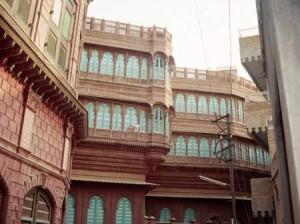
Located at Banthia chowk Bikaner, Mohta havelies cluster is well known among tourist for their architectural design. Havelies in mava patti and kothari Mohalla also deserve special mention.

Bikaner Havelis

Haveils – Symbol of Wealth and Status

These havelies were the residence of wealthy merchants who had a fancy for beauty and art. Nine months in a year they lived in far off lands to earn money and then came to this city to rest and enjoy and build havelies and live in them, show their wealth and status, their love, fascination for architecture and colours.

Haveli’s Attractions

In every haveli the dankhana is the most adored room and most prestigious too. The guests are received here. It is significant to mention that every haveli has two dankhanas. One for men and another for women and these are situated at the main entrance of the haveli. A dankhana generally has six pillars. Every pillar has a glass mirror with gold frame engrossed with flowers mostly roses.

Every diwankhana has paintings of gods and goddesses. Apart from religious deities and flowers, the leaves fruits like apples, grapes, oranges and bananas also find place in most havelies in Bikaner.

Tags: , , , , , , , ,

Harasar Haveli in Bikaner – Offers Great Hospitality in Traditional Rajput Manner

Situated in Bikaner, Harasar Haveli was the residence of Army Minister of the former princely State of Bikaner – Late Colonel Rao Bahadur Thakur Jeoraj Singh.

Harasar Haveli in Bikaner

Harasar Haveli in Bikaner

He was the ruling chief  (Thakur) of the Thikana of Harasar, which was granted to him as an additional field by Maharaja Ganga Singhji of Bikaner.

Heritage Hotel of Bikaner

This Harasar Haveli was converted to a  heritage hotel of Bikaner in 1997 by Kanwar Visvajeet Singh,  the grandson of Thakur Jeoraj Singh. Now this haveli provides great hospitality in a traditional Rajput manner for their guest.

Harasar Haveli Features

Harasar Haveli has Rooftop giving a commanding view of the Junagarh Fort, Lallgarh Palace and of other prominent landmarks of the city, up to the sand dunes surrounding Bikaner. Every evening, folk dance and music performances by gypsies are arranged along with dinner.

Tags: , , , , , , , , , , ,

Kothari Havelis in Bikaner – Old Marwari Architecture and Art Collection

Bhairondan Kothari Haveli

Located at Bikaner, Bhairondan Kothari is one of the most beautiful havelis in Rajasthan.  The European influence is obvious in the architecture of this haveli.

haveli6

It imparts fascinating beauty to its floors. Marble tiles are studded in the floors of the haveli. The beautiful poem of Kamayani is also written on these stone.

Poonam Chand Kothari Haveli

Another remarkable haveli near this haveli is the haveli of Poonam Chand Kothari. Its exterior carvings are as beautiful as those of Daga havelies.

Havelis Attractions

These both havelis contains excellent art collection. Remarkable carved sandalwood doors and windows, airy sandstones balconies, balu strades and lacy jharokhas (latticed stone window) enclose an old fashioned world where the generation overlap.

Tags: , , , , , , ,

Daga Chowk Haveli Cluster in Bikaner, Rajasthan – Exquisite Carvings and Drawing Rooms

Daga Chowk Havelis, a cluster of havelis, is located in Bikaner, Rajasthan. A unique feature about these havelis is that they are spread out like the scattered clouds and are beautifully adorned with carvings of flowers.

Daga Chowk Havelis Features

Exquisite Carvings on Jharokhas

The artistic and exquisite carvings on Jharokhas resemble projected pieces of valuable ornaments.

The walls are all flowery and take the viewer in a world of nature and its infinite spelendours. They look like projected pieces of priceless jewelery.

Executive Drawing Rooms

It is believed that Daga family,  the founders of Daga chowk Havelis had a fascination for deevankhanas. The deewankhanas or drawing rooms gave prestige to the family.

The precious murals preserved in these havelis reveal old and contemporary face of Indian painting.  They are a treasury of art and a matter of pride. They even demonstrate the increasing English influence of those time.

Love for Nature

The creators of havelies had great love for nature which is quite indicated from the haveli designs. Leaves and flowers decorate every jharokha giving it an astonishing and pleasant natural effect. Jali or stone with small holes create unbounded beauty.

Tags: , , , , , , , , , ,

Rampuria Havelis Cluster in Bikaner, Rajasthan – Famous for Exquisite and Minute Carvings

Bikaner is situated in the north-west region of Rajasthan and it can legitimately boast of some unique architectural marvels of India. Apart from Junagarh fort in Bikaner, Jain temples like Bhandasar temple, Neminath temple, Adeshwar temple are adorable.

rampuriahaveli

Havelis in Bikaner

Bikaner is also famous among tourists for marvelous mansions which are a wonder in home architecture.  Aldous Huxley a famous English writer, visited these havelis reportedly said “They are the pride of Bikaner”.

The havelis are located in narrow lanes in the old city. Some of the havelis worth a visit are: the Rampuria Group of Havelies, Rikhji Bagri ki haveli, Daga Chowk havelies, haveli of Bhairondan and Kothari Sampatlal Agarwal haveli.

Rampuria Havelies in Bikaner

The most famous cluster of havelies is the Rampuria Group of Havelies. These havelis are built by Balujee Chalva under instructions from Rampuria family. Rampuria havelis are many in number and are big in size and located at nearly adjacent positions make great impression like the patwa havelies of Jaisalmer.

The interior scheme of decoration of these havelies is very different. The Rampuria havelies are built of dulmera stone, which are red in color. Exquisite and minute carvings come naturally to the havelis’s stones. The Rampuria havelies are decorated with golden work of the highest quality.

They have dankhanas (Drawing Room) which take us to the mughal and rajput period of amalgamation and synthesis. Another interesting feature is that Rampuria havelies have diverse exterior and each haveli has a pattern of its own.

Tags: , , , , , , , , , ,

Shri Sardul Museum and Anup Library in Lalgarh Palace, Bikaner

Shri Sardar Museum in Lalgarh Palace, Bikaner

Shri Sardul Museum and Anup Gallery in Lalgarh Palace, Bikaner

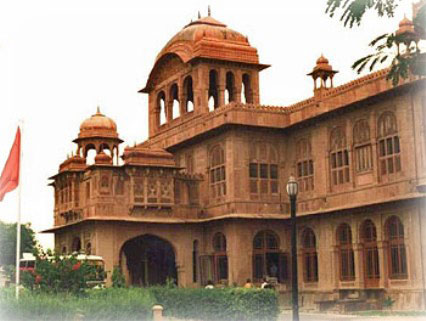
The Lalgarh palace in Bikaner city is an imposing red sand stone palace and was built by Maharaja Ganga Singhji in the memory of his father, Maharaj Lall Singhj in 1902 A.D.

Some time back it was converted to a Palace Hotel by the Welcome-Sheraton Group of hotels.

The intricate dexterous carving on the red sand stone is a hallmark of great craftsmanship. The lush green sprawling lawns with dancing peacocks and beautiful bougainvilleas adorn the palace. This rambling palace is built round an open garden court overlooked by ladies apartment windows.

Shri Sardul Museum and Anup Library

Some Part of Lallgarh Palace has been converted as a Museum containing a large numbers of items used and collected by Maharaja Ganga Singh and his successors. Old photographs, trophies, shikar objects early cameras and movie projectors and weapons used by Maharaja Karni Singh the great sportsman are on view here.

The Anup Library contains an extremely rare and valuable collection of Sanskrit manuscripts brought back from the Deccan by Raja Anup Singh in the 17th century. These rare specimen, counted among the best, are inscribed on parchments or engraved on copper, gold and silver plaques.

Other Tourist Attractions in Bikaner

Bikaner is also well known for the famous and impregnable Junagarh Fort which is made from red sandstone and encircled by a moat around which the modern city of Bikaner and consists of several palaces and apartments in a remarkable state of preservation.

One of the other Famous attraction of Bikaner is Karni Mata Temple which is also known as Rat Temple is at a distance of 30 Km from Bikaner.

The unique thing about the temple is the thousand of rats that come here  and worshipped by the devotees.

Tags: , , , , , , , , ,