Posts Tagged ajmer attractions

Beautiful Gardens Around Ana Sagar Lake in Ajmer – Durga Bagh and Daulat Bagh

Founded in 1100 AD by Aijpal Chauhan, Ajmer derives its name from ‘Ajaya Meru’ the invincible hill, at the foot of which the present city stands.
Gardens in Ajmer

Beautiful Gardens Around Ana Sagar Lake

Ana Sagar is the tank (manmade lake) in Ajmer. It is on the banks of this lake that Khwaja Sahib is said to have stayed after arrival in Ajmer in 1192 AD. The lake as history records was built by Raja Anaji the grandfather of Emperor Prithviraj Chauhan by damming the river Luni. The palace of the Khaajas’s stay is known as the Chilla Khawaja Sahib’, whch is located on the top of the Anasagar Ghati.

Daulat Bagh

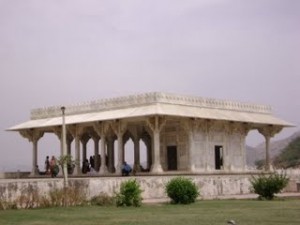
Later the Mughal Emperors made additional constructions to beautify the lake. In 1637 A.D Shah Jahan built five beautiful pavilions called Baradaris overlooking the lake with impeccable white polished marble on the embankment of Ana Sagar and the Daulat Bagh Gardens were laid by Jahangir.

Durga Bagh

Another charming garden on the banks of the majestic Ana Sagar Lake is Durga Bagh. The park built in 1868 AD by Maharaja Shiv Dan is a lush garden with numerous flowers and is one of the best known gardens in Ajmer.

Durga Bag is a garden on the near side of Ana Sagar and is a nice place to relax. There are marble monuments by the shore and plenty of ice cream and papad-wallahs selling snacks.

Tags: , , , , , , , , ,

Government Museum in Ajmer – Narrates The Rich History of Rajasthan

Ajmer Government Museum is one of the most attractive propositions of the city of Ajmer. It narrates the rich history of the place and preserves it with utmost care is the.

The museum is situated in the heart of the old city and is close to the railway station. The museum is housed in the beautiful fort and palace built by the Mughal Emperor Akbar in 1570. After British occupation in 1818 and during the first war of Independence in 1857 it was used as the Rajputana Arsenal by the British which gave the name magazine.

Government Museum in Ajmer

Government Museum in Ajmer

Museum Also Known as “Rajputan Museum”

The Museum was started in 1908 by the Government of India with the object of collecting and preserving many unique objects of antiquarian interest which were lying uncared for and scattered all over Rajasthan.

The rajputan Museum as it is significantly named, has in its galleries important exhibits from almost all the princely States. There is a library attached to his museum which cotains rare books and important historical publications.

Different Sections of Ajmer Government Museum

The Museum houses a rich collection of artifacts ranging from the Guptas to the late medieval period.

  • Home of Excellent Collection of Sculptures

An excellant collection of sculptures from the Chauhan centre of Baghera (10th 12th A.D.) are also preserved here as also a fine collection of Jain Tirthankara images and rare images of Gomukha Yaksha and Saraswati which are on display in the Jain gallery of this Museum.

  • Epigraphical Section

The Epigraphical section has around hundered exhibits, many of whom are still in excellent condition.Of special interest are the Brahmi inscription from Barli (2nd century B.C.), the Jodhpur Inscription of Bauka, the Pratapgarh Inscription of Mahendrapala II and the Nagari. Samoli Slab Inscription of Siladitya.

A number of important copper plate grants add to the value of rich collection of museum. They include: two copper plates of Maharaj Sarvanatha of Uchchhakapla (437-38 A.D. refferring to Kalachuri Era), Daulatpura copper plate of the Pratihara king Bhojadeva and, the copper plate of Rana Kumbha of Mewar.

  • Rich Collection of Paintings and Coins

The museum also has a rich collection of paintings and coins. From the early punch marked coins to those of the Gupta coins, once can trace the developments of coins in India. Coins of the Rajputs kings are also preserved here.

Tags: , , , , , , , , , , ,

The Fort of Ajmer – Taragarh Fort

The Fort of Ajmer - Taragarh Fort

The Fort of Ajmer - Taragarh Fort

The massive Taragarh Fort of Ajmer, one of the oldest forts of Rajasthan, was constructed by Raja Ajaipal Chauhan.

Location and Geography

The fort is situated on the crest of a hill 2855 feet above the sea level and 1300 feet from the plain.  It is also known as the Garh Beetali and spread over 32 hectares with about 32 tanks.

The curtain wall encloses avast space. The embattled parapet built of huge stone blocks is 20 feet thick at the base.  Round towers are built at every declivity in the hill sides. Its principal strength lies in ruggedness and acclivity of the hill upon which it is situated. Passing through a rugged land full of hills of small eminence, a narrow tress over both sides of the narrow rocky ascent present a lovely sight.

Attractions and Monuments of Taragarh Fort

The massive fort surrounded by a thick stone wall has six gates with the main gate named ‘Laxmi gate’ surmounted with exquisitely carved stone elephant. The second gate known as ‘Phuta Darwaja’ is as strong and solid as main gate. The second line of defense starts with the embattled parapet on both sides of this gate. Other gates named ‘Bhawani Pol’, ‘Hathi Pol’, ‘Arkat ka Darwaja’ are thrown across the ascent.

Many bastions have been raised in the crenelated rampart wall called Ghenga Darwaja, Gugandi, Nakarchi ka burj, Bandra Burj, Imali ka burj and Fateh Burj etc. Here is situated the holy Dargah of a great martyr and saint Hazrat Meeran Sahib Khing Sawar. The magnificent fort is known for its water harvesting system with several massive stone reservoirs that were used for water storage.

The Taragarh fort has a special place in the history of Ajmer as it was an important military hub during the Mughal reign in the region. This grand fort served as a sanatorium during the British domination in this region.

The fort was the key to Rajputana and for this very reason was attacked many a times. From Roshan Ali, Sahabuddin Gauri to Bahadur Shah and Sher Shah, several armies invaded the fort. The fort was convereted to sanitorium for European troops during the British Raj.

We complete our post on Taragarh fort here and promise to come back as usual !!

Tags: , , , , , , , , , , ,