Posts Tagged ajmer

Raja Amar Singh Rathore – A Brave Commander in Mughal Emperor Shah Jahan’s army

Raja Amar Singh Rajthore was a great king of a Rajput family. He was a commander in Mughal emperor Shah Jahan’s army whose saga of bravery is sung in Ajmer in Rajasthan.

His Exile

Raja Amar Singh Rathore was the eldest son of Maharaja and as per the tradition he was the obvious heir to the throne but because of his snide behavior towards the new mughal spouse, he was ordered to remain in exile rest of his life. He left Rajasthan and went to Agra where Mughal emperor Shah Jahan offered him a significant post in his army. After joining Mughal army he fought many battles and because of his brave performances he got steadily promotions in Shahjahan’s administration.

Amar Singh’s conflict with Shah Jahan

In mughal court the other fellow courtiers got jealous with Amar Singh as he was getting more value by their king. One day when Amar Singh went for a hunt without taking permission of Shah Jahan, the other fellow courtiers told that it is insult of Mughal emperor. Amar Singh challenged that he is not answerable to any one and killed a courtiers because of his misbehavior. Shah Jahan was shocked by this act and entire mughal army was trying to capture Raja Amar Singh. But the brave king jumped from Agra fort with his horse and escaped his life.

Bravery at its best

Shah Jahan gave the responsibility to Amar Singh’s brother in law to kill him. His brother-in-law invited Amar Singh for a compromise in mughal court and there he was killed by them. Shahjahan kept Amar Singh Rathore’s body was thrown on a tower challenging the Rajputs to take it away.

Brave wife of brave king

Amar Singh’s wife wanted to be sati with her husband so she went to Ballu (a friend of Amar Singh) to take his body. Ballu took the bravest Rajput soldiers with him and killed the mughal soldiers coming in his way. The brave Ballu jumped from Agra fort with Amar Singh’s body and delivered it to his wife. After this brave act Ballu got injured badly and died.
Tags: , , , , , , , , , , , , , ,

Beautiful Gardens Around Ana Sagar Lake in Ajmer – Durga Bagh and Daulat Bagh

Founded in 1100 AD by Aijpal Chauhan, Ajmer derives its name from ‘Ajaya Meru’ the invincible hill, at the foot of which the present city stands.

Gardens in Ajmer

Beautiful Gardens Around Ana Sagar Lake

Ana Sagar is the tank (manmade lake) in Ajmer. It is on the banks of this lake that Khwaja Sahib is said to have stayed after arrival in Ajmer in 1192 AD. The lake as history records was built by Raja Anaji the grandfather of Emperor Prithviraj Chauhan by damming the river Luni. The palace of the Khaajas’s stay is known as the Chilla Khawaja Sahib’, whch is located on the top of the Anasagar Ghati.

Daulat Bagh

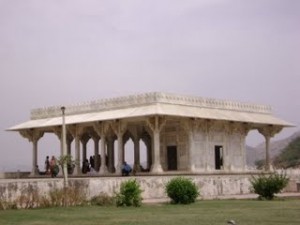
Later the Mughal Emperors made additional constructions to beautify the lake. In 1637 A.D Shah Jahan built five beautiful pavilions called Baradaris overlooking the lake with impeccable white polished marble on the embankment of Ana Sagar and the Daulat Bagh Gardens were laid by Jahangir.

Durga Bagh

Another charming garden on the banks of the majestic Ana Sagar Lake is Durga Bagh. The park built in 1868 AD by Maharaja Shiv Dan is a lush garden with numerous flowers and is one of the best known gardens in Ajmer.

Durga Bag is a garden on the near side of Ana Sagar and is a nice place to relax. There are marble monuments by the shore and plenty of ice cream and papad-wallahs selling snacks.

Tags: , , , , , , , , ,

Adhi – Din – Ka Jhonpra, Ajmer Rajasthan

Adhi Din Ka Jonpra , Ajmer, Rajasthan

Adhi Din Ka Jonpra , Ajmer, Rajasthan

Location and Architecture

At the foot of the Taragarh hill stands the relic of the past and interesting historical magnificent building Jamia (Jamia in Arabic Connotes a University). Al – Tamish popularly known as  Adhai- din – ka Jhonpra.

This is a masterpiece of Indo Islamic architecture located very close to the dargah. It was orginally a Sanskrit college, built within a temple. As Legend goes. 

This structure has this unique name because it took only two and a half days (Adhai Din) to complete its construction.

In 1193 A.D. when  Mohhamed Ghauri conquered Ajmer he turned the building into a mosque by adding a wall with seven arches, in front of the pillared hall in just two-and-a-half days (adhai-din) and hence the name. 

Whats Unique About Adhai – din – ka – Jhonpra

The mosque has extensive and massive stony structure replete with extermly fine and intricate workmanship on stone. Some believe that only the smaller marble arch in the mosque may have been constructed in 2-1/2 days but the whole massive structure, with its elaborate Arabic tracings and delicate engraving detail, is definitely seems to be a work of many years sustained labor.

Three pillars have been placed on one top of the other to give the impression of height of which no two pillars are alike. The pillared hall is 61 mtrs long and its 124 columns support the 10 shallow domes. An arcade of seven arches can be seen, which is finely engraved with Kufi and Jughra inscriptions from the holy Koran. The district pillars and arched screen with its ruined minarets make it a splendid architectural masterpiece.

Nevertheless you could yourself marvel at the stunning piece of architure , read the inscribed Koranic verses and amaze at how this poetry in stone could be accomplished in two and a half days.

Tags: , , , , , , , , , , , , ,

The Fort of Ajmer – Taragarh Fort

The Fort of Ajmer - Taragarh Fort

The Fort of Ajmer - Taragarh Fort

The massive Taragarh Fort of Ajmer, one of the oldest forts of Rajasthan, was constructed by Raja Ajaipal Chauhan.

Location and Geography

The fort is situated on the crest of a hill 2855 feet above the sea level and 1300 feet from the plain.  It is also known as the Garh Beetali and spread over 32 hectares with about 32 tanks.

The curtain wall encloses avast space. The embattled parapet built of huge stone blocks is 20 feet thick at the base.  Round towers are built at every declivity in the hill sides. Its principal strength lies in ruggedness and acclivity of the hill upon which it is situated. Passing through a rugged land full of hills of small eminence, a narrow tress over both sides of the narrow rocky ascent present a lovely sight.

Attractions and Monuments of Taragarh Fort

The massive fort surrounded by a thick stone wall has six gates with the main gate named ‘Laxmi gate’ surmounted with exquisitely carved stone elephant. The second gate known as ‘Phuta Darwaja’ is as strong and solid as main gate. The second line of defense starts with the embattled parapet on both sides of this gate. Other gates named ‘Bhawani Pol’, ‘Hathi Pol’, ‘Arkat ka Darwaja’ are thrown across the ascent.

Many bastions have been raised in the crenelated rampart wall called Ghenga Darwaja, Gugandi, Nakarchi ka burj, Bandra Burj, Imali ka burj and Fateh Burj etc. Here is situated the holy Dargah of a great martyr and saint Hazrat Meeran Sahib Khing Sawar. The magnificent fort is known for its water harvesting system with several massive stone reservoirs that were used for water storage.

The Taragarh fort has a special place in the history of Ajmer as it was an important military hub during the Mughal reign in the region. This grand fort served as a sanatorium during the British domination in this region.

The fort was the key to Rajputana and for this very reason was attacked many a times. From Roshan Ali, Sahabuddin Gauri to Bahadur Shah and Sher Shah, several armies invaded the fort. The fort was convereted to sanitorium for European troops during the British Raj.

We complete our post on Taragarh fort here and promise to come back as usual !!

Tags: , , , , , , , , , , ,