Posts Tagged famous kings of Rajasthan

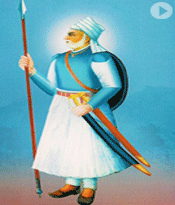
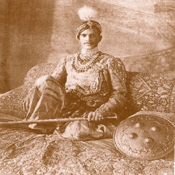
Man Singh Ji Saheb – Brave King of Jaipur

Raja Man Singh was son of Bhagwant Das, king of Amber (Jaipur), and Rani Bhagawati ji Sahiba. He was born on December 21, 1550. After his father’s death he received the title of Mansab (a commander of 5000 soldiers) in 1589. In 1605 he became mansabdar of 7000 soldiers in the Mughal force of Akbar.

His devotion for Akbar

Akbar sent Man Singh to Rana Pratap, the grandson of Rana Sanga, to convince him to accept Mughal sovereignty. Rana Pratap invited Man Singh for a dinner but when he came to know that Man Singh wanted, him to accept Mughal sovereignty, he refused to come in dinner and sent his son Amar Singh for dinner.

Man Singh took it as insult of his king Akbar and left the dinner. After that he was appointed to lead the Mughal army against Maharana Pratap and he fought many wars against him for Akbar.

Haldighati war

In 3 April 1576 Man Singh fought a gruesome war with Maharana Pratap. In this war Man Singh’s Mahout and Rana Pratap’s famous horse ‘Chetak’ were killed. The war was won by Mughal forces but one of Rana Pratap’s nobleman Jhala Man Singh saved him by putting the helmet of Rana Pratap and pretending to be Rana Pratap, was killed by Mughal forces.

Man Singh and Mughal’s Governor in Kabul

In 1580 when Akbar started to expend his empire in Kabul, his troops were hesitating to cross the Indus River. At that time the brave Raja Man Singh was able to cross that first and the remaining troops followed him. In 1582 Kabul was annexed by the Mughal Empire and Man Singh was appointed Governor.

Cultural Achievements

Raja Man Singh built a seven store temple of Lord Krishna in Virndavan as he was a devotee of Lord Krishna. Later three stores were demolished by Aurangzeb and four stores are still present in Vrindavan. Raja Man Singh devoted himself for Mughal Empire. He was  a trusted general of Mughal army that Akbar called him “Farzand” (son) and also included him in his Navaratnas.
Tags: , , , , , , , , , , , , , ,

Maharana Sangram Singh – Bravest Ruler of Mewar

Personal Profile

Maharana Sangram Singh, popularly known as Rana Sanga was born on April 12, 1484. His father, Rajmal, was the ruler of Mewar and a scion of the Sisodia clan of Suryavanshi Rajputs at that time. Rana had two brothers named as Prithviraj and Jaimal.

Childhood

In childhood, an astrologer told his brothers that Rana Sanga would become the next king of Mewar. Because of this the brothers got jealous and after a bad quarrel with his brothers, Rana left the fort.

Rana Sanga spent that period working as a shepherd in a remote village in Aravalli hills and got married the daughter of the village’s chief.

During that period, his two brothers died fighting violently for the throne and Rana returned to court. In 1509 he became the Ruler of Mewar after his father’s death.

Maharana Sangram Singh fought 18 battles with mughal army and sustained eighty-four wounds on his body during these battles. Even he lost his one arm and got crippled in one leg, he was a magnanimous winner. He won a lot of fights against rulers of Delhi, Gujarat and Malwa.

Battle of Khanwa

On March 17, 1526 Maharana Sangram Singh launched a furious attack on the center and right wing of Mughal force. In this battle the brave Rajput soldiers showed the great heroism by stuffing themselves in the mouth of Mughal army’s cannons to stop the throw.  Rana Sanga sustained many wounds but he fought on. The battle’s carried on for many days but result was not decided. Maharana Sangram Singh chose to retreat from the battle.

Achievements

Maharana Sangram Singh established Mewar as the foremost Rajput state and united the Rajput states to put up a strong defense against the Mughal armies. He brought Mewar to the heights of success and governed a large part of Rajputana. Rana Sanga is the finest example of the Kshatriya king as the Protector, the Suryavanshi king whose focus was on consolidating and developing his state.

Tags: , , , , , , , , , , , , , , ,

Raja Amar Singh Rathore – A Brave Commander in Mughal Emperor Shah Jahan’s army

Raja Amar Singh Rajthore was a great king of a Rajput family. He was a commander in Mughal emperor Shah Jahan’s army whose saga of bravery is sung in Ajmer in Rajasthan.

His Exile

Raja Amar Singh Rathore was the eldest son of Maharaja and as per the tradition he was the obvious heir to the throne but because of his snide behavior towards the new mughal spouse, he was ordered to remain in exile rest of his life. He left Rajasthan and went to Agra where Mughal emperor Shah Jahan offered him a significant post in his army. After joining Mughal army he fought many battles and because of his brave performances he got steadily promotions in Shahjahan’s administration.

Amar Singh’s conflict with Shah Jahan

In mughal court the other fellow courtiers got jealous with Amar Singh as he was getting more value by their king. One day when Amar Singh went for a hunt without taking permission of Shah Jahan, the other fellow courtiers told that it is insult of Mughal emperor. Amar Singh challenged that he is not answerable to any one and killed a courtiers because of his misbehavior. Shah Jahan was shocked by this act and entire mughal army was trying to capture Raja Amar Singh. But the brave king jumped from Agra fort with his horse and escaped his life.

Bravery at its best

Shah Jahan gave the responsibility to Amar Singh’s brother in law to kill him. His brother-in-law invited Amar Singh for a compromise in mughal court and there he was killed by them. Shahjahan kept Amar Singh Rathore’s body was thrown on a tower challenging the Rajputs to take it away.

Brave wife of brave king

Amar Singh’s wife wanted to be sati with her husband so she went to Ballu (a friend of Amar Singh) to take his body. Ballu took the bravest Rajput soldiers with him and killed the mughal soldiers coming in his way. The brave Ballu jumped from Agra fort with Amar Singh’s body and delivered it to his wife. After this brave act Ballu got injured badly and died.

Tags: , , , , , , , , , , , , , ,

Rawal Ratan Singh – Brave Rajput King

Rawal Ratan Singh ruled over Mewar from 1302 to 1303 AD. He belonged to Guhilote clan and was the 42th ruler of Mewar. He ascended the gaddi of Mewar in 1302 after his father was Samar Singh and got the responsibility to maintain the warlike tradition of his house by defending the fort of Chittor against Alauddin khilji’s force.

A Justified Ruler

Rawal Ratan Singh was a brave and warrior noble king, Apart from being a loving husband and justified ruler; he was very fond of arts and patron. He got married with famous beauty, Rani Padmini. The lady was so much beautiful that Alauddin khilji attacked several time to get a glimpse of her. Every time Rawal Rantan Singh defeated him and save the glory of Rajputs.

Alauddin khilji wanted to get Rani Padmini so he told Rawal Rantan Singh that he considers Rani Padmini as a sister and wanted to see her. Ratan Singh allowed him and invited him to his fort. But Rani Padmini allowed Khilji to see her reflection in the water. While returning Alauddin was accompanied by Rawal Ratan Singh for some way and he unfaithfully seized him and took him as a prisoner into his camp. Khilji sent a message to the fort that Rawal Ratan Singh can only be freed by exchanging Rani Padmini as his mistress.

Rani Padmini’s brave act

Rani Padmini made a plan and sent a message to Alauddin khilji that she wanted to meet him. She went to his tent with 700 servants in palkis and told Alauddin that no one will peek inside those palkis. She put another condition that she will meet her husband Rawal Ratan Singh first. Alauddin allowed her to do so but he did not know that the palki’s were containing thousands of soldiers with swords. By performing such a brave act Rani Padmini save her husband Rawal Ratan Singh.

Gallant Leadership of Ratan Singh

In 1303 AD, Alauddin khilji attacked,Chittor with a huge force but every time the brave king, Rawal Rantan Singh defeated him every time. After seven months Rana has to submit and got death while fighting against Sultans, on 26 august 1303AD. He defended his fort till the last breath. Rani Padmini and other ladies, who lost their husbands in war, performed Jauhar.

Tags: , , , , , , , ,

Veer Durgadas Rathore – A Loyal and Courageous Warrior

Durgadas Rathore was among the great personalities of Rajasthan (the land of heroes). He was born on 13 August 1638 at Salwa in a Rajput family of Marwar. His father, Askaran Rajthore, was a general in the army of Maharaja Jaswant Singh.

Durgadas’s childhood days were very uneventful. As his mother didn’t get along with her husband and co-wives, he has to live with her in a village near Sawla Kalan.

His uprightness in Childhood

When Durgadas was young, he killed the official herdsman who looked after the king’s camels for speaking insolently about the king. This act got him an appointment in the army of Maharaja Jaswant Singh. He served the army throughout the king’s life and after the kings’s death in 1678, Durgadas shouldered the task of safeguarding the freedom of Marwar and life of its young king, Ajit Singh, son of Jaswant Singh.

After the death of Maharaja Jaswant Singh, mughal emperor Aurangzeb intervened and appointed a Muslim to rule over Marwar, which unsettled the Rathore clan. Durgadas took the infant Ajit Singh to Aurangzeb and asked him that the infant be confirmed in his late father’s estated and titles.

The Great Saving of Ajit Singh

When Durgadas and others of the delegation were taking Ajit Singh out of Delhi, the mughal guard fell in hot pursuit of them. Durgadas and his 300 men, fought with them. At regular intervals, some 15-20 Rajputs would fall behind to check the mughal pursuers. In this process, many rajputs got killed, but this allowed the forward party to create some distance between Ajit and the Mughals. By evening, Durgadas was left with just 7 men out of the 300. He finally managed to shift Ajit Singh to Jaipur. Later, the infant was moved to Sirohi, a remote town on the southern fringes of Marwar. The infant grew up there in anonymity.

For 30 years after this event, Marwar remained under the direct rule of a mughal governor. During this period, Durgadas carried out a relentless struggle against the occupying forces. After that Ajit Singh was proclaimed Maharaja of Jodhpur.

His Last Days

Heroic Durgadas completed his duties successfully with bravery and after fulfilling the promise which he gave to Jaswant Singh. He left Jodhpur and stayed at many places including Sadri, Sadri, Udaipur, Rampura, Bhanpura for some time and then left to worship Mahakaal at Ujjain. On 22nd November 1718, on the banks of the Sipra at Ujjain, Durgadas passed away at the age of 81 years. Durgadas left behind a shining example of loyalty, chivalry and courage.

Tags: , , , , , , , , , , , ,

Jai Singh – Mirza Raja of Jaipur

Mirza Raja Jai Singh was king of Amber (small township close to Jaipur). He was born on July 15 1611. His mother was the famous princess of Mewar and his father name was Maha Singh.

After the death of his elder brother Jagat Singh in 1621, he became the king of Amber at a young age of 10.

Titled as Mirza Raja

Raja Jai Singh gave great services to Shah Jahan (1627) for which he was entitled as Mirza Raja. He rebelled Khan Jahan Lodi along with his Afghan followers and promoted as a commander of 4000. He played a vital role against the southern sultanates and got a district of Chatsu in Ajmer in his kingdom as a reward. He expanded his kingdom by defeating Meo robber tribes in the north of Amber.

In 1638, the Persian commander Ali Mardan Khan surrendered the fort of Kandahar to Shah Jahan. The emperor’s son Shuja, accompanied by Mirza Raja Jai Singh, was sent to take liberation of this important fort. To frighten the Persian Shah from interfering in this task, Shah Jahan gathered a 50,000 strong army in Kabul. On this occasion Mirza Raja Jai Singh received the exclusive title of Mirza Raja from Shah Jahan.  His great-grandfather Raja Man Singh I was also honored by the same title by Emperor Akbar.

A great Builder

A powerful ally of Emperor Jahangir, Jai Singh was a great builder. The greater part of the palace at Amber was built by him. During his time, the influence of Persian art and letters dominated the court at Amber. Several crafts, such as inlay work in jewels and ivory flourished during his reign.

Final Days

Mirza Raja Jai Singh died on 28 August 1667 under mysterious circumstances. It is believed among the Rajputs that he had been poisoned by order of Aurangzeb.

Tags: , , , , , , , , , , , , ,

Maharana Kumbha – A Warrior and Hindu Sultan from Mewar, Rajasthan

The land of state Rajasthan is the victim of bravery of great and outstanding Rajput warriors. The Rajput kings of Rajasthan had the capacity to change the destiny of their land by virtue of their bravery, strength of character and achievements.

Maharana kumbhakaran better known as Maharana Kumbha was one of those great Rajput kings who devoted their whole life for the safety and security of their region.

Personal Profile

Maharana Kumbha, the son of Rana Mokal by his wife Sobhagya Devi, was the ruler of Mewar, between AD 1433 and 1468. He was a Rajput belonging to the Sisodia clan and ruled Mewar continuously for fourteen centuries. He ascended the throne of Mewar in A.D. 1433 in the renowned fortress of Chittor.

His Bravery

Maharana Kumbha was a real fighter, who won many fights against sultans. In November 1442, Mahmud Khilji, Sultan of Malwa, commenced a series of attacks on Mewar. For his defense Rana Kumbha on April 26, 1443, attacked the Sultan’s encampment and make him to return Mandu. The Sultan attacked again in November 1443, capturing Gagraun and adjoining forts but the capture of Chittor eluded him.  In 1446 he again attacked on Mandalgarh but was unsuccessful and did not attack Mewar for another ten years.

Titled as Hindu Sultan

Rana Kumbha was the first Hindu ruler who was declared as Hindu-suratrana (Hindu Sultan) by the kings of Delhi and Gujarat in the middle period. Rana Kumbha was the first Hindu ruler to be given this accolade by the Muslim Sultans.

When Kumbha captured Nagaur, Kasil, Khandela and Sakambhari in 1456, in reaction to this, Qutbuddin captured Sirohi and attacked Kumbhalmer. Mahmud Khilji and Qutbuddin then reached an agreement (treaty of Champaner) to attack Mewar and divide the spoils. Qutbuddin captured Abu, was unable to capture Kumbhalmer, and his advance towards Chittor was also blocked. Mahmud Khalji captured Ajmer and in December 1456, conquered Mandalgarh. Taking advantage of Kumbha’s preoccupation, Rao Jodha (the son of Ranmal Rathore) captured Mandore. It is a tribute to Rana Kumbha’s skills that he was able to defend his kingdom against this multi-directional attack.

Forts Constructed by Kumbha

Kumbha build up many forts in his state.  There are total 84 fortresses in Mewar, out of which 32 were erected by Maharana kumbha. Inferior only to Chittor, the chief citadel of Mewar, is the fort of Kumbhalgarh, built by Kumbha. It is the highest fort in Rajasthan (MRL 1075m).The building of Kumbalgarh was a great change done in the ancient rules of Vastu Shashtra.

Achievements

Maharana Kumbha wrote the Samgita-raja, the Rasika-priya commentary on the Gitagovinda, the Sudaprabandha, and the Kamaraja-ratisara. He commissioned the construction of an imposing, 37 meter high, 9 story Victory Tower at Chittor. The tower called Vijay Stambha (victory tower) was completed in 1458. It is also referred to as Vishnu Stambha — “Tower of Vishnu”.

Tags: , , , , , , , , , ,