Posts Tagged maharana pratap

Man Singh Ji Saheb – Brave King of Jaipur

Raja Man Singh was son of  Bhagwant Das, king of Amber (Jaipur), and Rani Bhagawati ji Sahiba. He was born on December 21, 1550. After his father’s death he received the title of Mansab (a commander of 5000 soldiers) in 1589. In 1605 he became mansabdar of 7000 soldiers in the Mughal force of Akbar.

His devotion for Akbar

Akbar sent Man Singh to Rana Pratap, the grandson of Rana Sanga, to convince him to accept Mughal sovereignty. Rana Pratap invited Man Singh for a dinner but when he came to know that Man Singh wanted, him to accept Mughal sovereignty, he refused to come in dinner and sent his son Amar Singh for dinner.

Man Singh took it as insult of his king Akbar and left the dinner. After that he was appointed to lead the Mughal army against Maharana Pratap and he fought many wars against him for Akbar.

Haldighati war

In 3 April 1576 Man Singh fought a gruesome war with Maharana Pratap. In this war Man Singh’s “Mahout” and Rana Pratap’s famous horse “Chetak” were killed. The war was won by Mughal forces but one of Rana Pratap’s nobleman Jhala Man Singh saved him by putting the helmet of Rana Pratap and pretending to be Rana Pratap, was killed by Mughal forces.

Man Singh and Mughal’s Governor in Kabul

In 1580 when Akbar started to expend his empire in Kabul, his troops were hesitating to cross the Indus River. At that time the brave Raja Man Singh was able to cross that first and the remaining troops followed him. In 1582 Kabul was annexed by the Mughal Empire and Man Singh was appointed Governor.

Cultural Achievements

Raja Man Singh built a seven store temple of Lord Krishna in Virndavan as he was a devotee of Lord Krishna. Later three stores were demolished by Aurangzeb and four stores are still present in Vrindavan. Raja Man Singh devoted himself for Mughal Empire. He was  a trusted general of Mughal army that Akbar called him “Farzand” (son) and also included him in his Navaratnas.

Tags: , , , , , , , , , , , , , ,

Maharana Pratap – The Famous Mewar Ruler

Personal Profile

Maharana Pratap was the eldest son among all sons of Maharana Udai Singh II and Rani Jeevant Kanwar. He was born on May 9th 1540 in Kumbhalgarh and after his father, Pratap became the 54th ruler of Mewar. The epitome of fiery Rajput pride and self-respect, Pratap has for centuries exemplified the qualities to which Rajputs aspire.

His Scarify for Father Respect

In 1567 Mughal forces of Emperor Akbar forced the family of Maharana Udai Singh II to leave Chittor. Maharana Pratap was not ready to leave but his family enforced him to do so. At that time, Pratap was 27 years of age only.

Udai Singh set up a temporary government in Gogunda but after few years in 1572 he passed away. Under the influence of his favorite queen Rani Bhatiyani, he willed his son Jagmal to ascend to throne. Maharana Pratap respected his father’s wishes and let his half-brother Jagmal to become the next king. All the Sisodia Rajputs especially the Chundawat Rajputs were against of Jagmal Singh and that forced Jagmal to leave the throne to Maharana Pratap. Jagmal left the throne and to take revenge he joined Akbar armies, where he was offered the town of Jahapur as jagir.

The famous war of Haldighati

In 1572 Maharana became the king of Mewar. Pratap’s wish was to rule chittor which was then controlled by Akbar.  As Akbar wanted to rule all over Hindustan so he sent many diplomatic missions to Mewar to get Rana Pratap to agree to the former’s suzerainty. Rana Pratap turned down each one of them.

In 1576, a huge army of 80000 commanded by Raja Man Singh- the brother in law of Akbar attacked on 20000 Rajput soldiers. The battle is known as the battle of Haldighati.  Pratap moved his capital to Kumbhalgarh, where he was born. He commanded his subjects to leave for the Aravali mountains and leave behind nothing for the approaching enemy – the war would be fought in a mountain terrain which the Mewar army was used to but not the Mughals.

In the war Maharana Pratap fought like a real Maharana. His army was not defeated but he was surrounded by Mughal soldiers. At that time his brother Shakti Singh, appeared and saved the Rana’s life. Another casualty of this war was Maharana Pratap’s famous, and loyal, horse Chetak, who gave up his life trying to save his Maharana.

Light and life of the Hindu community

Maharana Pratap’s army grew weaker with time and the funds got greatly reduced. The king got badly hurt when his children’s meal – bread made from grass – was stolen by a dog which made him to lose his spirit in fighting Akbar. At that time Bhama Shah offered wealth and army to him. King Pratap was depressed by the condition of his family and army and thus sent a letter to Akbar demanding “a mitigation of his hardship”.

Akbar got rejoiced at his condition and showed the letter to a literate Rajput at his Court. The famous letter of Prince Prithvi (the younger brother of Rai Singh, the ruler of Bikaner) led to Pratap reversing his decision and not submitting to the Mughals.

In 1587 Akbar relinquished his obsessive pursuit of Maharana Pratap and took his battles into Punjab and India’s Northwest Frontier. Thus for the last ten years of his life, Maharana Pratap ruled in relative peace and eventually freed most of Mewar, including Udaipur and Kumbhalgarh, but not Chittor. Maharana Pratap Singh was also called the light and life of the Hindu community.

Final Days

Maharana Pratap was never able to win back Chittor but he never gave up fighting to win it back. In 1597 he was bitterly injured in a hunting accident and died at the age of fifty six. He was really a great hero who stood firmly for his dignity and honour during a dark chapter of Hindu history.

Tags: , , , , , , , , , , , , ,

The Marwari Horse – Brave and Beautiful Horse of Rajasthan

Riding on Marwari Horse - A Rajasthani Breed of Horses 

Riding on Marwari Horse - A Rajasthani Breed of Horses

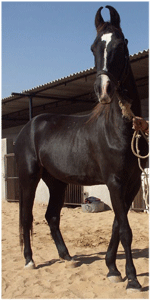
Rajasthan is famous for the Marwari or Malani breed of horses which have become status symbols and  known for its inward-turning ear tips. It comes in all colors, although pinto colors tend to be the most popular.

He is a tough, brave and undeniably beautiful horse who has proven his ability to adapt and thrive in most environments. Trained highly in the art of war, it was known for its bravery on the battlefield.

Over the centuries, the Marwari horse was bred in the harsh desert climate of Rajasthan by warring Rajput clans. The outcome was a hardy, intelligent horse with a great stamina, which could thrive on little food and water. 

Famous Example of  Marwari Horse’s Courage in History

The Marwari horses have been used throughout History of Rajasthan as a cavalry horse by the people of the Marwar region, and was noted for its loyalty and bravery in battle.

The most famous example is the story of how the Marwari steed Chetak saved his master Maharana Pratap in the battle of Haldi Ghati in 1546. Though mortally wounded, with one foot severed, Chetak carried his master to safety by jumping over a river. Only then he gave up his life and died, according to the legend, in his master’s arms.

Maharana Pratap never forgot his loyal Chetak and when the circumstances improved, he erected a monument in his memory. This memorial still exists today in the village of Haldi Ghati, 30 km north of Udaipur.

Characteristics of the Marwari Horse Breed

The Marwari horse is a medium-sized, elegant horse. The most distinguishing features of the Marwari horse are its lyre-shaped ears, which curve inward and often meet at the tips.

Besides providing a sharp hearing, they can turn 180 degrees.It has a longish head with a broad forehead, wide-set and alert eyes and a well-shaped, rather small mouth. It is elegantly proportioned with a proud head carried on a well-arched neck. The legs are straight and sound with small and very hard hooves.

The coat of the Marwari horse is silky and often has the metallic shine of the Turkmeni horses. It comes in all colours, including piebald and skewbald. Very popular as well, are the Cremellos, which in Rajasthan are called Nukra.

Riding on Marwari Horse -  Realise New levels of Joy

To ride a Marwari horse is to realise new levels of joy that demand in turn, a receptive stillness for its appreciation. It is to view the way ahead through a pair of perfectly curved ears, gateway to the heart of Rajasthan’s spiritual and ceremonial heritage.

In Rural Rajasthan the Marwari horses are commonly trained for dancing at the many festivals and marriages that occur throughout the year.

Marwari Horses on The Decline

Lack of government support to protect and promote the horse has led to a steady decline in its number.

Scattered breeders across western Rajasthan are striving hard to increase the numbers, but feel without financial assistance their efforts would not bear fruit.

Tags: , , , , , , , , , , , , ,