Posts Tagged rajasthan temples

Sri Krishna Janmashtami – Lets Celebrate The Birth of Hindu God Krishna

Shri Krishna Janmashtami - Celebrating The Birth of God

Shri Krishna Janmashtami - Celebrating The Birth of God

Janmashtami celebrates the birth of one of the most famous Gods of Hindu religion, Bhagwan Krishna, on the eighth day (Ashtami) in the month of Sravana or Savana. Lord Sri Krishna was born on the ‘Rohini’ nakshatram (star).

It is generally celebrated in the month of August-September according to the Christian Calendar. According to the legends, Sri Krishna was born on a dark, stormy and windy night to end the rule and atrocities of his maternal uncle, Kansa.

How is Janmashtami Celebrated?

Special pujas are held in Sri Krishna Temples around the world. Special poojas and rituals are also held at midnight – the time of Krishna’s birth. Processions with tabloids depicting various episodes from the life of Shri Krishna enacted by children are a major highlight of the festival.

At every temple of lord krishna, this Janmashtami festival is celebrated with a great charm, people dance with bhajans, they offer pooja to lord. Social groups organise competitions like “Matki fod Pratiyogita”. Women and little children goes to lord Krishna’s temple for darshan and pooja.

People put Lord Krishna’s idol in the decorated little cradles. Singing bhajans like jai Kanhaiya Lal Ki, Madan Gopal ki, devotees offer prayers to Lord Krishna. They also chant mantras of Lord Krishna.

Devotees observe fast for the entire day and it is broken after the birth of the Lord at midnight. Only milk and milk products are preferred by them, as these were the favorites of Lord Krishna.

Sri Krishna Janmashtami is known by various names such as Krishnashtami, Gokulashtami, Saatam Aatham, Ashtami Rohini, Sri Krishna Jayanti and Sree Jayanthi.

Janmashtami Celebrated for over Two Days

Krishna Janmashtami is celebrated for over two days as “Rohini” nakshatra and Ashtami may not fall on the same day. The first day known as Krishnashtami, as the birth of Bhagwan Krishna falls on the eighth day after Raksha Bandhan, which generally falls in the month of August. The second day is known as Kalashtami.

Famous Krishna Temples in India

Some of the famous Krishna Temples in India where Krishna Janmashtami is celebrated with much importance includes Krishna Janma Bhoomi Mandir in Mathura, Banke Bihari Mandir in Vrindavan, Srinath Temple in Rajasthan, Dwarkadhish Temple in Gujarat, Guruvayur Temple in Kerala, Udupi Sri Krishna Temple in Karnataka, and ISKCON Temple in Tirupati.
Tags: , , , , , , , , , ,

Bhaneshwar and Sandheswar Temples – Bikaner Rajasthan

Bhaneshwar & Sandheswar Temples in Bikaner

The oldest existing structures in Bikaner are the 14th century Jain Temples built by two merchant brothers. Sandeshwar and Bhandeshwar. Neither had a son to carry on the family name, so each built a temple.  The temples are dedicated to 23rd Jain teerthankar, Parsvanathji.

Unlike other Jain shrines across the country, these temples are adorned with brightly coloured wall paintings. These temple maintains the piety of the traditional Jain place of of worship despite their radical appearance.

Architecture

The Bhandeshwar temple-rich in mirror work and the Sandeshwar temple-stylized enamel and gold leaf wall paintings.

The Bhandeshwar Temple is decorated with gold-leaf work, beautiful sculpted pillars, and floral designs. This temple is carved in red sand stone and white marble – its famous for carvings, wall paintings, structural beauty and artistically designed statues. The rich mirror work, decor and frescoes of Bhandashah and their gold leaf paintings are noteworthy.

What’s Unique about these temples

According to myth, it is said, that 40, 000 kg of ghee had been used in laying the foundation of these temple.

It is carved in red sand stone and white marble, famous for its carvings, paintings, structural beauty and artistically designed statues.

Tags: , , , , , , , , , , ,

Parshavanath Temple, Nakoda – Barmer , Rajasthan

Parshavanath Temple, Nakoda, Rajasthan

Parshavanath Temple, Nakoda, Rajasthan

About Parshavanath Temple – Location

Nakoda pilgrimage, built in the desert land of Rajasthan, bears a gloriously pious dignity.  Dedicated to Jain Tirthankara Shri Parshavanath, this temple was built by the Mandlik family in 1458-59 A.D.

It is situated on a beautiful hill as high as 1500ft on the road from Jodhpur to Barmer.

The Temple at Nakoda is one among the main Jain tirth centres in India.  Because of the importance given to Adhisthayak in India, tirth is always full of pilgrims.

Architecture of the Parshavanath Temple

This is the tallest of all temples having three storeyes. The outer walls of the sanctum have beautiful sculptures in gray sandstone showing Dikpals, Vidhyadevis, Yakshinis and Shalabhanjikas. These beautiful sculptures are frequently compared to the ones in Khajuraho and Konark temples.

There is an image of the Jain saint (tirthankara) Parshvanath in black stone and the ancient idol of Shri Parshwanath Bhagwan is very attractive and full of magical powers.  It is said that 2300 years ago two brothers namely Veersen & Nakorsen has built up this city and the temples.

The main temple consists of the teerth Adhiraj idol along with the idols of Shri Adinath Bhagwan & Shri Shantinath Bhagwan in other temples in its campus. Shri Nakoda Parshwanath Bhagwan in Padmasan mudra, 58 cm in height, is an amazing blueish colour statue. The life history of Shri Shantnath Bhagwan is displayed in form of idols and placed on the walls of Shri Shantinath Bhagwan temple.

Other Jain Temples in Nakoda

There are several small and big temples near the main temple. On the right side of the temple a magnificent idol of ‘Sanwalia’ (dusky) Parshwanath is installed. In this very chamber the idols of Mother Saraswati, Dada Jindutt Suri, Acharya Kirtiratna Suri et al are also installed. There is the magnificent temple of Lord Aadinath at the rear of the main temple. The outer arch of this temple is very artistic.

The miraculous deity of this place, Shree Bhairavji Maharaj was ceremoniously installed here in samvat 1511 by Acharya Kirtiratna Suri. This pilgrimage continuously prospered after the installation of Nakoda Bhairav. The miracles of this place found abode in the minds of the people. The devotees poured in from various places of the country and abroad.

Image Source: Wikipedia

Tags: , , , , , , , , , ,

EklingJi Temple – Udaipur, Rajasthan

EklingJi Temple, Udaipur, India

EklingJi Temple, Udaipur, India

About  Eklingji Temple – Location

The Eklingji temple,  is devoted to Lord Shiva, the tutelary deity of the former Mewar rulers. It is situated approximately 24 km to the north of Udaipur.

Eklingji Shiva temple Udaipur is a huge complex consisting of 108 temples. Enclosing the temple are high walls with bathing terraces leading down to the water. Filling the temple with fragrance all the time are the lighted incense materials.

History – Eklingji temple

One of the legends relating to Eklingji is that after killing Vrakshasur, indra had meditated and prayed toeklingji in repentance and to be free of the curse.

According to another legend, Bapparawa had seen the Shivlinga in his dream when he was in trouble and when the problem was solved, he constructed the tample and later build Mewar. The ruler of Mewar regards Eklangji as the real kingdom.

Architecture  of  Eklingji Temple

Eklingji temple houses a 50 feet high multi-faced black stone statue of Lord Shiva. There are four faces of the statue, depicting Lord Shiva in his four forms. In the east is Surya (sun), in the west is Brahma, in the north is Vishnu and in the south is Rudra. In the center of these images is the Shivlinga, encircled by a silver snake. The temple houses the whole family of Lord Shiva, including Parvatiji (wife of Shiva) and Ganeshji (son of Shiva).

Eklingji temple  also contains the statues of Yamuna and Saraswati. The temple has silver doors depicting Lord Ganesha and Lord Kartikeya. Located nearby Eklingji Shiva temple, are the temples of Amba Mata, Ganeshji and Kalika. Also shown in the brackets are nymphs in erotic dance postures and a life size image of Bapparawal.

It is a beautiful temple complex, with fine art work and delicate sculptures and of course a soothing spiritual atmosphere.

There are two tanks situated on the Northern side of the temple – Karz Kund and Tulsi Kund. Water from these tanks is utilized for temple services. The prayer service is performed in a very elaborate and authentic manner, using the Vedic and Tantric styles – beginning sharp at 4 in the morning.

Shivratri is an important religious event here, on this day the image of the deity is decked with jewellery and large gatherings of devout hindus come here to offer prayers.

Image Source: Wikipedia

Tags: , , , , , , , , , , ,

Chamunda Devi Temple – Mehrangarh Fort , Jodhpur Rajasthan

Chamunda Devi Temple, Jodhpur, India

Chamunda Devi Temple, Jodhpur, India

Location

The temple is situated in the southern end of the Mehrangarh Fort located on a hill top in Jodhpur, 330 km from Jaipur.

The fort, one of the largest in India, is situated 400 feet above the city and is enclosed by imposing walls. It comprises several palaces known for their intricate carvings and sprawling courtyards.

About Chamunda Devi Temple

Chamunda Mata, a form of goddess Durga, was the favourite deity of Rao Jodha, the founder of Jodhpur. He brought her idol from the old capital of Mandore near here in 1460 and installed it in the Mehrangarh Fort.

The goddess remains the Isht Devi (patron deity) of the erstwhile royal family. The Chamunda temple draws tens of thousands of devotees, especially during the Navaratri period.

People in Jodhpur believe that Goddess Chamunda is their guarding deity. Pilgrims coming here tie a piece of cloth or thread to a trident in the temple in the hope that the goddess will answer their prayers. When their wishes are fulfilled, devotees pay a thanksgiving visit.

The temple is maintained by the Maharaja Ummaid Singh Religious Trust.

During Dussehra celebrations, Mehrangarh Fort is thronged by devotees to get a glimpse of Chamunda Devi. If you are a devotee of Chamunda Devi, do visit this temple, when in Jodhpur.

Human Stampede Occurred in Chamunda Devi Temple

More recently the temple has been in news because on September 30, 2008, a stampede took place at Chamunda Devi temple. There were more than 25, 000 worshippers who gathered at the temple to celebrate the onset of Navaratri, the greatest festival among the Hindus in India. This incident has caused more than 113 deaths and injuries to over 300 people.

The pathway leading to the temple is not more than five-six feet wide, one reason why so many people died stampede.

Image Source: Wikipedia

Tags: , , , , , , , , , , ,

Khatu Shyam Ji Temple – Sikar, Rajasthan

Location

Khatu Shyam Ji Temple is situated in district of Sikar in state of Rajasthan, at a distance of 17 km from Reengus.

Khatu Shyamji, Sikar, Rajasthan, India

Khatu Shyamji, Sikar, Rajasthan, India

History – Why it is called Khatu Shyam Ji Temple ?

The legend of this immensely popular Krishna temple can be traced back to the medieval Mahabharat where Barbareek, the son of great Pandav brother Bhim and Nag Kanya (snake princess) displayed his great warrior skills that pleased Lord Shiva who endowed his blessings in the form of Teen Ban (three arrows)

In order to watch the famous war of Mahabharat, he sat towards the battle field and in between his tryst with Lord Krishna in disguise becasme a vital part of the history and thus the incarnation of KHATU SHAMJI.

Architecture of the Temple

The temple is architecturally rich. Lime mortar, marble and tiles have been used in constructing the structure. The shutters of the sanctum are beautifully covered with silver sheet.

Outside is the prayer hall, named Jagmohan and its walls are elaborately painted, depicting mythological scenes. The entrance gate and exit gate are made of marble; their brackets are also of marble and feature ornamental floral designs.

There is an open space in front of the entrance gate of the temple. The Shyam Bagicha is a garden near the temple from where flowers are picked to be offered to the deity. The Samadhi of Aloo Singh, a great devotee, is located within the garden.

The Gopinath temple lies to the south-east of the main temple. The Gaurishankar temple also lies nearby. There is an interesting tale associated with the Gaurishankar temple.

There is a steady stream of devotees the year round, but lakh of them gather at the annual fair from Phalgun Sudi Dashmi to Dwadashi. Apart from being a place of pilgrimage, a large number of people come for the Jadula ceremony (the first time all hair is shaved off the head) of their children.

Images Source: Wikipedia

Tags: , , , , , , , , , , , , , ,

Atmateshwar Temple – Pushkar , Rajasthan

Pushkar Sarovar, Pilgrimage Centre, Rajasthan

Pushkar Sarovar, Pilgrimage Centre, Rajasthan

About Pushkar – A Pilgrimage for Hindus

Pushkar is considered as one of the most significant places of pilgrimage for Hindus. With its sacred lake near Ajmer in Rajasthan, Pushkar is an ancient holy spot.  The town of Pushkar situated on the lake is surrounded by hills on three sides

It is the only place in India where there is a temple dedicated to Lord Brahma. Lakhs of devotees assemble at Pushkar from the 11th day of Kartik till the full moon and take a dip in the holy lake during these five days every year.

Pushkar now has five principal temples, all of modern construction, These are dedicated to Brahma, Savitri, Badrinarayan, Varaha and Shiva Atmateshwar.

About Atmateshwar Temple

Dedicatedd to lord Shiva, the Atmateshwar Temple in Pushkar is visited by numerous people throughout the year. Lord Shiva is considered to be the destroyer in the Hindu Trinity, whereas Load Vishnu the preserver and Lord Brahma the creator

Constructed in the 12th century A.D, this temple has splendid architecture. The intricate Hemadpanti architectural style carvings give it a magnificently historical look.

If you visit Atmateshwar Temple in Pushkar during Shivaratri , when Lord Shiva is ritually revered, you shall get to see thousands of devotees thronging the temple.

Tags: , , , , , , , , , , , , , , , ,

Galtaji Temple , Jaipur Rajasthan

Galta Ji Temple, Jaipur, India

Galta Ji Temple, Jaipur, India

About GaltaJi – Location

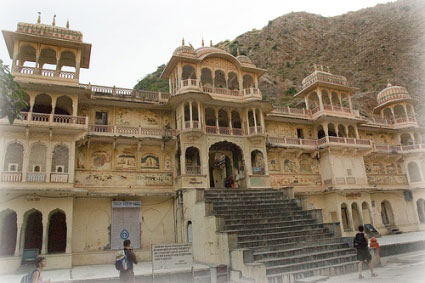
Galtaji is a holy pilgrimage of Rajasthan, located 10 kms away from Jaipur. The vast complex of Galta Ji has several temples in it.

The Temple of Galtaji is famous for its natural water springs. Set amidst the beautiful landscape, Galtaji Temple offers a picturesque view of the city. Galtaji is considered holy place, as Saint Galav spent his life meditating here.

Architecture of Temples in Galtaji

The most celebrated temples of the place include the triple-storied temple of Balaji, which attracts to the aesthetic sense of the travelers and is built in pink stone.

The impressive structure of the Balaji Temple appears more like a palatial mansion or Haveli. Located in the midst the low hills, the Temple of Galtaji, also is built in pink stone and has a huge complex.

The location of temple is such that it provides awe-inspiring views of the surrounding plains. The Galtaji Temple is a souvenir of the former age and a sacred pilgrimage of the Hindus. The tranquility of the Temple, attracts people from far and near, to visit it again and again.

About Galta Kund in Galtaji

There are seven tanks in all, the most pious being the Galta Kund, which is thought never to become dry. A large number of devotees take a holy bath in these tanks especially on Makar Sankranti in mid-January. These tanks are fed by Gaumukh, which is a spring arising from a rock shaped like a cow’s head.

The temple takes pride on its numerous pavilions with rounded roofs, delicately carved pillars and painted walls. Large springs and reservoirs circumvent the temple.

Tags: , , , , , , , , , , , , , , ,

Rishabhdeo Temple – Udaipur Rajasthan

Location

Rishabhdeo Temple is an important pilgrimage site for followers of Jain religion. The temple is located on Udaipur-Ahmedabad road, at a distance of 65 kms from the city of Udaipur in Dhulev. Dhulev is a small town that is also known as Rikhabdeo, famous for its Rishabhdeo Temple.

About Rishabhdeo Temple

Dedicated to Rishabhdeoji, one of the 24 Tirthankars of the Jains, the 15th century A.D Rishabhdeo Temple is an important pilgrimage site. Owing to a large amount of saffron offering made, the temple has also come to be known as the Kesariyaji Temple.

Both Jains and Bhils have immense respect for this temple, since the lord fulfills all their wishes and desires.  Rishabhdeoji is  also considered as one of incarnations of Lord Vishnu and due to this reason; many of the Hindus come to this place of worship every month from all over Rajasthan.

Architecture & Attractions of Rishabhdeo Temple

Carvings Inside Rishabhdeo Temple, Udaipur, India

Carvings Inside Rishabhdeo Temple, Udaipur, India

While entering this temple, you will be received by the Elephants that are carved out of black stone. In the north, the image Goddess Chakreshvari adorns the site and in the south, the image of goddess Padmavati fetches the attention. In this temple, the idol of Lord Rishabh Dev captures the major attraction.

On special occasions the image is clothed with the angia (a garment studded with precious stones worth severed hundred thousand rupees).

Besides the main idol, there are 23 other idols and out of them, 2 are standing and 21 are in a sitting position. All these idols are made up of Ashtadhatu (composed of eight metals) and encircle the idol of Lord Rishabhdeo.

The northern and southern parts of the Khela Mandapa (Hall) are occupied by the idols of Tirthankaras Vasupujya, Mallinath, Neminath, Parshvanath and Mahavir Swami that are collectively known as Panch-Balayati. Apart from this, there are 52 other devakulikas (shrines) of the Tirthankaras.

Tags: , , , , , , , , , , , , , , ,

Luna Vasahi Temple – Delwara Jain Temples , Mount Abu, Rajasthan

Delwara Jain Temple

The famous Delwara Jain temples are 2.5 km away from the Mount Abu, which in ancient Hindu and Jain scriptures is referred to as Arbudgiri. The Delwara temples were dedicated to the Jain Tirthankars and also served as storehouses of illustrated manuscripts and treatises.

Vimala Shah, Vastu Pala and Teja Pala contributed a lot toward the development of Jain art and architecture. The Jain temples at Mount Abu are built in the Nagara style of temple architecture

The ornamental detail spread over the minutely carved ceilings, doorways, pillars and panels is simply marvelous and has to be seen to be believed.

About Luna Vasahi Temple

Luna Vashi - Dilwara Jain Temple, Mount Abu, India

Ornate Sculptures @ Luna Vasahi - Dilwara Jain Temple, Mount Abu, India

The magnificent Luna Vasahi temple dedicated to the 22nd Jain Tirthankara Shri Neminathji, was built in 1231 A.D by two  porwal brothers Vastupal and Tejpal both ministers of Raja Virdhaval, a ruler of Gujarat.

The temple built in memory of their late brother Luna was designed after the Vimal Vashi temple.

Historically, this is the last of the monuments built in the Solanki Dynasty.

Architecture of Luna Vasahi Temple

The main hall or Rang mandap has a central dome from which hanfs a big ornamental pendent featuring elaborate carving.

You will notice, arranged in a circular band are 72 figures of Tirthankars in sitting posture and just below this band are 360 small figures of jain monks in another circular band. The Hathishala or elephant cell features ten elaborately carved marble elephants.

The Navchowki features some of the most magnificent and delicate marble stone cutting work of the temple. Each of the nine ceilings here seems to exceed the others in beauty and grace.

The Gudh mandap features a black marble idol of the 22nd Jain Tirthankara Neminath. The Kirthi Stambha is a big black stone pillar that stands on the left side of the temple. The pillar was constructed by Maharana Kumbha of Mewar. The remaining three temples of Dilwara are smaller but just as elegant as the other two.

There is a small cell, in between the trees, dedicated to the worship of foot-prints of ‘Dada Sahib’ Jain Acharaya Shri Jindutt Suri.

Tags: , , , , , , , , , , , , , , ,