Posts Tagged jaisalmer tour

Lodurva – A Jain Pilgrimage – Jaisalmer, Rajasthan

Lodurva Jain Temples, Jaisalmer, Rajasthan

Lodurva Jain Temples, Jaisalmer, Rajasthan

Location and History about Lodurva

Lodurva, located at a distance of 15-kilometers from Jaisalmer is one of the most enchanting Rajasthan tourist attractions.

Lundurva ,the ancient capital of Bhatti Rajputs was once a flourishing city but most of the splendour when the Bhattis shifted their capital to Jaisalmer.

According to a popular legend the ancient River Kak flew in this part of Rajasthan. It was on the banks of this river that the legendary prince Mathendru of Amarkot and princess Momal fell in love and eventually met their tragic end. It is believed that the River Kak dried up after the two lovers perished.

The most mesmerizing experience will be the peacock dance amid exotic Lodurva ruins. Yes, Peacocks are a great pull and they are in plenty here.

Lodurva Attractions -  Jain Temples

There are several Jain temples at Lodurva, though the most significant are the Parswanath Temple, Rishabhnath Temple and the Sambhavnath Temple.

Nevertheless the place is a major tourist attraction and have jain temples made of bright yellow sandstone, these temple walls are decorated with the pictures of Lord Parsvanath, the Jain Tirthankar arch in the main temple building. These arches are typical of the Delwara style of temple architecture.

The beautiful Jaali works make these temples a piece of marvel. You will notice the splendid and dominating arch in the main temple building.

About Kalpavriksha (Celestial Tree)

Inside the temple complex is the Kalpavriksha or the celestial tree. A tree was once believed to have grown here, and when it died it was substituted by a true to life sculpture in an alloy of eight metals, making it an ‘eternal tree’ symbolizing enlightenment.

The copper leaves are believed to have the power to fulfil the wishes of any devotee. On the temple’s outer wall there is a low – relief carving on stone, reportedly inhabited by a black cobra who’s been living here for 400 years. Rumor has it that he comes out 10-15 times every summer and anyone catching a glimpse of it is blessed with good luck.

In your visit to Jaisalmer, you just can’t remain silent without admiring the intricately imprinted yellow sandstone in the temples and miracle of the artistic beauty visible on these ancient monuments. Even the ruins the temple at Lodurva radiate character.
Tags: , , , , , , , , , , , , , , , , ,

Desert National Park – A Wildlife Sanctuary in Jaisalmer, Rajasthan

Location and Area

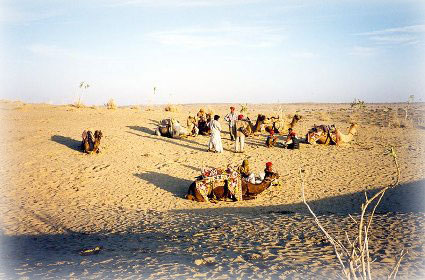
Twenty – eight miles to the southwest of Jaisalmer, The Desert National Park Covers 1220 sq miles of scrub, thorn forest, desert and dunes. The range  of both flora and fauna is, to many surprisingly large for a desert area. The unique ecosystem reflects the successful adaptation  by a range of mammals, birds, insects and flowers to a harsh climate with temperature ranges from below freezing to over 130 F.

The rolling landscape of a sand – dunes and scrub- covered hills is often breathtaking beautiful. The active dunes of Sam contrast with 180 million year old wood fossils at Akal 10 miles from jaisalmer which indicate that his now arid area must have once been hot, humid and luxuriant.

The scant vegetarian and the animals dependent on it are in turn dependent on it are in turn dependent on whatever water is available. Water holes are therefore the ideal sports from which to watch animals and birds.

Desert National Park, Jaisalmer, Rajasthan

Desert National Park, Jaisalmer, Rajasthan

Famous Species in the Park

The small active desert fox is an important predator keeping a natural check on the population of desert rats and gerbils.

The wolf is perhaps the main predator and the jackal is found on the periphery of the park.

Group of blackbuck, chinkara and nilgiri are found in the villages and now thrive in the park’s areas of sparse.

Some smaller mammals have adapted to the desert environment by burrowing  like the gerbil, by living crested porcupine.

The desert bird life is extensive , ranging from a large number of birds of pery to sandgrouse, doves, quails, partridges, shrikes, bee- eaters and desert coursers. The most remarkable bird of the desert is the Great Indian Bustard weighing up to 30 pound. The Houbara Busted also found in the park Of three resident species of snadgrouse, the Indian sandgrouse is impressive with its routine of arriving in small groups to join large turbulent flocks in the early morning to drink at the same place each day.

Habitual destruction and hunting this majestic bird but its population in the park alone is over 1000. Many insects and reptile species evident throughout the park form important links in the desert food chains. The 43 species of reptile include lizards , chameleons and snakes.

Photo Source: http://en.wikipedia.org/wiki/Image:D%C3%A9sert-du-Thar.jpg

Tags: , , , , , , , , , , , , , , , , , ,