Posts Tagged wildlife in rajasthan

Water Scarcity at Bharatpur Bird Sanctuary – Tourism Industry in Despair

Birds at Bharatpur Bird Sanctuary

Birds at Bharatpur Bird Sanctuary

Keoladeo Ghana National Park , Bharatpur or Bharatpur Bird Sanctuary which is amongst India’s premier wildlife sanctuaries is in the grim situation due to lack of water.

It is one of the best bird preserves in the world. The park was created by the erstwhile Maharaja – Suraj Mal, in the 18th century. The sanctuary was created so as to supply a regular stock of waterfowls to the royal kitchen.

The park was accorded the status of a sanctuary in the year 1956 and in 1982 declared as a national park. The sanctuary supports a large number of water birds, including many rare species

Air of Despair among Bird Watchers

There is an air of despair among bird watchers and officials at the Keoladeo Bird Sanctuary. The rains have played truant so far and the swamps are dry. Without aquatic life, that is food for the migratory birds, many of the winged visitors may not show up this winter, which is bad news for tourism.

Last year’s monsoon was really good for the region, with more than 800 mm of rainfall recorded, but this year so far there has been only 96 mm of rainfall in the district. The sanctuary urgently needs water, otherwise the birds would lose interest, and this would naturally affect tourism. Already hotels outside the sanctuary are running almost empty now.

Though there are half a dozen projects in the pipeline to bring in water, work has not begun on any of them. The nearby Panchna and Ajan dams cannot meet the water requirements of the big sanctuary. At sanctuary, they need lots of water to sustain aquatic life on which the birds feed.

The Rajasthan Government is working on a project to arrange regular supply of water through a pipeline from a Yamuna canal.

Two years ago UNESCO had threatened to de-recognize Keoladeo as a world heritage site as there was no water in the swamps. The threat again looms large.
Tags: , , , , , , ,

Desert National Park of Rajasthan Approved in Unesco’s World Heritage Properties

Unesco’s  approval of listing of the Desert National Park on India’s tentative list of Natural World Heritage Properties is a  great news for Rajasthan Tourism.

Desert National Park - Jaisalmer

Desert National Park - Jaisalmer

The name was approved in a recently-held World Heritage Committee meeting in Spain.

The other three sites are Great Himalayan National Park, Himachal Prades; Bhitarkanika Conservation Area, Orissa; and Neora Valley National Park, West Bengal.

Located in Jaisalmer district of Rajasthan, Desert National Park covering an area of 3,162 sqkm across Jaisalmer and Barmer districts, is one of the only natural habitat of the globally threatened the Great Indian Bustard bird which is also known as Rajasthan State Bird and endemic fauna and flora of Rajasthan.

Utmost Attraction of the Desert National Park – Great Indian Bustards

The utmost attraction of the Desert National Park is the great Indian bustards (a rare species of bird) that is a heavy and graceful bird, draws thousands of bird lovers from all corners of the world.

Other Famous Species in Desert National Park

Other birds of significance include the endangered Oriental White-backed vulture Gyps bengalensis and Long-billed Gyps indicus,  Stoliczka’s Bushchat Saxicola macrorhyncha,  Green Munia Amandava formosa MacQueen’s or Houbara Bustard Chlamydotis maqueeni.  Indeed it offers an exciting feeling to wildlife tourists.

The park is teeming with wildlife and some of the resident species include chinkara, hare, desert fox, black buck, wolf, desert cat to name just a few.

Excellent Wildlife Photography at Sudashri Watch Tower

One of the most sought after vantage points of the park is the Sudashri watch tower from where one can observe the varied resident wildlife species of the sanctuary.

The Sudashri tower offers excellent wildlife photography opportunities and you can shoot your cameras to your hearts content.

Tags: , , , , , , , , , , ,

Special Arrangements For lions and Tigers To Help Them Beat The Heat in Rajasthan’s Rescue Centre

Officials of Nahargarh Rescue Centre in Rajasthan have made special arrangements like water coolers in every cage, bathe three to four times a day etc to save the tigers and lions from the scorching heat of summers.

One cooler is installed between two animals and “Khus-Khus” mats, which are continuously kept wet so that hot waves convert into cool breeze, wrap a cage. Even the diet of the animals, is taken care of. Moreover, to prevent the tigers from getting dehydrated in the scorching heat, they are being given a dose of glucose in the water that they drink.

In Nahargarh Rescue Centre the animals mostly brought from circuses or injured in sanctuaries, are housed in the rescue centre for recuperation. The number of tigers in India has plummeted to around 1,411, nearly half the previous estimate, as humans either kill them for their body parts or encroach on their habitat, according to a government survey.

Experts believe that India’s dwindling tiger population will never recover and it will take a miracle to save those left from habitat destruction and poaching. The previous census, carried out in 2001 and 2002, said there were 3,642 tigers. A century ago there were 40,000.

Source: Leading Media Channels

Tags: , , , , , , , ,

Sariska Tiger Reserve | Palace in Alwar, Rajasthan

Sariska Palace, Alwar, Rajasthan

Sariska Palace, Alwar, Rajasthan

Location and Area

On the main highway to Jaipur 21 miles south of Alwar , lies the Sarisla National Park. Sariska is one of the few remaining pockets of forest in the Aravali range of hills and the area now covers 308 square miles is the core area.

Places to See in Sariska

The forest is mainly hilly with two extensive plateaus, Kanakwari and Kiraska and a wide Vally starting at the Baran Tal Gate and running south to Thana Gazi. At the northeastern corner, just off the road between Alwar and Sariska, is the Siliseth Lake where crocodiles are often seen. During the winter there are many migrant water birds also.

In spring the surrounding hillsides are filled with color as the flame of the forest and other flowering trees bloom. In the summer, the park is parched and brown but with the monsoon becomes lush and green. Among the undulating hills and wide valleys of Sariska is rare combination of natural history and archaeology.

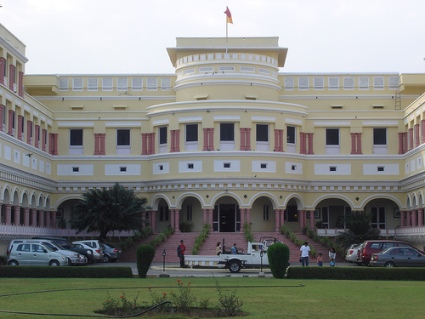
At Sariska, opposite the Baran Tal Gate of reserve, is a large palace built in 1902 by Jai Singh of Alwar as a base for elaborate shoots. The palace is now a hotel. Sariska has a good networks of metaled roads From thee main arteries forest racks lead into side valleys. The forest department has provided many  artificial water holes on the roads which attract the animals  and makes wildlife observation from vehicles easy.

Famous Species in the Park

Because of the scarcity of water , viewing from hides overlooking waterholes at Salopka and Kalghati watch , photograph and study many of species. The forest contains sambar, nilgai, Chinkara, Chausigha and chital and predators include leopard, byena, jungle cat and wide boar apart from the tiger.

Photo Source: http://www.flickr.com/photos/trayser/61604730/

Tags: , , , , , , , , , , , , ,

Keoladeo Ghana National Park – A Bird Sanctuary in Bharatpur, Rajasthan

Keoladeo Ghana National Park, Bharatpur, Rajasthan

Keoladeo Ghana National Park, Bharatpur, Rajasthan

History

In the middle of the 18th century a small reservoir was created three miles to the southeast of the Bharatpur fort. The building of the Ajan Bund and the subsequent flooding of this natural depression has created during the subsequent 250 years one of the world’s most facinating and spectacular bird reserves. It is commonly referred to as the Bharatpur Bird Sanctuary

The range of flora in the park is extraordinary for such a small area. Dozens of grasses provide cover, nest material and food to a range of birds and mammals. Trees range from the throny acacia or babul which dominates much of the park to ber, khajur and khejari.

The lakes with their rich range of floating plants algae, reeds, flowering plants to millions of crustaceans, insects and fish in such enormous quantities that thousand of bird can depend on the area for raising their young and as a winter home.

Famous Bird and Animal Species in the Park

From August through November, thousand of indigenous water birds breed and raise their young here. Painted strocks, spoonbills, cormorants, three kinds of egret, open billed strocks, purple herons, night herons and sarus cranes are some of the famous species that can be found here. In early October , the first migrants arrive from the high plateaus of central Asia, Mongolia, and Siberia. The ducks, geese and waders arrive first. Raptors, including the steppe eagle, golden eagle, osprey and harrier follow.

Some 35-40 beautiful species feed on sedge tubers till early March when they return to Central Siberia. The forest also supports animals as nilgai, sambar, wild boar, feral cattle, civet, jacket and the rhesus macaque.

How to Reach Keoladeo Ghana National Park

A metaled road runs through the park from the north gate near the main Agra- jai[pur road. Vehicles are now allowed only as far as the tourist and forest lodges. A good network of raised paths along tree-lined bunds give good cover for bird watching and the visitor can walk through much of the park along the bunds. Visiting the park at any time of the year is a rewarding experience especially betwen October and March.

Tags: , , , , , , , , , , , , , , ,

Desert National Park – A Wildlife Sanctuary in Jaisalmer, Rajasthan

Location and Area

Twenty – eight miles to the southwest of Jaisalmer, The Desert National Park Covers 1220 sq miles of scrub, thorn forest, desert and dunes. The range  of both flora and fauna is, to many surprisingly large for a desert area. The unique ecosystem reflects the successful adaptation  by a range of mammals, birds, insects and flowers to a harsh climate with temperature ranges from below freezing to over 130 F.

The rolling landscape of a sand – dunes and scrub- covered hills is often breathtaking beautiful. The active dunes of Sam contrast with 180 million year old wood fossils at Akal 10 miles from jaisalmer which indicate that his now arid area must have once been hot, humid and luxuriant.

The scant vegetarian and the animals dependent on it are in turn dependent on it are in turn dependent on whatever water is available. Water holes are therefore the ideal sports from which to watch animals and birds.

Desert National Park, Jaisalmer, Rajasthan

Desert National Park, Jaisalmer, Rajasthan

Famous Species in the Park

The small active desert fox is an important predator keeping a natural check on the population of desert rats and gerbils.

The wolf is perhaps the main predator and the jackal is found on the periphery of the park.

Group of blackbuck, chinkara and nilgiri are found in the villages and now thrive in the park’s areas of sparse.

Some smaller mammals have adapted to the desert environment by burrowing  like the gerbil, by living crested porcupine.

The desert bird life is extensive , ranging from a large number of birds of pery to sandgrouse, doves, quails, partridges, shrikes, bee- eaters and desert coursers. The most remarkable bird of the desert is the Great Indian Bustard weighing up to 30 pound. The Houbara Busted also found in the park Of three resident species of snadgrouse, the Indian sandgrouse is impressive with its routine of arriving in small groups to join large turbulent flocks in the early morning to drink at the same place each day.

Habitual destruction and hunting this majestic bird but its population in the park alone is over 1000. Many insects and reptile species evident throughout the park form important links in the desert food chains. The 43 species of reptile include lizards , chameleons and snakes.

Photo Source: http://en.wikipedia.org/wiki/Image:D%C3%A9sert-du-Thar.jpg

Tags: , , , , , , , , , , , , , , , , , ,

Bird Watching in Rajasthan – A Heaven for Bird Lovers

Peacock - National Bird of India - Dancing in Rajasthan

Peacock - National Bird of India - Dancing in Rajasthan

In spite of a comparatively hostile terrain, Rajasthan surprisingly is the abode of a number of mammals and birds.

The large number of lakes and other waterholes in the state make it inviting for avian visitors from around the globe. And so, also for bird watchers from the world over.

The Bird  sanctuaries attract herds of species from all over to their temporary habitat that provides comfortable subsistence.

During the season, the whole place echoes with enchanting sounds and fascinating visuals against the sprawling meadows of flora.

About Keoladeo National Park

The Keoladeo National Park, situated in Bharatpur is a heaven for birds and has been declared one of the most breeding ground for birds in the world.

Once duck shooting preserve for Maharaja of Bharatpur, today the sanctuary is frequented by birds of over 375 species, of which 132 are said to be breed inside the Keoladeo Ghana National Park. Numerous endangered species also visit the area, including the Siberian Crane.

Lots of Species of Birds Visit Rajasthan - Especially in Winters

Lots of Species of Birds Visit Rajasthan - Especially in Winters

Being a unique bird place, the UNSECO has recognized it as a world heritage site.

It is truly a paradise of pretty feathered life which provides unlimited fantastic  opportunities to bird watchers.

Other birds that can be seen here are the Cormorant, Darter, Purple and Grey Heron, various species of Egret, painted , Open billed, White- necked and Black necked Strok. Millions of water – fowls flock to the park during mating season, along with ducks like Pintail , Common Teal, Ruddy Sheduck, Mallard, Gadwall etc.

The park opens from sunrise to sunset around the year. The ticket is Rs 200 per foreign visitor and Rs 25 for Indian visitor. Vehicles are permitted upto Shanti Kutir about 1.7 kilometres inside at Rs 50 per vehicle.

Other Places of Bird Watching in Rajasthan

The major wetlands other than Bharatpur for Bird Watching are Kukas, Kalah, Bund, Buchora Chandi, Chhaparwara and Ramgarh in Jaipur, Silislerh Jaisamand and Mansarover in Alwar, Ana Sagar and Faterhsagar in Ajmer, Jaisamand, Pichhola and Badi ka Talab in Udaipur, Balsamand and Sardar Samand in Jodhpur, Bassi Dam in Chittaurgarh and Meja Dam in Bhilwara.

In  Rajasthan the best season for bird watching starts with the onset of winter marshlands and lakes are inhabited by migratory birds as well as resident birds. In salt-water lakes, flamingos are also found, like in Pachpadra near Barmer and Sambhar near Jaipur. Bird watching is a hobby which has minimum requirements. All you need is a binocular.

Tags: , , , , , , , , , , , , , , , ,

Wildlife Adventure in Rajasthan

So you thought all of Rajasthan was barren desert ? so you thought the only animal found here was tall and yellow and hairy and called camel?

Wildlife in Rajasthan

Wildlife in Rajasthan - Tigers Roaming in National Park

Wildlife in Rajasthan - Tigers Roaming in National Park

You will be surprised by Rajasthan the land of Contrasts , at every step. An extraordinary variety of fauna and flura have flourished across the highly varied vegetation in the large state. Rajasthan has a number of wildlife Sanctuaries and National parks which draw thousands of visitors from across the world.

Rajasthan has nine major wildlife sanctuaries . Across the state, the species of animals and birds vary with the type of vegetation – from desert grasslands to thorn forests on rocky terrain, to thick jungles and waterlands.

Ranthambore Wildlife Sanctuary

Rantahmbore has been the natural choice for the Tiger and other big cats including the leopard, for centuries. The sanctuary sprawls across the junction of two mountain ranges -The Aravalis nad Vindhyas and has six large lakes within its perimeter . Together they offer the perfect environment for the Tiger and a large variety of other animals to flourish.

Sariska Wildlife Sanctuary

Situated on the hills and valleys of the Aravali range, the deciduous forest of Sariska make it an excellent tiger reserve. Sariska also has an equally rich architectural and cultural heritage with ruins of temples .

Sambhar, Darrah Sanctury

Sambhar, Darrah Sanctury

Desert National Park

The deserts of Rajasthan are a heady mix of endless sand dunes and rugged rocky mountain ranges. There exists a whole world of fauna within the diverse terrain of Thar desert.  The Desert National park is ideal to get a glimpse of animals that inhabit the hostile wildness like Chinkara, Wolf, Indian fox, Hare and Desert Cat.

Carry a camera. Besides the magnificence of the forts and palaces in Rajasthan , you will come across such a variety of birds and animals, and landscape of such beauty , you will never forgive yourself for forgetting your camera.

Other Major Wildlife Sanctuaries in Rajasthan

  • Kumbalgarh Sanctuary
  • Darrah Sanctuary

Tags: , , , , , , , , , , , , , , , , , , , , , , , , , ,