Posts Tagged national park

Keoladeo Ghana National Park – A Bird Sanctuary in Bharatpur, Rajasthan

Keoladeo Ghana National Park, Bharatpur, Rajasthan

Keoladeo Ghana National Park, Bharatpur, Rajasthan

History

In the middle of the 18th century a small reservoir was created three miles to the southeast of the Bharatpur fort. The building of the Ajan Bund and the subsequent flooding of this natural depression has created during the subsequent 250 years one of the world’s most facinating and spectacular bird reserves. It is commonly referred to as the Bharatpur Bird Sanctuary

The range of flora in the park is extraordinary for such a small area. Dozens of grasses provide cover, nest material and food to a range of birds and mammals. Trees range from the throny acacia or babul which dominates much of the park to ber, khajur and khejari.

The lakes with their rich range of floating plants algae, reeds, flowering plants to millions of crustaceans, insects and fish in such enormous quantities that thousand of bird can depend on the area for raising their young and as a winter home.

Famous Bird and Animal Species in the Park

From August through November, thousand of indigenous water birds breed and raise their young here. Painted strocks, spoonbills, cormorants, three kinds of egret, open billed strocks, purple herons, night herons and sarus cranes are some of the famous species that can be found here. In early October , the first migrants arrive from the high plateaus of central Asia, Mongolia, and Siberia. The ducks, geese and waders arrive first. Raptors, including the steppe eagle, golden eagle, osprey and harrier follow.

Some 35-40 beautiful species feed on sedge tubers till early March when they return to Central Siberia. The forest also supports animals as nilgai, sambar, wild boar, feral cattle, civet, jacket and the rhesus macaque.

How to Reach Keoladeo Ghana National Park

A metaled road runs through the park from the north gate near the main Agra- jai[pur road. Vehicles are now allowed only as far as the tourist and forest lodges. A good network of raised paths along tree-lined bunds give good cover for bird watching and the visitor can walk through much of the park along the bunds. Visiting the park at any time of the year is a rewarding experience especially betwen October and March.
Tags: , , , , , , , , , , , , , , ,

Desert National Park – A Wildlife Sanctuary in Jaisalmer, Rajasthan

Location and Area

Twenty – eight miles to the southwest of Jaisalmer, The Desert National Park Covers 1220 sq miles of scrub, thorn forest, desert and dunes. The range  of both flora and fauna is, to many surprisingly large for a desert area. The unique ecosystem reflects the successful adaptation  by a range of mammals, birds, insects and flowers to a harsh climate with temperature ranges from below freezing to over 130 F.

The rolling landscape of a sand – dunes and scrub- covered hills is often breathtaking beautiful. The active dunes of Sam contrast with 180 million year old wood fossils at Akal 10 miles from jaisalmer which indicate that his now arid area must have once been hot, humid and luxuriant.

The scant vegetarian and the animals dependent on it are in turn dependent on it are in turn dependent on whatever water is available. Water holes are therefore the ideal sports from which to watch animals and birds.

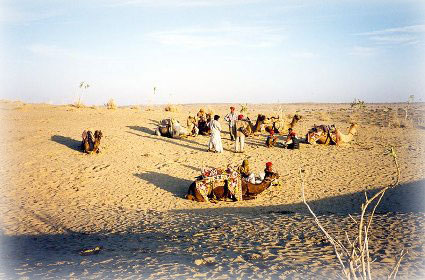
Desert National Park, Jaisalmer, Rajasthan

Desert National Park, Jaisalmer, Rajasthan

Famous Species in the Park

The small active desert fox is an important predator keeping a natural check on the population of desert rats and gerbils.

The wolf is perhaps the main predator and the jackal is found on the periphery of the park.

Group of blackbuck, chinkara and nilgiri are found in the villages and now thrive in the park’s areas of sparse.

Some smaller mammals have adapted to the desert environment by burrowing  like the gerbil, by living crested porcupine.

The desert bird life is extensive , ranging from a large number of birds of pery to sandgrouse, doves, quails, partridges, shrikes, bee- eaters and desert coursers. The most remarkable bird of the desert is the Great Indian Bustard weighing up to 30 pound. The Houbara Busted also found in the park Of three resident species of snadgrouse, the Indian sandgrouse is impressive with its routine of arriving in small groups to join large turbulent flocks in the early morning to drink at the same place each day.

Habitual destruction and hunting this majestic bird but its population in the park alone is over 1000. Many insects and reptile species evident throughout the park form important links in the desert food chains. The 43 species of reptile include lizards , chameleons and snakes.

Photo Source: http://en.wikipedia.org/wiki/Image:D%C3%A9sert-du-Thar.jpg

Tags: , , , , , , , , , , , , , , , , , ,

Wildlife Adventure in Rajasthan

So you thought all of Rajasthan was barren desert ? so you thought the only animal found here was tall and yellow and hairy and called camel?

Wildlife in Rajasthan

Wildlife in Rajasthan - Tigers Roaming in National Park

Wildlife in Rajasthan - Tigers Roaming in National Park

You will be surprised by Rajasthan the land of Contrasts , at every step. An extraordinary variety of fauna and flura have flourished across the highly varied vegetation in the large state. Rajasthan has a number of wildlife Sanctuaries and National parks which draw thousands of visitors from across the world.

Rajasthan has nine major wildlife sanctuaries . Across the state, the species of animals and birds vary with the type of vegetation – from desert grasslands to thorn forests on rocky terrain, to thick jungles and waterlands.

Ranthambore Wildlife Sanctuary

Rantahmbore has been the natural choice for the Tiger and other big cats including the leopard, for centuries. The sanctuary sprawls across the junction of two mountain ranges -The Aravalis nad Vindhyas and has six large lakes within its perimeter . Together they offer the perfect environment for the Tiger and a large variety of other animals to flourish.

Sariska Wildlife Sanctuary

Situated on the hills and valleys of the Aravali range, the deciduous forest of Sariska make it an excellent tiger reserve. Sariska also has an equally rich architectural and cultural heritage with ruins of temples .

Sambhar, Darrah Sanctury

Sambhar, Darrah Sanctury

Desert National Park

The deserts of Rajasthan are a heady mix of endless sand dunes and rugged rocky mountain ranges. There exists a whole world of fauna within the diverse terrain of Thar desert.  The Desert National park is ideal to get a glimpse of animals that inhabit the hostile wildness like Chinkara, Wolf, Indian fox, Hare and Desert Cat.

Carry a camera. Besides the magnificence of the forts and palaces in Rajasthan , you will come across such a variety of birds and animals, and landscape of such beauty , you will never forgive yourself for forgetting your camera.

Other Major Wildlife Sanctuaries in Rajasthan

  • Kumbalgarh Sanctuary
  • Darrah Sanctuary

Tags: , , , , , , , , , , , , , , , , , , , , , , , , , ,

E-Ticket For A Tour Of Tiger Reserve – Ranthambore National Park

Ranthambore National Park Wildlife Tour - Book Online Now

Ranthambore National Park Wildlife Tour - Book Online Now

The fort series could have continued today also, but I wished to share a breaking news which I read in the newspaper in the morning. So I am writing this blog informing you about the news and also presenting you the in details about the related city and some of its tourist attractions.

An e-ticket for a tour of a tiger reserve ! That is exactly what the state forest department will unfold in a couple of days as the tourist season begins at the Ranthambore national park from October 1. In a bid to simplify and decongest crowd at the entry to the Ranthambore national park from the forthcoming season, the state forest department will soon be launching a website that would allow tourists from any part of the world to book their tours at the park on the Internet.

The website, www.rajasthanwildlife.in would be activated in a couple of days.

About Ranthambore National Park

Ranthambore National Park is one of the finest tiger reserves in the country. Park’s abandoned fortress, lakes and above all it’s friendly tigers have made it one of the most filmed wildlife reserves in the world.  It is situated in Sawai Madhopur district of southeastern Rajasthan, about 130 km from Jaipur.

Ranthambore was declared a wildlife sanctuary in 1955 and became part of Project Tiger in 1972. The Chambal River forms a natural boundary of the Park towards the east, and on the eastern shore of Chambal lies the central Indian state of Madhya Pradesh.

It is right now the only forest reserve in Rajasthan state and in the entire Aravali hill ranges where wild bengal tigers still exist. The dry deciduous habitat of the reserve makes it much easier to find and observe tigers in their natural wild habitat. Ranthambore is most famous for its large tiger population.

There are many water bodies located all over the park, which provide perfect relief during the extremely hot summer months for the forest inhabitants. There are many ruins of bygone eras scattered all over the jungle,  which give it a unique, wonderful and mixed flavor of nature, history and wildlife.  Tigers at Ranthambore National park have been known to even hunt in full view of human visitors. These tigers are famous for being seen in the daytime too, due to their lack of fear of human presence in vehicles.

About Ranthambore City

Besides the Ranthambore Park, there are places like the Ranthambore Fort, Jogi Mahal (the wonderful forest guesthouse) and the various species of flora and fauna, which are also worth a look and Padam Talao, this is the largest of the lakes present in the park and Bakaula Kachida Valley, Raj Bagh Ruins are other places in the park.

Ranthambore National park contains a huge variety of animals, birds and reptiles within it.Besides tigers, the reserve has thriving bird population with more than 270 different species of birds here.  This National park is a wildlife enthusiast and photographer’s dream. It offers excellent accommodation and internal transportation facilities. The park remains open every year from October to May.

Tags: , , , , , , , , , , , ,