Posts Tagged culture of rajasthan

Tie and Die, Bandhej Shawls – Popular Winter Wear from Rajasthan

The term shawl is derived from Persian word shal, which means a clothing worn around a person. It is mainly worn to give a warm feeling, to complement a costume and for symbolic reasons.

It is a rectangular or oblong piece of cloth or garment that is worn to cover the head, neck or shoulders. It is also worn for offering prayers in many religions.
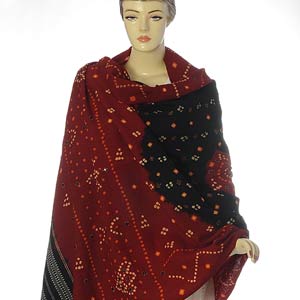
Bandhej Shawls of Rajasthan

HISTORY

Shawls were popular among Indians in variety of forms since ancient times. Kashmir valley of India is known for weaving shawl. The intricate embroidery and hand woven shawls from Kashmir are popular throughout Europe, Persia and other western countries.

RAJASTHANI SHAWLS

Tie and Die Shawls

Tie and die shawls in wool with beautiful embroidery and mirror work from craftsman of Rajasthan are famous world over. Tie and die is one of the most traditional method of printing shawls. These methods  involves dyeing only selected parts of cloth which yield multicolored designs and shades in a shawl.

Bandhej Shawls

Bandhej is also popular technique in which muslin, handloom or silk cloth as well as cotton is used for making bandhej shawl.  Starch, colours and ordinary threads are the raw material required for this type off shawls.

Earlier, vegetable dyes were used but now chemical dyes are becoming popular.

Wooden blocks are used for making attractive designs.
Tags: , , , , , , , , ,

Odhani – Symbolic Representation of Rajasthani Women’s Devotion and Culture

Odhani - Rajasthani Women Wear Representing a Rich Culture

Odhani - Rajasthani Women Wear Representing a Rich Culture

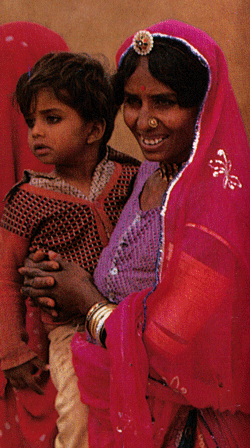
Odhani is the symbolic representation of Rajasthan clan culture.  In high class of rural areas, the tradition of wearing odhani is quite ancient. The rural women adapt it as an idol of prestige and self respect.

Odhani wearing is a custom and devotion of Rajasthani women towards their husband and culture. Odhani is worn in combination with ghagra on lower portion and upper kurti/kanchali.

The length of odhani is around 3 meters and breadth is approx 1.5 meters which hangs along with ghagra.

On ordinary course, cotton and voil odhani is worn while on special  occasions, gota  odhani  with many colours    is more prevalent.

Printing and Coloring

The art of coloring and bandez work used to be done by famous Mittoji of Jaipur and Tadthyub khan.

From eighteen century onwards, the clothes used to be printed, colored and tied up in various forms in the markets of Jaipur city in Rajasthan, some of them are::

POMCHA

In this type of odhani, there is rounded motifs of lotus. The base is of yellow, saffron or pink coloured in which lotus flowers are beautifully displaced.

LEHARIYA

It is made of five colours which is the basis of Rajasthani number system.

CHUNARI

There are many kinds of motifs in chunari  like birds,  animals, floral and geometrical patterns.

IMPORTANCE

Many folk songs of Rajasthan are based on odhani which are sung on special festivals.

LAVERI ODHANI

In Vishnoi and Charan class, Laveri odhani is worn.

Tags: , , , , , , , , , , , ,

Fire Dance of Rajasthan – Extremely Difficult Dance to Perform

Folk Dance in Rajasthan is a multimedia canvas which portrays human emotion better than anything else and it is found in almost limitless variations. In some dance performances, whole communities participate; others are enacted only by men or by women.

Fire Dance of Rajasthan

Fire Dance of Rajasthan

Fire Dance of Rajasthan

Fire Dance an extremely difficult dance to perform which is done by the Banjara community of Rajasthan.

Performing fire dance or also known as “Agni Nach” is one of the most thrilling experience for must of the tourists, it is a pure devotional dance of Bikaner region, producing a mixed feeling of awe and reverence.

Mind blowing Skills of Fire Dancers

In this dance, dancers jump on to the fire with the accompaniment of drum beats. These drumbeats give a tempo for the performance. This music gradually rises & sets a dance in a fast tempo.

If there is a divine protection, than the Jasnaiths of Bikaner and Churu district must be responsible for cornering for the hazard of people. These dancers perform on a large bed of flaming coals, their steps moving to the beat of drums that rises in crescendo till the dancers appear to be in a near hypnotic state, most interestingly none of them get burns or blister on their feets. These devotional performances are usually to be seen late on a winter’s night.

Tags: , , , , , , , , ,

Bhavai Dance of Rajasthan – Exemplary Skill To Balancing Acts With Dance.

Rajasthan has a very rich and varied cultural heritage. When it comes to art, Rajasthan has everything in abundance – be it folk dances, drama, music,  handicraft. As far as Rajasthani dances are concerned, they are not only spectacular but also very colorful.

Bhavai Dance  – Traditional Folk Dance of Rajasthan

bhavai-2

Bhawai or Bhavai is the traditional folk dance of Rajasthan and is one of the nail biting, suspenseful dances of the state.

Performed with great skill, it consists of veiled women dancers balancing up to seven or nine brass pitchers as they dance nimbly, pirouetting, and then swaying with the soles of their feet perched on top of a glass, or on the edge of a sword.

Balancing Precision of Rajasthani Dancers

The womenfolk of these tribes are used to such balancing precision due to their endeavor in the parched desert areas.

A number of such urns and pots are easily carried across a distance in this fashion by the Rajasthani women who transport water from the wells to their homes.

The accompaniment to the dance is provided by the male performers singing melodious songs and playing a number of musical instruments, which include pakhwaja, dholak, jhanjhar, sarangi and harmonium.

The History of  Bhavai Dance

Believed to have originated in the neighboring state of Gujarat, Bhawai was soon picked up and adapted by the local tribal men and women who imparted the dance a distinctive Rajasthani essence.

This genre of dance is performed by the female performers belonging to the Jat, Bhil, Raigar, Meena, Kumhar and Kalbelia communities of Rajasthan.

Tags: , , , , , , , , , ,

Kucchhi Ghodi Dance of Rajasthan – Where The Dancer Rides a Dummy Mare

Entertainers and performers have been an integral part of the culture of Rajasthan since ages. The royal families of Rajasthan have always been known to invite these performers at their courts. These talented artists traveled through the state, skillfully reciting and staging tales of both passion and valor.

Kucchhi Ghodi -  Famous Traditional Dance of Rajasthan

Kucchhi Ghodi Dance of Rajasthan

Kucchhi Ghodi Dance of Rajasthan

Kucchhi Ghodi is one of the most famous dance forms and an exemplary folk art form. It brings rustic charms of rural life in Rajasthan.

Kucchhi Ghodi also known as Dummy Horse Dance derives its name from the word Ghodi meaning ‘mare’. It is a sprightly dance where the men and women costumes resembling horses and pretend to be cavalry soldiers or horsed bandits.

Attractive Colorful Horse Dummy Attires

The costume from hip down is a wooden horse and the footwork is coordinated with the beats of the drums and flutes to resemble the trotting movements of the horse rider looks very attractive and certainly eye catching in every sense.

The fast paced dance generates a high spirited verve in the audience and the mock fights are egged on with cheers. The costumes of the performers are flashy, colorful and pleasing.

Mock-Fights and Brandishing of Swords

This vigorous dance, uses mock-fights and the brandishing of swords, nimble sidestepping and pirouetting to the music of fifes and drums.  In this dance, performers play the part of the brave bandits of the Shekhawati region of Rajasthan known as the Bavaria.

The dacoits of this region were the local Robin Hoods; they stole from the rich, oppressive landlords and distributed among the poor and the needy. Though denounced as criminals, these bandits were highly regarded by the common folk.

Tags: , , , , , , , , , , , , ,

Terah Talli Dance of Rajasthan – Most Devotional Form of Dance

Music and dance reverberates across the long golden stretches of sand of Rajasthan. It is also infused in the blood of its hearty people.

People in Rajasthan know how to celebrate life and this very fact is possibly reflected in its many folk song and dance forms of Rajasthan, which exude an innate earthy charm. Each region of Rajasthan flavors its own form of dance styles and performers to the state.

There are dances that follow a lineage of age old traditions, adhere to religious significance, display their daring attitude as well as complimenting various fairs and festivals and  Terah Talli is one of famous traditional dance of rajasthan

About Terah Talli Dance

Terah Taali Dance of Rajasthan

Terah Taali Dance of Rajasthan

Terah Taali dance is one of the most devotional form of dance, practiced by  Kamad community of Pokhran and Deedwana, to honour their folk hero, Baba Ramdeo.

It is termed as `Terahtali’ as  thirteen manjeeras ( little brass disc) which is used to create rhythm on which, the dancers move.

Most Fascinating Dance of Rajasthan

The dance began with the women, who sit on the floor and her body parts are tied with the manjeeras. These are tied on their wrists, elbows, waists, arms and a pair in their hands as well.

Their Mail accompanists sing and play the tandoora while the women create a strong rhythm with the manjeeras.

Balancing Act Spellbound the Viewers

She perform various arabesques, while doing this, and for more special effects and for capturing the public gaze, at times the women also balance numerous pots on their hands and hold a sword in their mouth. Their balancing act spellbinds the viewers.

Tags: , , , , , , , , , ,

Gair Dance of Rajasthan – An Inevitable Part of Rajasthani Culture

Gair is one of the most beautiful dances of Rajasthan. There are several variations to perform this picturesque dance, which is performed by both the men and women of Rajasthan.

Gair Dance of Rajasthan

Gair Dance of Rajasthan

Gair basically means circle or round. It is performed in a circle and that is how it has got its name.

Dance Attractions

The Bhil folk perform this dance by wearing colorful dresses and carrying swords, arrows and sticks.

The men wear long, pleated tunics that are open out into the full-length skirts. Firstly they move clockwise and then in anti-clockwise direction, with the tempo of striking sticks, so as to create the rhythm at the time of turning.

It is believed by the locals that this dance must have got some significance to war.

Swinging With the Beat

The sticks used in the dance are called Khanda. These sticks are very attractive and catches every eye. The sticks play vital role in the dance. They are very thin and does not carry much of weight and give a flare look.

The striking of the sticks gives the dance a vigorous character & a consistent tempo.

Sometimes, it is performed exclusively by men folk. At that time, a series of half-swirls make up a simpler version of the dance. Depending on the dancer’s ability & proficiency, it is danced with a series of intricate pattern steps.

Famous Dance  of  Bhil Community of Rajasthan

This dance is famous and performed mostly by all the communities but it is more famous of Bhil Community which is performed at the festival of Holi.  Some of its variations are the Dandi Gair found in the Marwar region and Geendad found in the Sehkhawati region of Rajasthan.

Tags: , , , , , , , , ,

Government Museum in Udaipur – Highlight the Rich Culture of Rajasthan

Udaipur is a majestic city that presents artifacts of the bygone age by the means of museums. These museums peep into the ancient times of the imperial city.

These museums are made to preserve the priceless objects of the noble kings. They offer a glimpse of the items that used to be the part of the regal lifestyle.

Udaipur Government is making constant efforts to preserve the artifacts of the previous age.

Government Museum in Udaipur

The Government Museum of Udaipur was originally located in Gulab Bagh and was called the Victoria Hall Museum. It has now been shifted to Karan Vilas Mahal within the precincts of the City Palace.

This museum highlights the the richness of the culture and heritage of Rajasthan all the way through its wide-ranging collection of excavated items, inscriptions, sculptures, paintings and handicrafts.

Attractions at the Museum

The inscriptions exhibited at the museum range from those of 2nd B.C to 17th century A.D. The antiquities of the plastic art of Mewar add to the attraction. The sculpture gallery, spread over a big hall, contains some unique and valuable specimens. Inscriptions exhibited at the museum date back to as early as 200 BC.

The most remarkable collection is that of more than nine thousand miniature paintings of Mewar School from the period of Maharana Jagat Singh (1628 – 1652 AD) to Maharana Swaroop Singh (1842 – 1861 AD).

It has a Natural History section called the Children Gallery which has models of animals like tiger, deer etc. The museum also has collection of colourful Mewari turbans.

Tags: , , , , , , , ,

Ghoomar – Famous Social Folk Dance of Rajasthan

Dance is an expression of human emotion as much as music and it is found in almost limitless.

The desert region of Rajasthan is famous for the color and vibrancy of its folk forms. Each region in Rajasthan has its own form of folk dance. Tribal areas have maintained these folk dances which are often performed for special occasions.

Ghoomar – Rajasthan’s Popular Folk Dance

Ghoomar - Popular Rajasthani Folk Dance

Ghoomar - Popular Rajasthani Folk Dance

The famous Ghoomar,  Rajasthan’s popular folk dance gets its name from ‘ghoomna’, the pirouetting which displays the spectacular colors of the flowing ‘ghaghara’, the long skirt of the Rajasthani women.

There is an amazing grace as the skirt flair slowly while the women folk twirl in circles, their faces covered with the help of the veil. Their measured steps and various graceful inclinations of body, beating palms or snapping fingers at particular cadences while singing some lilting songs.

Women from all age group participate in Ghoomer dance. At times this dance may continue for hours or the whole night. While dancing, the dancers move in a circular direction with clockwise and anti-clockwise steps. The performers sometimes unite their hands and even clap their hand in-between.

The performers move gracefully on the beat of the songs in synchronizing steps. As the tempo of the dance increases, the dancers swirl fleetly.

Traditional Ritual in Rajasthani People

The Ghoomar dance is the characteristic dance of the Bhils and a community dance of the Rajputs, also which only the women traditionally perform. It is considered as one of the traditional rituals among this community. So, on the occasion of marriage, a bride is expected to dance Ghoomar after being welcomed at her husband’s home.

Suggestions

If you happen to travel Rajasthan in festival season, don’t miss a ghoomar recital at the City Palace in Jaipur.

Tags: , , , , , , , , , , ,

Amber Archeological Museum – Home of Traditional Mughal Style Artifacts

Amber Fort in Jaipur is located 9 kilometer north west of Jaipur and was once the capital of the Minas. This fort set on the banks of Maota Lake, was founded by Raja Man Singh in 1592.

Some Architectural Marvels at Amber Fort

Some of the noteworthy architectural marvels in the complex are the ‘Diwan-E-Khas’, the ‘Sheesh Mahal’ and the ‘Jai Mandir’ with exquisite mirror work, the ‘Diwan-E-Aam’, the ‘Sukh Niwas’, the Shila Mata Temple and Kali temple and the well laid out garden the ‘Kesar Kyari’.

The fort is entered through the ‘Dil-e-Aaram’ Garden, laid out in the traditional Mughal style.

Amber Archeological Museum

Amber Archeological Museum

Amber Archeological Museum

The museum is located in the Dil-e-Aaram Gardens of Amber and was established way back in 1949. Prior to this, the excavated material from Rairh, Bairat, Sambhar, Nagar etc. and the sculptures and epigraphs collected from various sites in the erstwhile Jaipur State were housed at Vidyadhar Gardens in Purana Ghat.

In July 1949 the entire collection was transferred to Dil-e-Aaram Garden, a part of the old palace 1992 in this complex.

Different Sections of  Museum

The museum is divided into three sections :

  • Archaeological section, Which contains material recovered from excavations at Rairh, Bairat,Sambhar, Nagar, Pamvar, Bansi and Virat Nagar.
  • Sculpture section.
  • Epigraphy section.

There are two yupa Pillars (sacrificial posts) with inscriptions from Barnala,  Pratihar sculptures from Abhaneris (8th ccentury A.D.) and Terracotta from Rairh, Bairat, Sambhar and Nagar belonging to an earlyu historical perios.

The material is arranged in chronological sequence, making the visitor familiar with the contribution of Rajasthan in various fields of art through the ages.

Timing: 10 A.M to 5 P.M

Closed  On: Friday and Gazetted Holidays

Personal Note

I have visited this Museum 2-3 times. I find it really interesting as you can learn a lot about the history, culture and other aspects of civilization. There are not a huge number of articles but still a visit to the museum is helpful in knowing a lot of stuff particularly about Amber.

Tags: , , , , , , , , , , , , , , , ,