Posts Tagged art of rajasthan

Bhavai Dance of Rajasthan – Exemplary Skill To Balancing Acts With Dance.

Rajasthan has a very rich and varied cultural heritage. When it comes to art, Rajasthan has everything in abundance – be it folk dances, drama, music,  handicraft. As far as Rajasthani dances are concerned, they are not only spectacular but also very colorful.

Bhavai Dance  – Traditional Folk Dance of Rajasthan

bhavai-2

Bhawai or Bhavai is the traditional folk dance of Rajasthan and is one of the nail biting, suspenseful dances of the state.

Performed with great skill, it consists of veiled women dancers balancing up to seven or nine brass pitchers as they dance nimbly, pirouetting, and then swaying with the soles of their feet perched on top of a glass, or on the edge of a sword.

Balancing Precision of Rajasthani Dancers

The womenfolk of these tribes are used to such balancing precision due to their endeavor in the parched desert areas.

A number of such urns and pots are easily carried across a distance in this fashion by the Rajasthani women who transport water from the wells to their homes.

The accompaniment to the dance is provided by the male performers singing melodious songs and playing a number of musical instruments, which include pakhwaja, dholak, jhanjhar, sarangi and harmonium.

The History of  Bhavai Dance

Believed to have originated in the neighboring state of Gujarat, Bhawai was soon picked up and adapted by the local tribal men and women who imparted the dance a distinctive Rajasthani essence.

This genre of dance is performed by the female performers belonging to the Jat, Bhil, Raigar, Meena, Kumhar and Kalbelia communities of Rajasthan.

Tags: , , , , , , , , , ,

Kucchhi Ghodi Dance of Rajasthan – Where The Dancer Rides a Dummy Mare

Entertainers and performers have been an integral part of the culture of Rajasthan since ages. The royal families of Rajasthan have always been known to invite these performers at their courts. These talented artists traveled through the state, skillfully reciting and staging tales of both passion and valor.

Kucchhi Ghodi -  Famous Traditional Dance of Rajasthan

Kucchhi Ghodi Dance of Rajasthan

Kucchhi Ghodi Dance of Rajasthan

Kucchhi Ghodi is one of the most famous dance forms and an exemplary folk art form. It brings rustic charms of rural life in Rajasthan.

Kucchhi Ghodi also known as Dummy Horse Dance derives its name from the word Ghodi meaning ‘mare’. It is a sprightly dance where the men and women costumes resembling horses and pretend to be cavalry soldiers or horsed bandits.

Attractive Colorful Horse Dummy Attires

The costume from hip down is a wooden horse and the footwork is coordinated with the beats of the drums and flutes to resemble the trotting movements of the horse rider looks very attractive and certainly eye catching in every sense.

The fast paced dance generates a high spirited verve in the audience and the mock fights are egged on with cheers. The costumes of the performers are flashy, colorful and pleasing.

Mock-Fights and Brandishing of Swords

This vigorous dance, uses mock-fights and the brandishing of swords, nimble sidestepping and pirouetting to the music of fifes and drums.  In this dance, performers play the part of the brave bandits of the Shekhawati region of Rajasthan known as the Bavaria.

The dacoits of this region were the local Robin Hoods; they stole from the rich, oppressive landlords and distributed among the poor and the needy. Though denounced as criminals, these bandits were highly regarded by the common folk.

Tags: , , , , , , , , , , , , ,

Terah Talli Dance of Rajasthan – Most Devotional Form of Dance

Music and dance reverberates across the long golden stretches of sand of Rajasthan. It is also infused in the blood of its hearty people.

People in Rajasthan know how to celebrate life and this very fact is possibly reflected in its many folk song and dance forms of Rajasthan, which exude an innate earthy charm. Each region of Rajasthan flavors its own form of dance styles and performers to the state.

There are dances that follow a lineage of age old traditions, adhere to religious significance, display their daring attitude as well as complimenting various fairs and festivals and  Terah Talli is one of famous traditional dance of rajasthan

About Terah Talli Dance

Terah Taali Dance of Rajasthan

Terah Taali Dance of Rajasthan

Terah Taali dance is one of the most devotional form of dance, practiced by  Kamad community of Pokhran and Deedwana, to honour their folk hero, Baba Ramdeo.

It is termed as `Terahtali’ as  thirteen manjeeras ( little brass disc) which is used to create rhythm on which, the dancers move.

Most Fascinating Dance of Rajasthan

The dance began with the women, who sit on the floor and her body parts are tied with the manjeeras. These are tied on their wrists, elbows, waists, arms and a pair in their hands as well.

Their Mail accompanists sing and play the tandoora while the women create a strong rhythm with the manjeeras.

Balancing Act Spellbound the Viewers

She perform various arabesques, while doing this, and for more special effects and for capturing the public gaze, at times the women also balance numerous pots on their hands and hold a sword in their mouth. Their balancing act spellbinds the viewers.

Tags: , , , , , , , , , ,

Gair Dance of Rajasthan – An Inevitable Part of Rajasthani Culture

Gair is one of the most beautiful dances of Rajasthan. There are several variations to perform this picturesque dance, which is performed by both the men and women of Rajasthan.

Gair Dance of Rajasthan

Gair Dance of Rajasthan

Gair basically means circle or round. It is performed in a circle and that is how it has got its name.

Dance Attractions

The Bhil folk perform this dance by wearing colorful dresses and carrying swords, arrows and sticks.

The men wear long, pleated tunics that are open out into the full-length skirts. Firstly they move clockwise and then in anti-clockwise direction, with the tempo of striking sticks, so as to create the rhythm at the time of turning.

It is believed by the locals that this dance must have got some significance to war.

Swinging With the Beat

The sticks used in the dance are called Khanda. These sticks are very attractive and catches every eye. The sticks play vital role in the dance. They are very thin and does not carry much of weight and give a flare look.

The striking of the sticks gives the dance a vigorous character & a consistent tempo.

Sometimes, it is performed exclusively by men folk. At that time, a series of half-swirls make up a simpler version of the dance. Depending on the dancer’s ability & proficiency, it is danced with a series of intricate pattern steps.

Famous Dance  of  Bhil Community of Rajasthan

This dance is famous and performed mostly by all the communities but it is more famous of Bhil Community which is performed at the festival of Holi.  Some of its variations are the Dandi Gair found in the Marwar region and Geendad found in the Sehkhawati region of Rajasthan.

Tags: , , , , , , , , ,

Shilpgram Museum, Udaipur – An Ethnographic Museum which Gives a Glimpse of Tribal life of Rajasthan

 Huts at Shilpgram Museum in Udaipur

Huts at Shilpgram Museum in Udaipur

Shilpgram Museum is located near Fateh Sagar, just 6 kms from the City Palace in Udaipur.  It is basically a  village which is created with 26 replica huts. 

This museum has a wide collection of folk art and covers 70 acres of land and considered to be an ethnographic museum which portrays the West Zone folk and tribal people’s lifestyles.

Shilpgram means the “Craftsmen’s Village”

The term Shilpgram literally means the “Craftsmen’s Village”. The tremendous diversities in craft, art and culture between various states in India is portrayed by Shilpgram Museum, Udaipur. The strength of this ethnic village are it’s exquisite terracotta works. 

A Potter Showing How to Do Pottery in Shilpgram at Udaipur

A Potter Showing How to Do Pottery in Shilpgram at Udaipur

The terracotta work done here is mainly in dark red and dark brown sand material along with the artistic wooden carvings. All this makes Shilpgram Museum one of the major tourist attraction spot in udaipur.

Initally, the Shilpgram Museum used to display only the simple objects of daily use, which symbolized the sense of wonder and aesthetics in the rural and tribal life. Then a Crafts Bazaar was built where the visitors could purchase traditional crafts from that zone. This Craft Bazaar was made in the style of a traditional haat.

Shilpgram Organizes  Crafts Fair Every Year

Shilpgram  also hosts crafts fair every year in winter season which is one of the biggest in India, people from different states in the country hold their stalls showcasing their art and crafts work.

Tags: , , , , , , , , , , , ,

Amber Archeological Museum – Home of Traditional Mughal Style Artifacts

Amber Fort in Jaipur is located 9 kilometer north west of Jaipur and was once the capital of the Minas. This fort set on the banks of Maota Lake, was founded by Raja Man Singh in 1592.

Some Architectural Marvels at Amber Fort

Some of the noteworthy architectural marvels in the complex are the ‘Diwan-E-Khas’, the ‘Sheesh Mahal’ and the ‘Jai Mandir’ with exquisite mirror work, the ‘Diwan-E-Aam’, the ‘Sukh Niwas’, the Shila Mata Temple and Kali temple and the well laid out garden the ‘Kesar Kyari’.

The fort is entered through the ‘Dil-e-Aaram’ Garden, laid out in the traditional Mughal style.

Amber Archeological Museum

Amber Archeological Museum

Amber Archeological Museum

The museum is located in the Dil-e-Aaram Gardens of Amber and was established way back in 1949. Prior to this, the excavated material from Rairh, Bairat, Sambhar, Nagar etc. and the sculptures and epigraphs collected from various sites in the erstwhile Jaipur State were housed at Vidyadhar Gardens in Purana Ghat.

In July 1949 the entire collection was transferred to Dil-e-Aaram Garden, a part of the old palace 1992 in this complex.

Different Sections of  Museum

The museum is divided into three sections :

  • Archaeological section, Which contains material recovered from excavations at Rairh, Bairat,Sambhar, Nagar, Pamvar, Bansi and Virat Nagar.
  • Sculpture section.
  • Epigraphy section.

There are two yupa Pillars (sacrificial posts) with inscriptions from Barnala,  Pratihar sculptures from Abhaneris (8th ccentury A.D.) and Terracotta from Rairh, Bairat, Sambhar and Nagar belonging to an earlyu historical perios.

The material is arranged in chronological sequence, making the visitor familiar with the contribution of Rajasthan in various fields of art through the ages.

Timing: 10 A.M to 5 P.M

Closed  On: Friday and Gazetted Holidays

Personal Note

I have visited this Museum 2-3 times. I find it really interesting as you can learn a lot about the history, culture and other aspects of civilization. There are not a huge number of articles but still a visit to the museum is helpful in knowing a lot of stuff particularly about Amber.

Tags: , , , , , , , , , , , , , , , ,

Alwar Goverment Museum – Rich Repository of Arts and Artifacts of Heritage Rajasthan

Former Rulers of Alwar - Owner of the Collections at Government Museum

Former Rulers of Alwar - Owner of the Collections at Government Museum

Rajasthan is culturally rich and has extensive tradition in art and culture, which reflects Indian way life. Each region of Rajasthan has different and diverse form of art and culture to present to its visitors.

About Alwar Government Museum

Foremost amongst the Tourist Attractions in Alwar is the Government Museum, a rich repository of arts and artifacts that well reflect the cultural heritage of this royal land of Rajasthan. The Vinay Vilas Mahal in the City Palace of Alwar is home to this fabulous museum.

Entire Collection of the Museum Belongs to Royal family

This Museum  has a unique collection of arms, bidri work, lacquered and ivory work, musical instruments, stuffed animals, beautiful brass and pottery works from Jaipur, Multan, Bengal and Ceylon, miniature paintings and Persian and Sanskrit manuscripts.

Entire collection of the museum came from the royal family, which includes 234 sculptures, 11 inscriptions, 9702 coins, 35 metal objects, 2565 paintings & manuscripts, 2270 arms & weapons and 1809 objects of local art, crafts and musical instruments.

Costumes and Clothes at Display in Alwar Government Museum

Costumes and Clothes at Display in Alwar Government Museum

Different Sections of Museum

The museum is divided into three major sections, each housed in a big hall.

The first section contains various archaeological finds chiefly sculptures and inscriptions from the region. Items presented by the ruler of the former Alwar state includes mounted skins of wild animals like tiger, leopard and lion shot by them during their local and foreign excursions.

The second section is the most important one as it contains various manuscripts in Persian including Gulistan of S’adi as well as marvellous paintings of Mughal and Rajput Schools. The paintings have been further divided into various sub-styles.

The third section of the museum contains the armory of State rulers. Various kinds of shields, swords, pistols, rifles, daggers and other items are on display.

Timing : 10 A.M to 4.30PM
Closed On: Friday and Gazetted Holidays

Tags: , , , , , , , , , , , , , , , ,

Museums and Art Galleries in Rajasthan – A Peep into Art, Culture and Heritage

An Inside View of a Palace in Rajasthan - Now a Part of Museum

An Inside View of a Palace in Rajasthan - Now a Part of Museum

Rajasthan is the land of massive forts, sprawling palaces and intricately carved temples of colorful tribes. Its the home to brave warriors, unrivaled form of arts and crafts, unique dance and music traditions. The desert state of India is changing at a rapid pace in the recent times.

The vast network of Museums in large and small towns, archaeological sites and art galleries in the palaces of erstwhile rulers of old states help to preserve this great heritage for posterity.

Explore History and Culture of Rajasthan

There are numerous monuments and traditional heritage buildings that have a lot of historical importance. These monument houses the traditional arts and craft galleries that are quite famous and have a significant place amongst the antique. All these historical facts and evidences are stored in the repository in the museums and galleries in Rajasthan.

These museums and galleries are the known to preserve the stories of courage and chivalry of Maharajas and Queens.

The Maharajas and their opulent lifestyle and lavish way of living can be witnessed in a limited span of time in these beautiful art galleries. The tourists who are keen in learning more about the culture and heritage of Rajasthan may well get to know about the regal families and their influence subject like how the Rajas and their queens dressed up, what jewelleries and accessories they adorned and what were the thrones like on which they sat.

Museums and Galleries also house a lot of other items that include metalware, decorative wares, miniature portraits, sculptures, traditional Rajasthani paintings, Rajasthani costumes, pottery, brassware and inlaid wood carvings. All these craft works are simply s delight to the eyes.

There are many museums and galleries in Rajasthan that are the abode of the treasured and well preserved antique art and craft work. These museums and galleries are located in the various cities across the state and offer a quick access to the various other places of tourist interests in Rajasthan.

Decorative Gates - Entrance to Art Galleries and Museums of Rajasthan

Decorative Gates - Entrance to Art Galleries and Museums of Rajasthan

Famous Museums and Art Galleries of  Rajasthan

  • City Palace Museum, Jaipur
  • Albert Hall Museum, Jaipur
  • Amer Archaeological Museum, Jaipur
  • Government Museum, Ajmer
  • Mehrangarh Museum, Jodhpur
  • Ganga Golden Jubilee Museum, Junagarh-Bikaner
  • Bhartiya Lok Kala Museum, Udaipur
  • Umaid Bhawan Museum, Udaipur

Tags: , , , , , , , , , , , ,

Dolls and Toys Art of Rajasthan – Handmade Lovely Toys for Children

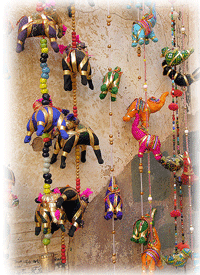
Handmade Toys and Dolls Hanging at a Store in Rajasthani Handicrafts Market

Handmade Toys and Dolls Hanging at a Store in Rajasthani Handicrafts Market

Handicrafts making in Rajasthan covers a wide array of products. The tradition of crafting toys and dolls actually dates back to the pre-historic periods in Rajasthan. Excavations at different regions of Rajasthan have come up with handmade toy carts, figures of human beings or animals, birds and even religious figurines.

Toys and dolls in Rajasthan are crafted primarily from wood, clay, stones and other natural and easily available materials. They not only cater to the dreams of a child but they are also associated with religious rituals and festivals. Even today, there are some religious festivals like Janmashtami, which include rituals involving handmade toys and dolls.

The little cosmetic box called Shringardani is traditionally given to a bride on her wedding day and is a toy for children as well.

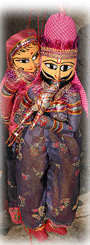
The puppets of Rajasthan are very charming due to their exaggerated eyes and lips and colourful dresses. These Puppets  are the obvious expression of the human psyche, social and cultural practices, demo graphical differences and as such is a very important part of traditional knowledge and wisdom, passed on through generations.

Famous Destination to Shop Toys and Dolls in Rajasthan

The wooden toys are made in Udaipur and Soft tinted clay toys made in Merta in Nagaur are very popular among tourists. It is also famous for imitation dry fruit which bear a striking resemblance to the real fruits.

Katputli (Puppet) Toys Singing Folk Tales and Dancing in Rajasthan Villages

Katputli (Puppet) Toys Singing Folk Tales and Dancing in Rajasthan Villages

Bassi in Chittorgarh district is another noted centre for wooden toys where the entire village is engaged in wood-carving and in making wooden products.

Jaipur too is very well known for cloth dolls and toys which are generally dyed and stuffed with waste material. These toys are beautifully decorated with colourful paper with expression writ large on their faces.

Dolls Industry in Rajasthan

Rajasthani Dolls Industry is engaged in the manufacture and export of unique and high quality handmade dolls known as ‘copa‘ dolls, traditional puppets, custom made dolls, puppets and handicraft items.

Copa dolls are eco-friendly and are made out of cotton cloth & stuffing. They are embellished with beads & gotta, extending a rich traditional look. These dolls & puppets are available in variety of designs, sizes, colour combinations, themes etc.

Tags: , , , , , , , , , , , ,

Leather Art of Rajasthan – Rajasthani Mojadi, Kuppies and Bags

Leather Items Hanging at a Store in popular Shopping Market of Rajasthan

Leather Items Hanging at a Store in popular Shopping Market of Rajasthan

Rajasthan with a treasure of history, picturesque architecture and bewitching landscape is an unparalleled destination on the tourist map of India. A destination that defies definition in shape of Rajasthan Art.

Leatherware of Rajasthan

Leather was an indispensable item for the great warriors of Rajasthan in the form of leather saddlery, shoes, shields and water bottles. Today the warriors no longer ride out of battle but the art of leather embroidery remains in all its delicate perfection.

The leather is embroidered, punched, studded and stitched in various designs. Designs include sequin work and tassels, brass studs of machine – stitched motifs depending on the region in which the leather articles is produced.

Rajasthani Mojadi (Jutti)

One of the most popular leather articles of Rajasthan is the Mojadi or Jutti- an attractive foot ware item. Mojadi or Jootis are made all over Rajasthan, the most refined work is found in Jaipur and Jodhpur to produce premium quality Jootis.

Leather Motifs (Juttis) and Bags on Show

Leather Mojadi (Juttis) and Bags on Show

The Jooties reflect the unique style of every district they belong to. It is amazing how the leather is beaten, tanned and dyed and put to the best use. The leather is punched and gouged to create patterns, studded, sequined and even embroidered with woolen motifs

They are incredibly sturdy and long lasting and although somewhat uncomfortable for the first few days, they fit like a glove after they are worn for some time.

Rajasthani Decorative Art – Kuppies

As decorative art, the water bottles of softened camel hide known as ‘kuppies’ are a specialty of Bikaner.  It is known for its painted perfume bottles, water jugs, vases and lampshades made from camel hide. Today, designer hand – bags with graphic embroideries also make a good buy.

The leather work of Rajasthan is interestingly a joint effort of the local men and women. While the men do the tanning, cutting and stitching, the women do the embroidery and ornamentation.

Tags: , , , , , , , , , , , ,