Posts Tagged rajasthani art

The Murmuria Haveli in Mandawa, Rajasthan – Exemplary Rajasthani Art and Culture

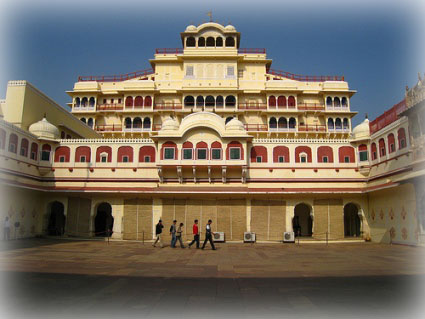
The Murmuria Haveli in Mandawa Region  is counted amongst some of the most beautiful havelis  of Rajasthan. It was built around 1850 by a wealthy merchant Rajput.

Mumuria Haveli in Mandawa

Mumuria Haveli in Mandawa

Nice example of Rajasthani Art

Its a nice example of Rajasthani art that existed during its golden years.

The haveli is richly decorated with beautiful paintings and portraits.  The paintings of trains, cars, George V, and Venice were executed on the walls of this haveli during the 1930s by Balu Ram, one of the last working artists of the region.

These paintings in the Murmuria Haveli in Mandawa are considered to be one of the most beautiful pictures and it attracts tourists from all over.

Unique Themed Pictures Adorns the Haveli

There are pictures like Lord Krishna with his cows in the English courtyard and a young Nehru on a horseback, holding the national flag.

This haveli uses a unique theme blending the East with the West.  The haveli also features a long frieze depicting a train with a crow flying above the engine and much activity at the railway crossing.
Tags: , , , , , , , , ,

Two Important Aspects of Rajasthani Music And Songs – Ragas And Tals

Music and dance are two very important aspects of the folklore of any region. In Rajasthan, songs play a dominant role in the life of the people.

The striking feature of Rajasthani music and dance is that there is great variety. In fact, nothing much has changed since the time of their inception, probably a thousand years back. The music and dance are rooted in tradition.

Today we are writing about Ragas and Tals which is used in Rajasthani Songs

The Ragas

The raga’s most widely used in Rajasthani folk songs are Bilawal, Kafi, Desh, Khamaj and Peelu.  Some in their pure forms and others in combination. Many folk songs are tuned in Bilawal and Kafi. The folk songs of Rajasthan have maintained the elements of Indian classical music despite the fact that they are freely composed and sung, knowing no rigid rules.

Classicism in music have been framing and improving its form with the help of folk-songs. The famous Mand style singing in Rajasthan is a typical example. This style is very important in folk-songs and it is well recognised in classical circles also. Mand is neither accepted as a full-fledged raga nor is it reckoned among the freely rendered folk songs. Mand goes very near the thumri or the ghazal. Mand is the exclusive contribution of Rajasthani folklore to the classical music of India.


The Tal

In Indian music, Tal unites the listener with the singer in the rhythm and ecstasy of music. The various ragas and raginis are rendered in accordance with the tempo of the tal differentiated by means of matras ranging from six to sixteen. No classical music composition can be rendered without tal. In Hindustani classical music, the Tal is  provided by the tabla, pakhawaj or mridang.

Folk music also requires tal for its effective rendering and the instruments used for it are many including the dhol (drum), dholak, nagara, majira, chang and daf.

Rajasthani folk-songs make use of six, seven or eight matras of tal on the dholak, tabla and nagara. The Kaharwa tal is generally played on the daf or the chang. The musical instruments used with folk song help to keep the tal which occupies in music, the same place as grammar does in language.

Tags: , , , , , , , , ,

Rajasthani Folk Songs – Composed Of All Kinds of Occasions And Moods

Rajasthan offers soulful, unadulterated, pure folk songs that can be heard throughout India. The folk songs of Rajasthan have been composed for all kinds of occasions and moods. They are suitable for the celebration of love, separation, union, familial ties, marriage and even death.

rajasthani folk songs

These folk songs are sung by different communities residing in the state of Rajasthan. These songs were written years back but have been carried forward by various generations through the last few years.

The culture and traditions of the Rajasthani people are very well depicted through the various Rajasthani songs.

Famous Folk Songs of Rajasthan

Songs sung by Rajasthnai People, are mostly about water and is cantered around the well, the style is called Panihari. Gorbund is a famous folk song which depicts the process of preparing a decorative string for a camel. The other folk songs are ‘Indhani’, ‘Lawarji’, ‘Jallo’, ‘Hichaki’, ‘Olyun’, ‘Sapno’, ‘Kurjan’ etc.

Songs, laden with religious flavor, are sometimes folk idioms of Saints, Surdas, Kabirdas, Meerabai and others. Bhajans and Banis are very popular among the Harijans, Chamars, Bhanghis, Balais and Rahgars and mostly heard in night-long gatherings.

In the ballad tradition, minstrels sing and narrate heroic tales of folk heroes like Tejaji, Gogaji and Ramdeoji and even of legendary lovers and their tragedies their tragedies.

Different Type of Folk Songs of Rajasthan

  • The Ragas
  • Maand Folk Songs
  • Peepli and Nihalde
  • Saajhi and Ghudla

Tags: , , , , , , , ,

Some Popular String Musical Instruments of Rajasthan – Kamaycha, Mochng and Ektaara

The music of Rajasthan has its own unique flavor which has kept the five thousand year old traditions of the state alive.  String instruments like Sarangi, Ektara, Morchang, Kamayacha, Rawanhatta are an integral part of music in Rajasthan along with dholaki.

In previous post we have already discussed Sarangi,  Rawanhathha and different types of Sarangi. Today we will post about some of the other popular string instruments in Rajasthan.

Kamayacha Musical Instrument

Kamayacha Musical Instrument

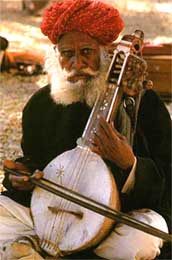
Kamaycha

Kamayacha is an extremely elegant instrument of the professional singing community of Mangniars all over Marwar region of Rajasthan. It has a large circular belly covered with parchment, a peg system and a finger board.

It has three main strings of gut, besides nine supplementary and four sympathetic steel strings all passing through a broad bridge. The long wooden curved bow of horse-tail hair moving on all the strings is characteristic of this instrument.

Morchang

The morchang resembles a jew’s-harp. The plaintive, melancholic twang of the morchang adds a desolate dimension to songs of Marwar.

Ektaara

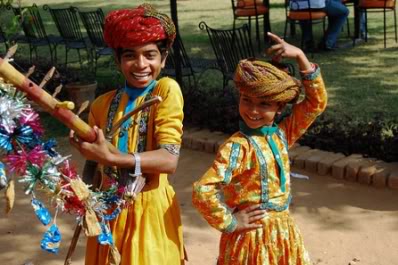
The Ektaara is also a single string instrument, but it is mounted on the belly of a gourd attached to a body made of bamboo.

The Galaleng Jogis of Dungarpur and Banswara have twin gourd-ed Kendru, which appears akin to the ancient Kinnari Veena. It is often called the Keengri in Rajasthan literature.

The Chautara, also called the Tandoora or Nissan , is a popular five stringed drone and beat instrument, it is used as an accompaniment to devotional music and for the Terathali dance of Rajasthan.

Tags: , , , , , , , , ,

String Instruments in Rajasthan – Sarangi, Ravanhatta and Other Versions

The melody of Rajasthan is hidden in the primitive looking instruments of various variety used by the experts musicians of Rajasthan during the time of the fairs, festivals and special occasion.

Today we are writing about some famous String Instruments in Rajasthan

Sarangi – Famous String Instrument in Rajasthan

Sarangi - Famous string instrument of Rajasthan

Sarangi - Famous string instrument of Rajasthan

One of the well-known string instrument of Rajasthan is Sarangi. This is a multi-stringed instrument that is played by using a bow drawn across the strings and running of fingers on the strings. The modern guitars have probably been modeled upon these.

The bridge of the sarangi supports the huge pressure of approximately 40 strings. Three of the strings mainly the comparatively thick, tight and short ones are bowed with a heavy horsehair bow and stopped tones svaras of the raga. A properly tuned sarangi will hum and buzz like a bee-hive, with tones played on any of the main strings eliciting echo-like resonances.

Rawanhathha

Ravanhatta is also a kind of sarangi. The Rawanhathha of the Thori or Nayak Bhopas is probably the earliest instrument played with a bow, and this humble instrument could well be the precursor of the violin.

It has two main strings and a variable number of supporting strings, with a belly of half coconut shell and a body of bamboo. The bow has ghungroos (bells) attached to it. The music is staccato and accompained by the syncopated singing of the Bhopa and the Bhopan.

Different Versions of Sarangi

The Jogis of Abu Road area use a smaller version of the Rawanhathha which has its two main strings tuned to the ‘Sa’ of the Indian octave and a third of steel to ‘Pa’.

The Langas use the Sindhi sarangi. It is made up of four main wires, seven jharas and seventeen tarafs. Others members of the family are the Gujratan, Jogia and Dhani sarangis. The Surinda, favourite of the Manganiyars, is a small sarangi. The Chikara, used by the Meos and Jogis of Mewat is a replica of the Sarangi.

Tags: , , , , , , , , ,

Rajathani Folk Musical Instruments – Makes The Traditional Music More Melodious and Delightful

The haunting melodies of Rajasthan are born from a variety of delightfully primitive looking instruments that have the power of the captivate your senses and transport you to the golden realm of the royal state of Rajasthan.

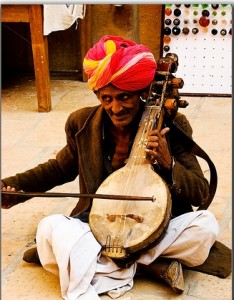
An Old Playing a Rajasthani Sarangi

An Old Playing a Rajasthani Sarangi

The musical instruments are essential in making the traditional music of rajasthan more melodious.  Simple instruments are used with the songs and these are played with such expertise that the songs sound incomplete without them. Some of these instruments are self-sufficient. They are played individually i.e. without any lyrics.

The vast array of Rajasthani folk instruments is made ingeniously from a variety of materials.  Shells of dried gourds of all shapes and sizes are used forgoes stems or bamboos segments for flutes and baked clay pots for drums. Conch shells are blown to produce full, resonant sounds, sticks create a rasping rhythms and ghungroos (brass bells) jingle on waists and ankles.

Type of Musical Instruments in Rajasthan

The Rajasthani musical instruments can be classified into

  • Percussion Instruments,
  • Wind Instruments
  • Autophonic instruments
  • String Instruments

The Sindhi Sarangi, the Gujratan sarangi, the jogiya sarangi, srimandal  and the rawanhathha are the important stringed instruments used in Rajasthan.

Other stringed instruments include the revaj, dusaka , apang, Dilruba  and the five-stringed tandoora.

Tags: , , , , , , , , , , ,

Kathputli Dance – Ancient and Popular Form of Folk Entertainment in Rajasthan

Kathputli Dance means the dances of puppets.  This  Puppet dance based on popular legends are performed by skilled puppeteers. Displaying his skill in making the puppets’ act and dance, the puppeteer is accompanied by a woman, usually his wife, who plays the dholak, or drum and sings the ballad.

Kathputli Dance Attractions

Puppet Dance of Rajasthan

Puppet Dance of Rajasthan

In the puppet dance, there are a number of wooden dummy dolls that are dressed up in bright and color attires. These puppets are attached with strings that the puppeteer uses to move them around. A miniature stage is set up with the help of a cot that is laid by length. The puppeteer tacks his puppets over a rope joined to the upper legs of the cots.

The cots are covered with sheets in order to conceal the puppeteer from the view of the public. He moves the jointed limbs of the puppets with the help of strings attached to each of them.

Different Puppetry Shows in Rajasthan

The puppets in Rajasthan are one of the popular sources of entertainment in the state.  It is an ancient and popular form of folk entertainment in Rajasthan and considered as the most expressive of all theatrical forms.

There are various types of puppetry shows performed in Rajasthan.  Some are glove puppets, some are rod puppets, some puppetry shows use string and rod puppets and last but not the least is the shadow puppets.

Puppetry – Traditional Occupation of People in Marwar

The art of puppetry is practiced by a community of agricultural laborers of Rajasthan. Known as the Bhats, these people have been associated with Rajasthani string puppetry to carry forward their traditional occupation.

Though they belong, originally, to the Nagaur area in the Marwar region, they travel all through the countryside to exhibit their skills. Also known by the name of the “kathputliwalas”, they usually perform the puppet shows during the late evenings.

Tags: , , , , , , , , , , , ,

Maharaja Sawai Mansingh Museum in Jaipur – Excellent Combination of the Mughal and Rajasthani Style of Architecture

Maharaja Sawai Mansingh Museum in City Palace Jaipur

Maharaja Sawai Mansingh Museum in City Palace Jaipur

Maharaja Sawai Mansingh Museum is located within the City Palace complex and nestled amidst old buildings, temples and the palace quarters. This museum was founded in 1959.

The exhibits consist of the ancestral collections built up by the successive rulers of  Jaipur. A small selection of paintings, manuscripts, maps, carpets, textiles, costumes, weapons and armours was displayed in the Pothikhana (library) and the Silehkhana or armoury (both of these in their present form, were established in 1952) of the palace.

Different Exhibits of Museum

Sileh Khana Armoury Gallery

One of the richest collection of the Indian weapons in the world is displayed here in a most artistic and symbolic manner.

Amongst the important weapons displayed here are: Heavy Khanda(sword) probably of Raja Man Singh I, swords of Mughal emperors Jehangir and Shahjahan, night polo ball, Sawai Jai Singh’s pistol and matchlock guns of 17th century probably cast at Jaigarh fort, Amber.

Rekhla(miniature cannon), Jujarba(Camel Guns), lances, Katars(daggers), bows and arrows, Maces and Gunpowder flasks, Howdahs(Elephants seat used during hunting) are also on display.

Art Gallery

The Art Gallery is housed in the Diwan-i-Aam constructed for holding important State functions.

A variety of objects-miniature paintings, illustrated manuscripts, decorated bookcovers, palm-leaf and Sanchipat manuscripts, old printed books, gigantic Mughal carpets, gold and silver Takhis-Rawan (movable throne), covered Ambabadis and open Howdahs, palanquins and carriages with richly embroidered velvet coverings are displayed in this gallery.

There are rare bird and animal studies by Ustad Mansur, court scenes, battle scenes, portraits and mythological paintings by famous Mughal painters can be shown here.

Textile Gallery

The royal costumes are displayed in the first floor of the Mubarak Mahal. The enormous Atamsukh, a beautiful rich Banaras brocade quilted cloak of Maharaja Sawai Madho Singh I is an object of amazement.

Baggi Khana

There are many Chariots and Coaches of or say baggies are displayed. The most interesting amongst these are the 19th century European cab adapted to Indian conditions and the Thakurji ka Rath.

The two silver jars  the largest silver object in the world, as per entry in the Guinness Book of World record made in The City Palace in 1896 weighing 345 kg each and taken to England by Maharaja Sawai Madho Singh II filed with Ganges water in 1902 can be seen in Sarvatobhadra.

Tags: , , , , , , , , , , , ,

City Palace Museum in Udaipur – Perfect Destination To Trace The Relics of The Bygone Era

The huge City Palace, towering over the Pichola Lake, is the largest palace  in Rajasthan. Construction of this palace was started by Maharana Udai Singh, the city’s founder. The main part of the palace is now preserved as a museum with a large and varied collection.

City Palace Museum Also Known as  ” Pratap Museum”

City Palace Museum in Udaipur

City Palace Museum in Udaipur

Located inside the complex of City Palace, this museum is also known as Pratap Museum. The name Pratap Museum was given because the museum holds dear the armor of the brave and gallant Maharana Pratap and also possesses the drums and bugles of the great ruler Rana Sanga.

As you enter the City Palace, the straight way will take you to this museum of artifacts. The entrance gate of the City Museum is known as Ganesh Deori, which means “Door of Lord Ganesha”.

It was established in 1890 and is one of the earliest museums of the Rajasthan.

Priceless Possessions of Detailed Rajasthani Art

The museum has priceless possessions of the former age like antique paintings of Mewar and detailed Rajasthani art. You will find an unusual assortment of coins, sculptures, inscriptions, portraits and wall-paintings here.

It also displays the turban of Khurram, who was popularly known as Emperor ShahJahan. The turban still depicts the friendship that survived between ShahJahan and Maharana Khazan Singh.

Different Sections of The Museum

The museum is divided into several pavilions and halls. Every pavilion has a distinct theme of its own.

  • Mor Chowk and Manka Mahal

The museum includes the Mor Chowk with its beautiful peacocks in mosaics. The Manka (Ruby) Mahal has glass and porcelain figures while Krishna Vilas has a remarkable collection of miniatures.

  • Bari Mahal,  Zenana Mahal and Moti Mahal

In the Bari Mahal, there is a fine central garden. Zenana Mahal is the main place where you can see arms and armor, paintings and photographs, majestic insignia, processional accouterments and various other objects that reveals the royal legacy and conventions of the Maharanas of Mewar and Sisodia..

The Moti Mahal has beautiful mirror work and the Chini Mahal is covered in ornamental tiles.

The city museum opens between 10-4:30 and is closed on fridays and gazetted holidays.

Tags: , , , , , , , , , , , , ,

Mehndi on Hands – An Ancient Folk Art of Rajasthan

Designer Mehndi on Hands of a bride in Rajasthan

Designer Mehndi on Hands of a bride in Rajasthan

Mehndi, also known as henna, is a temporary art of skin decoration. In Rajasthan,  Mehndi is a very ancient folk art, which signifies life and prosperity at the time of various special occasions.

The use of mehndi designs on the palms and feet is symbolic of welfare, artistic taste and religious attitude. There is hardly a function or festival in Rajasthan when women do not apply mehndi.

Professional Mehndi Designers Creating Wonderful Designs on a hand

Mehandi – Sign of Bringing Good Fortune in Life

This is believed to be very auspicious and sign of bringing good fortune in life, thus it is applied on hands and feet at the time of special and holy occasions such as marriage, festivals, engagements etc. The color of Mehndi symbolizes the color of life and prosperity.

In Indian marriages, especially in Rajasthan, a special night is celebrated before the day of marriage in which mehndi is designed on the palms of bridegroom and it is followed by some colorful dance and music.

Mehndi has a special role during Karva Chauth, celebrated mostly in North India in the month of October. On this occasion, women take the day off, apply mehndi, dress in their wedding clothes and fast for the well-being of their husbands until they see the moon at night.

Although the art is used primarily for decoration today, the use of mehndi is expressive of a distinct culture and bond that is created between women on such occasions.

Design Patters of Mehndi (Heena) - Drawings

Design Patters of Mehndi (Heena) - Drawings

Patterns and Designs of Mehndi

Although there are large variety of patterns, the one called chowk- literally meaning a courtyard, is amongst the most popular with the womenfolk.

There are different forms of designs and patterns used at the time of various festive occasions. Thus, there is a specific design of chowk for the Gangaur – dance festival, another for the Teej, and yet another for Holi and other festivals. Amongst other favorites are chopper design, representation of a game, played by throwing dice and is symbolic of love.

Mehndi – Ancient Herb of Grace and Healing

Mehndi is not only famous as a product of ornamentation but also an ancient herb of grace and healing. It acts as a valuable medication and its effect is not less than a miracle.

It protects the body from fungi and bacteria if it is applied on the skin. Not only this but it is also capable to lower down the body temperature in fever, burning feet, and violent temper.

Tags: , , , , , , , , , , , , ,