Posts Tagged rajasthani musical instruments

Algoza, Satara, Murla, Nad, Poongi and Shehnai – The Wind Instruments of Rajasthan

A wind instrument is a musical instrument that contains some type of resonator in which a column of air is set into vibration by the player blowing into a mouthpiece set at the end of the resonator.  Prominent in the music of all cultures since prehistoric times, wind instruments exhibit great diversity in structure and sonority.
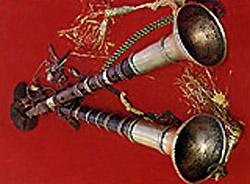
Shehnai - A Wind Instrument of Rajasthan

Shehnai - A Wind Instrument of Rajasthan

A variety of wind instruments complete the multitude of folk music instruments of Rajasthan which include, Algoza, Satara, Murla, Nad, Poongi and Shehnai.  There are other instruments like Morchang (Jewish Harp) that are unique additions to the great repository of folk instruments as they are unlike any instruments found anywhere in the world.

Today we will discuss about various Wind Instruments of Rajasthan.

Algoza – Type of Double Flute

This instrument is played by blowing into them. Rajasthan folk music has many variations of the flute.  The Peli of the Meos of Alwar is a short flute, to the music of which the Ratwai is sung in a high pitch. The Algoza, common in the Tonk-Ajmer areas, is two such flutes played together. The Kathodis use the Pawri, a flute of bamboo held vertically.

Satara, Nad

The Satara of the Langas has one long flute and another flute to provide the drone. The Narh or Nad produces music most evocative of the desert. It is a vertical flute with a single long hollow tube, into which the player whistles, at the same time gurgling a song in his throat or actually singing intermittently. The effect is haunting.

Poongi and Murla

Then there is the Poongi of the snake charmers and its adaptation by the Langas called the Murla. Both have two tubes, one for the notes and the other for the drone.

Tags: , , , , , , , , ,

Discover Dhol, Matka and Nagara – The Percussion Musical Instruments of Rajasthan

A percussion instrument produces a sound by being hit with an implement, shaken, rubbed, scraped, or by any other action which sets the object into vibration. These produces tones of definite or indefinite pitch. Their primary function is often rhythmic, but many are used as melody instruments.

dholak

Today we will write about different kind of  percussion instrument which includes Drums, Matka and Nagara.

Drums

Different kinds of drums form this group of musical instruments in rajasthan. They are of various kinds – the two sided drums, the shallow rimmed and single faced. The twin faced drums include the tiny Damru or Dugdugi of the Kalbeliyas and Madari.

The Bhils use the Maadal , a folk version of ‘Moisang’ which has a body of baked clay and gives a booming sound. The single faced and shallow rimmed drums are the Daf and the Chang. The Chang is the biggest, and with a parchment pasted on its rim, is a big favorite of the Holi revellers.

Matka and Algoza

Matkas and the Ghada and pair of huge earthenware pots, their mouths covered with membrane. One player plays each Matkas, and the Bhopas use it to accompany their singing. The whole effect is heightened by the graceful dance of the player.

The enchanting music for song is provided by the Algoza. An instrument belonging to the regions Tonk, Ajmer consisting of bamboo flutes played together.

Nagara

The Nagara is a conical drum played with the Surnai and Nafeeri (the two sticks). It forms part of the orchestra for the folk operas by providing rhythm.

Tags: , , , , , , , ,

Autophonic Instruments of Rajasthan – Ghungroo, Manjeera, Khartal & Jhalar

For travelers Rajasthan offers exotic music that can completely stupefy them. Autophonic Instruments are one of the Rajasthani Musical Instruments, which are made of the material used in day to day life. Today these very instruments are used for creating fusion music as well.

Among the autophonic instruments, the Ghanti or the Ghanta, the ghungroo (ankle bells), the manjeeras (including Jhanit and the Taala), the Thali or Tasli and the Jhalar are commonly used.

We will write about some of the above mentioned autophonic instruments.

Manjeera - An Instrument of Rajasthan

Manjeera - An Instrument of Rajasthan

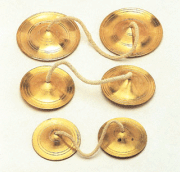
Manjeera

Manjeeras are made of brass and is in the shape of hemispherical metal cups struck against each other. They have different kinds like jhanit and the taala. They are held and played with the hands and often accompany folk or devotional music.

Ghungroo

A ghungroo is one of many small metallic bells strung together to form ghungroos. The sounds produced by ghungroos vary greatly in pitch depending on their metallic composition and size, which are served to accentuate the rhythmic aspects of the dance. The Bhopas of bherunji wear large ghungroos(ankle bells) around their waists and sway their bodies to provide a rhythm.

Khartal

There is another instrument known as khartal which is made of small cymbals incrustated into wood blocks. The khartaal is mostly used as backdrop for bhajans (devotional songs). In Rajasthan, they are commonly used during the religious ceremonies. They also have historic significance as they remind us about the Bhakti Movement and Rajasthan was famous for Meerabai and other bhakti saints.

Jhalar

Jhalar is another variety of musical instrument which is formed by a single metal plate, the thali. This is struck in various ways producing different kinds tones and rhythms. Tha jhalar, also known as ghanta and thali or tasli are commonly used.The jhalar is usally played with bells, blowing of conchshells and beating of drums at aarti and on other religious occasions.

Tags: , , , , , , , , , , , , , ,

Some Popular String Musical Instruments of Rajasthan – Kamaycha, Mochng and Ektaara

The music of Rajasthan has its own unique flavor which has kept the five thousand year old traditions of the state alive.  String instruments like Sarangi, Ektara, Morchang, Kamayacha, Rawanhatta are an integral part of music in Rajasthan along with dholaki.

In previous post we have already discussed Sarangi,  Rawanhathha and different types of Sarangi. Today we will post about some of the other popular string instruments in Rajasthan.

Kamayacha Musical Instrument

Kamayacha Musical Instrument

Kamaycha

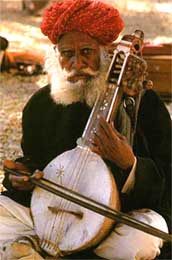
Kamayacha is an extremely elegant instrument of the professional singing community of Mangniars all over Marwar region of Rajasthan. It has a large circular belly covered with parchment, a peg system and a finger board.

It has three main strings of gut, besides nine supplementary and four sympathetic steel strings all passing through a broad bridge. The long wooden curved bow of horse-tail hair moving on all the strings is characteristic of this instrument.

Morchang

The morchang resembles a jew’s-harp. The plaintive, melancholic twang of the morchang adds a desolate dimension to songs of Marwar.

Ektaara

The Ektaara is also a single string instrument, but it is mounted on the belly of a gourd attached to a body made of bamboo.

The Galaleng Jogis of Dungarpur and Banswara have twin gourd-ed Kendru, which appears akin to the ancient Kinnari Veena. It is often called the Keengri in Rajasthan literature.

The Chautara, also called the Tandoora or Nissan , is a popular five stringed drone and beat instrument, it is used as an accompaniment to devotional music and for the Terathali dance of Rajasthan.

Tags: , , , , , , , , ,

String Instruments in Rajasthan – Sarangi, Ravanhatta and Other Versions

The melody of Rajasthan is hidden in the primitive looking instruments of various variety used by the experts musicians of Rajasthan during the time of the fairs, festivals and special occasion.

Today we are writing about some famous String Instruments in Rajasthan

Sarangi – Famous String Instrument in Rajasthan

Sarangi - Famous string instrument of Rajasthan

Sarangi - Famous string instrument of Rajasthan

One of the well-known string instrument of Rajasthan is Sarangi. This is a multi-stringed instrument that is played by using a bow drawn across the strings and running of fingers on the strings. The modern guitars have probably been modeled upon these.

The bridge of the sarangi supports the huge pressure of approximately 40 strings. Three of the strings mainly the comparatively thick, tight and short ones are bowed with a heavy horsehair bow and stopped tones svaras of the raga. A properly tuned sarangi will hum and buzz like a bee-hive, with tones played on any of the main strings eliciting echo-like resonances.

Rawanhathha

Ravanhatta is also a kind of sarangi. The Rawanhathha of the Thori or Nayak Bhopas is probably the earliest instrument played with a bow, and this humble instrument could well be the precursor of the violin.

It has two main strings and a variable number of supporting strings, with a belly of half coconut shell and a body of bamboo. The bow has ghungroos (bells) attached to it. The music is staccato and accompained by the syncopated singing of the Bhopa and the Bhopan.

Different Versions of Sarangi

The Jogis of Abu Road area use a smaller version of the Rawanhathha which has its two main strings tuned to the ‘Sa’ of the Indian octave and a third of steel to ‘Pa’.

The Langas use the Sindhi sarangi. It is made up of four main wires, seven jharas and seventeen tarafs. Others members of the family are the Gujratan, Jogia and Dhani sarangis. The Surinda, favourite of the Manganiyars, is a small sarangi. The Chikara, used by the Meos and Jogis of Mewat is a replica of the Sarangi.

Tags: , , , , , , , , ,