Posts Tagged men wear rajasthan

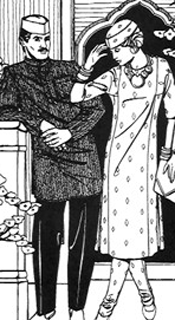
Jodhpuri Coat – Elegant Designed Rajasthani Men Wear

Jodhpuri Coat - Elegant Designed Rajasthani Men Wear

Jodhpuri Coat - Elegant Designed Rajasthani Men Wear

A Coat is a long garment worn by both men and women for warmth, protection and fashion. It typically have long sleeves, open from the front, closing by means of buttons, zippers, hooks, loops, fasteners, togglers and a belt.

HISTORY

In Iran two garments were introduced to the history of clothing – Trousers and Fitted Coats.
An early use of coat in England was the coat of men as tunic like garment of metal of rings usually knee or mid calf length.

JODHPURI COAT

A coat worn by men in Rajasthan is of shorter length than sherwani. Jodhpuri coat  or Prince is mostly known as a Lounge coat. Its length is similar to a suit jacket. The stand up collar is focal part of this garment. When worn with matching trousers, its impact can set one apart from ordinary.

FABRIC

Dark wool blends are normally preferred for this garment.

JODHPURI SUIT

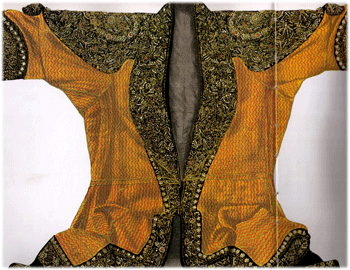
Jodhpuri suit comes with Jodhpuri coat and trousers. It is piece of splendid combination of fabric with embroidery. Pattern of embroidery starts from collar and neckline of designer suit and spreads to the shoulder of coat. Needle work is used to highlight lighter shades of Jodhpuri coat.

Colour depicts the elegance and sparkle of attire teamed with matching pants and fine neckline.

It is traditional wear of people of Jodhpur in Rajasthan. It looks cool at formal occasions and ceremonies.

Tags: , , , , , , ,

Patka (Waistband) – Traditional Clothing of Rajasthani Men

Patka - A Waist Band on Maharaja Jai Singh

Patka - A Waist Band on Maharaja Jai Singh

PATKA or kamarband  is a waistband (simply a piece of cloth tied across the waist ) in which a sword is fixed. There is a tradition of tying patkas as it is useful in two ways : Firstly it makes the person active and secondly it aids in tucking weapons and arms which made the two hands free to hold.

BACKGROUND

The Royal Rajasthani class used to tie high quality patkas like cotton ,silken  while  in  winter season they prefer woolen patkas. The past pictures depicts that earlier patka’s length and breadth was less. They used to have geometrical designs printed on them.

BASIC CLOTH

The cloth was woven, printed and embroidered. The base is of one colour and type only. Even bootis were of same colour as base. The corners had multi-coloured stems and on border huge size of bootis of lotus, chameli etc were embroidered.

HISTORY

During the period of Akbar, geometrical designs were made while in Jahangir and Shaahjahan period, floral pattern was in trend.  The best  example can be seen from collection shown in Kashi  Hindu University where there is patka in which beautiful combination and style of grape stem is depicted. The auspicious birds and animals like peacock were embroidered in it.

How Patka’s Evolved?

In eighteen century, patka become less useful. It used to have more ornaments and there was greater difference in their length and breadths. Gradually its broadness increased from 1.5 mtr to 2 mtr.

In 20th century, the art of making patka was stopped, only olden patka’s were used in royal courts. In Rajasthan, patkas of Chanderi, Banaras and Ahmedabad became popular. These patkas were worn in Mughal and Rajput courtyards.

Tags: , , , , , , , , , , ,

Choga – A Royal and Aristocratic Rajasthani Men’s Garment

Choga - Royal and Aristocratic Rajasthani and Indian Wear

Choga - Royal and Aristocratic Rajasthani and Indian Wear

Rajasthani men have a wide range of upper garment to satisfy their sartorial taste. Jama, Achkan, Angarkha and Choga  are some of the royal and aristocratic garments of Rajasthani men.

CHOGA

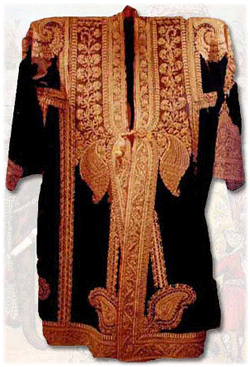
Choga, an affluent class wear, is worn above angarkha. It is primarily made of woolen, silken material. It is very attractive in appearance. Choga is a long sleeved robe that is worn loosely around bodice. It is not worn daily rather preferred for special occasions. It is an upper wear in which there are ghoondis instead of buttons and rounded ties in which ghoondis are fixed .

IMPORTANCE

In royal courts, choga were so prevalent that the artisans of Banaras and Dhaka used to prepare the garment according to measurement in which different styles of designs, motifs, decorative items were used. It’s present  attire can be seen in museum of Kashi Hindu University.

The motifs of hunting scenes are made on outer portion while on inner part drawings of birds and animals were beautifully woven.

Variety of Choga: Seasonal, Designer and Patterned

Tailors stitch the cloth according to the pattern depicted on the pieces. These pieces are known as Parcha and they became the trend and style of garment.

In winters, woollen choga are preferred. Generally needlen work is done for depicting the designs on choga. The silken threads are used for needle work.

In Rajasthan during nineteen century, badlas and sitare (decorative items) were used. In Punjab, embroidered chogas are more popular. In Amritsar, there is a main centre of woolen chogas manufacturing unit from where it is supplied to royal class of Rajasthan.

The choga made of muslin which was woven in jamdani style was worn in summers. It was lightly embroidered with bootis. In Tanjeb, choga silken threads are used for embroidery.

Rounded motifs of filled floral pattern are used on choga made from pashmina and expensive woollen cloth. In these type of woolen choga  there are two types of lining: interior one is of thick white cloth while exterior one is of stripped and silk material.

Tags: , , , , , , , , , , , , , , ,

Chakdar and Gherdar Jama – Tradition Mughal and Rajasthani Wear

The tradition of wearing jama was on the occasions of wars and marriage ceremonies. Jama  is a tight fitting bodice, high waist and a flared skirt which vary from knee to ankle length. On the upper portion there is choli and it touches the knees. It’s not a daily wear clothing.

ORIGIN:

In the mid of seventeen century before Akbar reign, jama was court dress known as “Takauchiya’jama”. The flare of jama was not chakdar rather it was gherdar. Abdul fazl has written in the history that Akbar promoted gherdar jama. It is depicted in pictures, paintings and museum of the sixteen century.

Jama - Tradition Mughal and Rajasthani Wear

Jama - Tradition Mughal and Rajasthani Wear

STRUCTURE:

It is open fronted garment with one panel crossed over another on the front. It is kept in pace by tie cords which held the inner panel on the inside at the waist or armpit

Fabric:

Fine cloth, silk or brocade is used for making jama. Jama measured cloth is embroidered, woven and printed.

TYPES:

There are two types: chakdar jama and gherdar jama. The chakdar jama has hanging, narrowing  ends of the sort while later on had an even round hemline and tended to be full.

Earlier in Rajasthan knee length jama was there but with passage of time long jama, that covered  the feet and trailed the floor, was in fashion. It started in the eighteen centuary while earlier one last till (1719-1748)Mohammad shah period.

EMBROIDERY PROCESS:

On bodice there are dense bootis which are embroidered. There is strings or cords for closing choli known as kas. These underneath kas are simple and outer ones are beautiful, ornamented and attractive. The stem which are on corners is broad on exterior and narrow in interior.

In the 19 th centuary the area of choli in which there is one flap over other was changed to front open.

Tags: , , , , , ,

Kumar And Nathdwara Bandis – Closed Sleeveless Jacket For Rajasthani Men

Rajasthani Traditional Winter Jacket - Bandi

Rajasthani Traditional Winter Jacket - Bandi

Bandi is a close fitted sleeveless garment (jacket). There are two types of bandi which is commonly used in Rajasthan. One type of bandi is worn by kumhar or potter community as an outer garment which is totally for the comfort purpose. It generally features a round neck in front and the back.

Different communities of Rajasthan wear bandi with variations in neck openings. A central placket with buttons could be incorporated or an opening on the shoulder with ties.  Kumar bandi has silver buttons linked with chain. A slit opening  for holding cash etc is there .

NATHDWARA BANDIS:

Another type of Bandi is originated and developed in Nathdwara.  This place is located 48 kms from Udaipur in Rajasthan literally means “gateway of lord shrinathji“. It is worn both by male and female for keeping them warm in winters. It is generally made by putting lining under pashmina or costly warm cloth.

ORIGIN:

It was originated before 100yrs by Gordhan Das of Nathdwara. Shree Basantilal and Shree Purshottum have learned this art and manufacture it in larger scale.

IMPORTANCE:

It has same significance as quilt occupies in winter nights. That effect remain in the day time so these are stitched.

PRESENT SCENARIO:

Nowdays  Satin and cotton bandis are made. Earlier zari bandis  are manufacture. Initially, lining is cut then cotton is filled in it. The cost of cotton bandis ranges from Rs 150 -300 while satin bandis are 350-500 Rs. Small bandis are 10,12,18 and 20 inch long while big bandis are 34-38 inch and are loose fitting.

DESIGN:

There are two types of designs found in bandis: Floral or Square cut pattern. In square pattern, the design is in straight line pattern either stripped horizontally or vertically while in floral pattern the shapes of lotus leaves are designed. On the corners Gota is stitched by defining the costume. In front 5-7 buttons are there to make it comfortable to wear.

The bandis which is made in Nathdwara are mostly of cotton material and prepared artistically. Thats why it is not not only famous in Rajasthan but also in Gujarat, Uttar Pradesh, Maharashtra and Madhya Pradesh. The Vaishnav class of Maharasthra and Gujarat specially wear these bandis and they purchase from Nathdwara. It is source of livelihood of Nathdwara local manufacturers.

Tags: , , , , , , ,

Atamsukh – Rajasthani Kings And Royal Family Wear

Rajasthan Kings And Royal Family Wear - Atamsukh

Rajasthan Kings And Royal Family Wear - Atamsukh

Rajasthan is famous for its colourful culture. It is not only depicted through its festivals and ceremonies but also reflected in clothing style and costume.

Atamsukh in sanskrit means “giver of comfort to the soul”. It is similar to jama but quilted. It used to be worn by Rajasthan’s royal family males.  It was mainly developed for the purpose of keeping the wearer warm.

Its length is upto knees but has small sleeves. It’s padded like jama-yi -puma -dar or salwar with cotton wool. Then quilted to keep padding in place between two layers of fabrics. During mughal period, it was decorated on outer surface by fabric such as silk and brocade both for insulating and warmth.

DISPLAY OF ATAMSUKH

The huge size atamsukh, a beautiful rich Banaras brocade quilted cloak of Rajasthani Maharaja Sawai is an object of attraction. They are displayed on the first floor of Mubrack Mahal and City Palace museum.

SIMILARITY

It is quite similar to Kashmiri Phiran. It denotes the size and style of Maharaja along with fashion and trend prevalent during those times. Royal members used to put  puthia on their shoulders.

Confusion reigns between atamsukh and choga of early mughal era. The prevalent Persian and Turkish garment brought over to India by Babur and its forces in 1525 would be mutating due to climate and inevitable fashion changes that happens naturally.

This garment which covers the entire body and is intended for wear in colder seasons, remains in wardrobe of man of affairs and status until today.

Tags: , , , ,

Angrakha – An Ethnic and Stylish Rajasthani Men Upper Wear

Angrakhan - The Protection Cover For Traditional Mens Wear

Angrakhan - The Protection Cover For Traditional Men's Wear

Angrakha is derivation from sanskrit word  ‘Angrakshak’ or body protector meaning something that protects the limbs. It is quite a famous and prevalent men wear in Rajasthan.

People wear angarkhas’ made of locally manufactured clothes.  It is mainly a long sleeve, full skirted tunic for men generally open at the chest and tied in front with an inner flap covering the chest.

Angarkha does not have a standing collar unlike choga or atamsukh. This neckline usually being close to the base of throat in its fitting. It closes in the front sometimes on the chest and held in place by means of either ties or a small fabric covered buttons and loop.

It is developmental garment which has contemporary origins in the 16 th century jama-yi -pumba mentioned by Abdul Fazl in Ain -i-Akbari. It is actually a formal wear of affluent class in Rajasthan. The local and tribal communities wear shorter version (angarkhi) know as putia in the region. To improve mobility of wearer slits are made at the sides and also at the wrists.

DIFFERENT STYLES

It is interesting notion that in Muslim tradition the visible outer tie cords are positioned under right armpit while the Hindu angarkhas have the noticeable tie under left armpit. The inner fastenings are in opposite sides. This style of tying distinguishes two communities of Rajasthan.

CLOTH

It is made of plain silk or brocade especially for wedding occasions. Fine cotton voile with gold tinsel printed make a special feature. Tie and die angarkhas are reserved for special Rajasthani festivals while cotton ones for daily wear.

SEASONAL INFULENCE

During winters angarkhas of thick quilted material are worn while in summer s fine cotton angarkhas are used to protect from  heat wave. In Rajasthan, people wear Kamari angarkhi that reaches the waist when they have to formally dressed. The length vary 5-7.5 m.

The beauty of Angarkha depicts the culture & colour which is still embedded in the land of Rajasthan.

Tags: , , , , ,