Posts Tagged rajasthani traditional clothing

Chakdar and Gherdar Jama – Tradition Mughal and Rajasthani Wear

The tradition of wearing jama was on the occasions of wars and marriage ceremonies. Jama  is a tight fitting bodice, high waist and a flared skirt which vary from knee to ankle length. On the upper portion there is choli and it touches the knees. It’s not a daily wear clothing.

ORIGIN:

In the mid of seventeen century before Akbar reign, jama was court dress known as “Takauchiya’jama”. The flare of jama was not chakdar rather it was gherdar. Abdul fazl has written in the history that Akbar promoted gherdar jama. It is depicted in pictures, paintings and museum of the sixteen century.
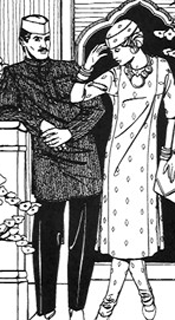
Jama - Tradition Mughal and Rajasthani Wear

Jama - Tradition Mughal and Rajasthani Wear

STRUCTURE:

It is open fronted garment with one panel crossed over another on the front. It is kept in pace by tie cords which held the inner panel on the inside at the waist or armpit

Fabric:

Fine cloth, silk or brocade is used for making jama. Jama measured cloth is embroidered, woven and printed.

TYPES:

There are two types: chakdar jama and gherdar jama. The chakdar jama has hanging, narrowing  ends of the sort while later on had an even round hemline and tended to be full.

Earlier in Rajasthan knee length jama was there but with passage of time long jama, that covered  the feet and trailed the floor, was in fashion. It started in the eighteen centuary while earlier one last till (1719-1748)Mohammad shah period.

EMBROIDERY PROCESS:

On bodice there are dense bootis which are embroidered. There is strings or cords for closing choli known as kas. These underneath kas are simple and outer ones are beautiful, ornamented and attractive. The stem which are on corners is broad on exterior and narrow in interior.

In the 19 th centuary the area of choli in which there is one flap over other was changed to front open.

Tags: , , , , , ,

Kumar And Nathdwara Bandis – Closed Sleeveless Jacket For Rajasthani Men

Rajasthani Traditional Winter Jacket - Bandi

Rajasthani Traditional Winter Jacket - Bandi

Bandi is a close fitted sleeveless garment (jacket). There are two types of bandi which is commonly used in Rajasthan. One type of bandi is worn by kumhar or potter community as an outer garment which is totally for the comfort purpose. It generally features a round neck in front and the back.

Different communities of Rajasthan wear bandi with variations in neck openings. A central placket with buttons could be incorporated or an opening on the shoulder with ties.  Kumar bandi has silver buttons linked with chain. A slit opening  for holding cash etc is there .

NATHDWARA BANDIS:

Another type of Bandi is originated and developed in Nathdwara.  This place is located 48 kms from Udaipur in Rajasthan literally means “gateway of lord shrinathji“. It is worn both by male and female for keeping them warm in winters. It is generally made by putting lining under pashmina or costly warm cloth.

ORIGIN:

It was originated before 100yrs by Gordhan Das of Nathdwara. Shree Basantilal and Shree Purshottum have learned this art and manufacture it in larger scale.

IMPORTANCE:

It has same significance as quilt occupies in winter nights. That effect remain in the day time so these are stitched.

PRESENT SCENARIO:

Nowdays  Satin and cotton bandis are made. Earlier zari bandis  are manufacture. Initially, lining is cut then cotton is filled in it. The cost of cotton bandis ranges from Rs 150 -300 while satin bandis are 350-500 Rs. Small bandis are 10,12,18 and 20 inch long while big bandis are 34-38 inch and are loose fitting.

DESIGN:

There are two types of designs found in bandis: Floral or Square cut pattern. In square pattern, the design is in straight line pattern either stripped horizontally or vertically while in floral pattern the shapes of lotus leaves are designed. On the corners Gota is stitched by defining the costume. In front 5-7 buttons are there to make it comfortable to wear.

The bandis which is made in Nathdwara are mostly of cotton material and prepared artistically. Thats why it is not not only famous in Rajasthan but also in Gujarat, Uttar Pradesh, Maharashtra and Madhya Pradesh. The Vaishnav class of Maharasthra and Gujarat specially wear these bandis and they purchase from Nathdwara. It is source of livelihood of Nathdwara local manufacturers.

Tags: , , , , , , ,