Posts Tagged clothes in rajasthan

Choga – A Royal and Aristocratic Rajasthani Men’s Garment

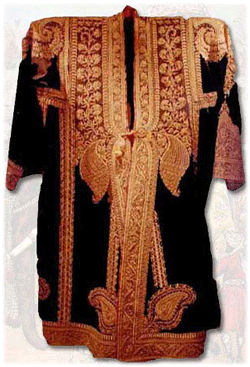
Choga - Royal and Aristocratic Rajasthani and Indian Wear

Choga - Royal and Aristocratic Rajasthani and Indian Wear

Rajasthani men have a wide range of upper garment to satisfy their sartorial taste. Jama, Achkan, Angarkha and Choga  are some of the royal and aristocratic garments of Rajasthani men.

CHOGA

Choga, an affluent class wear, is worn above angarkha. It is primarily made of woolen, silken material. It is very attractive in appearance. Choga is a long sleeved robe that is worn loosely around bodice. It is not worn daily rather preferred for special occasions. It is an upper wear in which there are ghoondis instead of buttons and rounded ties in which ghoondis are fixed .

IMPORTANCE

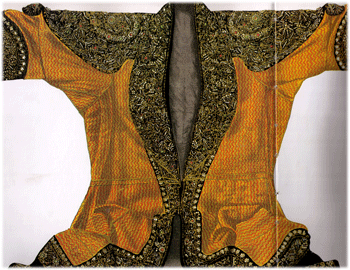
In royal courts, choga were so prevalent that the artisans of Banaras and Dhaka used to prepare the garment according to measurement in which different styles of designs, motifs, decorative items were used. It’s present  attire can be seen in museum of Kashi Hindu University.

The motifs of hunting scenes are made on outer portion while on inner part drawings of birds and animals were beautifully woven.

Variety of Choga: Seasonal, Designer and Patterned

Tailors stitch the cloth according to the pattern depicted on the pieces. These pieces are known as Parcha and they became the trend and style of garment.

In winters, woollen choga are preferred. Generally needlen work is done for depicting the designs on choga. The silken threads are used for needle work.

In Rajasthan during nineteen century, badlas and sitare (decorative items) were used. In Punjab, embroidered chogas are more popular. In Amritsar, there is a main centre of woolen chogas manufacturing unit from where it is supplied to royal class of Rajasthan.

The choga made of muslin which was woven in jamdani style was worn in summers. It was lightly embroidered with bootis. In Tanjeb, choga silken threads are used for embroidery.

Rounded motifs of filled floral pattern are used on choga made from pashmina and expensive woollen cloth. In these type of woolen choga  there are two types of lining: interior one is of thick white cloth while exterior one is of stripped and silk material.
Tags: , , , , , , , , , , , , , , ,

Angrakha – An Ethnic and Stylish Rajasthani Men Upper Wear

Angrakhan - The Protection Cover For Traditional Mens Wear

Angrakhan - The Protection Cover For Traditional Men's Wear

Angrakha is derivation from sanskrit word  ‘Angrakshak’ or body protector meaning something that protects the limbs. It is quite a famous and prevalent men wear in Rajasthan.

People wear angarkhas’ made of locally manufactured clothes.  It is mainly a long sleeve, full skirted tunic for men generally open at the chest and tied in front with an inner flap covering the chest.

Angarkha does not have a standing collar unlike choga or atamsukh. This neckline usually being close to the base of throat in its fitting. It closes in the front sometimes on the chest and held in place by means of either ties or a small fabric covered buttons and loop.

It is developmental garment which has contemporary origins in the 16 th century jama-yi -pumba mentioned by Abdul Fazl in Ain -i-Akbari. It is actually a formal wear of affluent class in Rajasthan. The local and tribal communities wear shorter version (angarkhi) know as putia in the region. To improve mobility of wearer slits are made at the sides and also at the wrists.

DIFFERENT STYLES

It is interesting notion that in Muslim tradition the visible outer tie cords are positioned under right armpit while the Hindu angarkhas have the noticeable tie under left armpit. The inner fastenings are in opposite sides. This style of tying distinguishes two communities of Rajasthan.

CLOTH

It is made of plain silk or brocade especially for wedding occasions. Fine cotton voile with gold tinsel printed make a special feature. Tie and die angarkhas are reserved for special Rajasthani festivals while cotton ones for daily wear.

SEASONAL INFULENCE

During winters angarkhas of thick quilted material are worn while in summer s fine cotton angarkhas are used to protect from  heat wave. In Rajasthan, people wear Kamari angarkhi that reaches the waist when they have to formally dressed. The length vary 5-7.5 m.

The beauty of Angarkha depicts the culture & colour which is still embedded in the land of Rajasthan.

Tags: , , , , ,

Traditional Rajasthani Male Costumes – Angarakha, Turban, Dhoti and Jooti

Traditional Rajasthani Man Wear

Traditional Rajasthani Man Wear

Rajasthan a mosaic of landscape and terrain each of singular beauty whether it is dunes of desert or forested hills. The people of Rajasthan are perhaps the most colourful – their history, religion, music and dance, arts and crafts remain vibrantly alive and active.

Rajasthan male is quite a peacock. Every inch of splendid frame is superbly ornamented  from stiff starched furl of his saffron or a shocking pink turban to the tips of tunned up toes of his traditional jootis.

Angarakha & Dhotis

The dress of Rajasthani male are well versed and well cut from top to bottom. It goes with the climatic conditions of the state. The upper portion is covered mainly with the angarakha or achakan. Angarakha is of two types: frock style and waist length kamari angarakha and long angarakha that reaches below ones knees.

Dhoti or pajama is the lower garment which make up the male outfit. The dhoti is long cotton cloth which is to be perfectly tied.

People of royal families and upper class used to wear “patka”1.5by 1m cloth that was kept on the shoulder or worn around the waist to tuck in the weapons in the medieval period. Nowdays it is obsolete.

Turbans (head cover) of different  colours is used  mostly on all occassions and ceremonies. There are different styles and pattern of turban each denoting class, culture and region of the wearer.

Royal costume in Rajasthan reflects regal taste of the state, but now with passage of time most trends have pushed the dressing style of male costume limited to shirt and trouser. Although the general masses (villagers) still continue the olden traditional wear.

One says “There is much to support the view that it is clothes that wear us and not we wear them. We may make them take the mould of arm and chest cover but they would mould our hearts ,our brains our tongues to their likings.”

Tags: , , , , , , , , , , , ,