Archive for category rajasthan pilgrims

Khatu Shyam Ji Temple – Sikar, Rajasthan

Location

Khatu Shyam Ji Temple is situated in district of Sikar in state of Rajasthan, at a distance of 17 km from Reengus.

Khatu Shyamji, Sikar, Rajasthan, India

Khatu Shyamji, Sikar, Rajasthan, India

History – Why it is called Khatu Shyam Ji Temple ?

The legend of this immensely popular Krishna temple can be traced back to the medieval Mahabharat where Barbareek, the son of great Pandav brother Bhim and Nag Kanya (snake princess) displayed his great warrior skills that pleased Lord Shiva who endowed his blessings in the form of Teen Ban (three arrows)

In order to watch the famous war of Mahabharat, he sat towards the battle field and in between his tryst with Lord Krishna in disguise becasme a vital part of the history and thus the incarnation of KHATU SHAMJI.

Architecture of the Temple

The temple is architecturally rich. Lime mortar, marble and tiles have been used in constructing the structure. The shutters of the sanctum are beautifully covered with silver sheet.

Outside is the prayer hall, named Jagmohan and its walls are elaborately painted, depicting mythological scenes. The entrance gate and exit gate are made of marble; their brackets are also of marble and feature ornamental floral designs.

There is an open space in front of the entrance gate of the temple. The Shyam Bagicha is a garden near the temple from where flowers are picked to be offered to the deity. The Samadhi of Aloo Singh, a great devotee, is located within the garden.

The Gopinath temple lies to the south-east of the main temple. The Gaurishankar temple also lies nearby. There is an interesting tale associated with the Gaurishankar temple.

There is a steady stream of devotees the year round, but lakh of them gather at the annual fair from Phalgun Sudi Dashmi to Dwadashi. Apart from being a place of pilgrimage, a large number of people come for the Jadula ceremony (the first time all hair is shaved off the head) of their children.

Images Source: Wikipedia

Tags: , , , , , , , , , , , , , ,

Atmateshwar Temple – Pushkar , Rajasthan

Pushkar Sarovar, Pilgrimage Centre, Rajasthan

Pushkar Sarovar, Pilgrimage Centre, Rajasthan

About Pushkar – A Pilgrimage for Hindus

Pushkar is considered as one of the most significant places of pilgrimage for Hindus. With its sacred lake near Ajmer in Rajasthan, Pushkar is an ancient holy spot.  The town of Pushkar situated on the lake is surrounded by hills on three sides

It is the only place in India where there is a temple dedicated to Lord Brahma. Lakhs of devotees assemble at Pushkar from the 11th day of Kartik till the full moon and take a dip in the holy lake during these five days every year.

Pushkar now has five principal temples, all of modern construction, These are dedicated to Brahma, Savitri, Badrinarayan, Varaha and Shiva Atmateshwar.

About Atmateshwar Temple

Dedicatedd to lord Shiva, the Atmateshwar Temple in Pushkar is visited by numerous people throughout the year. Lord Shiva is considered to be the destroyer in the Hindu Trinity, whereas Load Vishnu the preserver and Lord Brahma the creator

Constructed in the 12th century A.D, this temple has splendid architecture. The intricate Hemadpanti architectural style carvings give it a magnificently historical look.

If you visit Atmateshwar Temple in Pushkar during Shivaratri , when Lord Shiva is ritually revered, you shall get to see thousands of devotees thronging the temple.

Tags: , , , , , , , , , , , , , , , ,

Galtaji Temple , Jaipur Rajasthan

Galta Ji Temple, Jaipur, India

Galta Ji Temple, Jaipur, India

About GaltaJi – Location

Galtaji is a holy pilgrimage of Rajasthan, located 10 kms away from Jaipur. The vast complex of Galta Ji has several temples in it.

The Temple of Galtaji is famous for its natural water springs. Set amidst the beautiful landscape, Galtaji Temple offers a picturesque view of the city. Galtaji is considered holy place, as Saint Galav spent his life meditating here.

Architecture of Temples in Galtaji

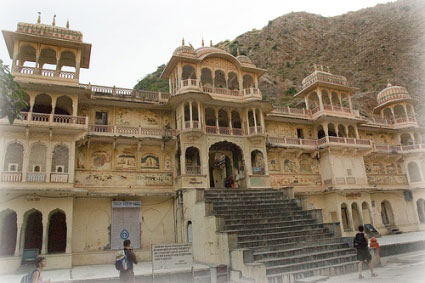
The most celebrated temples of the place include the triple-storied temple of Balaji, which attracts to the aesthetic sense of the travelers and is built in pink stone.

The impressive structure of the Balaji Temple appears more like a palatial mansion or Haveli. Located in the midst the low hills, the Temple of Galtaji, also is built in pink stone and has a huge complex.

The location of temple is such that it provides awe-inspiring views of the surrounding plains. The Galtaji Temple is a souvenir of the former age and a sacred pilgrimage of the Hindus. The tranquility of the Temple, attracts people from far and near, to visit it again and again.

About Galta Kund in Galtaji

There are seven tanks in all, the most pious being the Galta Kund, which is thought never to become dry. A large number of devotees take a holy bath in these tanks especially on Makar Sankranti in mid-January. These tanks are fed by Gaumukh, which is a spring arising from a rock shaped like a cow’s head.

The temple takes pride on its numerous pavilions with rounded roofs, delicately carved pillars and painted walls. Large springs and reservoirs circumvent the temple.

Tags: , , , , , , , , , , , , , , ,

Rishabhdeo Temple – Udaipur Rajasthan

Location

Rishabhdeo Temple is an important pilgrimage site for followers of Jain religion. The temple is located on Udaipur-Ahmedabad road, at a distance of 65 kms from the city of Udaipur in Dhulev. Dhulev is a small town that is also known as Rikhabdeo, famous for its Rishabhdeo Temple.

About Rishabhdeo Temple

Dedicated to Rishabhdeoji, one of the 24 Tirthankars of the Jains, the 15th century A.D Rishabhdeo Temple is an important pilgrimage site. Owing to a large amount of saffron offering made, the temple has also come to be known as the Kesariyaji Temple.

Both Jains and Bhils have immense respect for this temple, since the lord fulfills all their wishes and desires.  Rishabhdeoji is  also considered as one of incarnations of Lord Vishnu and due to this reason; many of the Hindus come to this place of worship every month from all over Rajasthan.

Architecture & Attractions of Rishabhdeo Temple

Carvings Inside Rishabhdeo Temple, Udaipur, India

Carvings Inside Rishabhdeo Temple, Udaipur, India

While entering this temple, you will be received by the Elephants that are carved out of black stone. In the north, the image Goddess Chakreshvari adorns the site and in the south, the image of goddess Padmavati fetches the attention. In this temple, the idol of Lord Rishabh Dev captures the major attraction.

On special occasions the image is clothed with the angia (a garment studded with precious stones worth severed hundred thousand rupees).

Besides the main idol, there are 23 other idols and out of them, 2 are standing and 21 are in a sitting position. All these idols are made up of Ashtadhatu (composed of eight metals) and encircle the idol of Lord Rishabhdeo.

The northern and southern parts of the Khela Mandapa (Hall) are occupied by the idols of Tirthankaras Vasupujya, Mallinath, Neminath, Parshvanath and Mahavir Swami that are collectively known as Panch-Balayati. Apart from this, there are 52 other devakulikas (shrines) of the Tirthankaras.

Tags: , , , , , , , , , , , , , , ,

Luna Vasahi Temple – Delwara Jain Temples , Mount Abu, Rajasthan

Delwara Jain Temple

The famous Delwara Jain temples are 2.5 km away from the Mount Abu, which in ancient Hindu and Jain scriptures is referred to as Arbudgiri. The Delwara temples were dedicated to the Jain Tirthankars and also served as storehouses of illustrated manuscripts and treatises.

Vimala Shah, Vastu Pala and Teja Pala contributed a lot toward the development of Jain art and architecture. The Jain temples at Mount Abu are built in the Nagara style of temple architecture

The ornamental detail spread over the minutely carved ceilings, doorways, pillars and panels is simply marvelous and has to be seen to be believed.

About Luna Vasahi Temple

Luna Vashi - Dilwara Jain Temple, Mount Abu, India

Ornate Sculptures @ Luna Vasahi - Dilwara Jain Temple, Mount Abu, India

The magnificent Luna Vasahi temple dedicated to the 22nd Jain Tirthankara Shri Neminathji, was built in 1231 A.D by two  porwal brothers Vastupal and Tejpal both ministers of Raja Virdhaval, a ruler of Gujarat.

The temple built in memory of their late brother Luna was designed after the Vimal Vashi temple.

Historically, this is the last of the monuments built in the Solanki Dynasty.

Architecture of Luna Vasahi Temple

The main hall or Rang mandap has a central dome from which hanfs a big ornamental pendent featuring elaborate carving.

You will notice, arranged in a circular band are 72 figures of Tirthankars in sitting posture and just below this band are 360 small figures of jain monks in another circular band. The Hathishala or elephant cell features ten elaborately carved marble elephants.

The Navchowki features some of the most magnificent and delicate marble stone cutting work of the temple. Each of the nine ceilings here seems to exceed the others in beauty and grace.

The Gudh mandap features a black marble idol of the 22nd Jain Tirthankara Neminath. The Kirthi Stambha is a big black stone pillar that stands on the left side of the temple. The pillar was constructed by Maharana Kumbha of Mewar. The remaining three temples of Dilwara are smaller but just as elegant as the other two.

There is a small cell, in between the trees, dedicated to the worship of foot-prints of ‘Dada Sahib’ Jain Acharaya Shri Jindutt Suri.

Tags: , , , , , , , , , , , , , , ,

Chaumukha Temple – Ranakpur, Rajasthan

About Ranakpur

Renowned for some marvelously carved Jain temples in amber stone, Ranakpur is one of the five holy places of Jain community in India.

Located between Udaipur and Jodhpur, travelling to Ranakapur is a treat in itself. It sits in a lush valley surrounded by steep mountains and rushing waterfalls. Built in late 15 century AD, this beautiful complex has the most exquisitely carved temples to be found in this region.

Chaumukha Jain Temple, Ranakpur, Rajasthan

Chaumukha Jain Temple, Ranakpur, Rajasthan

Chaumukha Temple -  Architecture

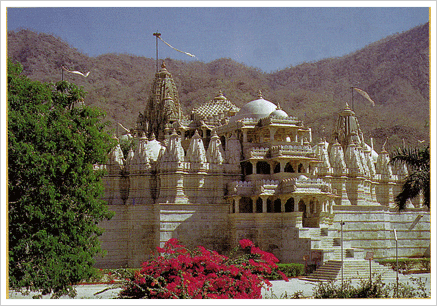
The most important structure here is the Chaumukha, or four faced temple, dedicated to the venerated Tirthankara Rishabdev.

The highlight of Chaumukha is its 29 halls and 1444 pillers none of which are similar in design. This temple is built on high plinth, encircled by lofty boundary walls with fraceful turrets.

The temple has three entrances with double stories portals each leading through columned courts into the main halls – a seeming confusion of halls, pillers and courtyards radiating from the central shrine with a hundred pillers.

Temple Attractions

Seen from the outside there are five spires each covering a shrine below the largest covering the central shrine housing the white marble image of Chaumukha. Surrounding the spires are cupolas, each forming the roof of a pillared hall.

Chaumukha is a marvel to view. Beautiful ceiling designs, several of which evidence the cycle of life, bring the eyes upward toward the heavens, while large carved elephants, complete with rider, bring us back to earth. A wonderful spiritual feels over takes you, sparked by incense and floral aromas hanging heavily in the air.

The ambience is charming and you can happily spend a couple of hours visiting the other temple in the complex or just sitting here to enjoy the lush greenery and walking around the wall – maintained gardens.

Tags: , , , , , , , , , , , , ,

Kalika Mata Temple – Chittorgarh, Rajasthan

About Chittorgarh

Chittorgarh is the epitome of Rajput pride, romance and spirit. It reverberates with history of heroism and sacrifice, which is evident as it echoes with the tales sung by the Bards of Rajasthan.

The main reason for visiting Chittorgarh is its massive hilltop fort, which is a depiction of Rajput culture and values. The fort stands on a 240-hectares site on an 180m high hill that rises rapidly from the plains below.

The town of the brave, known for its massive fort atop a hill, which can be singled out for its glorious past.

The fort has checkered history, it has witnessed some of the bloodiest battles in history, three great Sakas and some of the most heroic deeds of valor, which are still sung by the local musicians.

About Kalika Mata Temple

Kalika Mata Temple, Chittorgarh, Rajasthan

Kalika Mata Temple, Chittorgarh, Rajasthan

Kalika  Mata Temple built by Hamir in the 14 Century AD is dedicated to the Goddess of power and valor, Kali and is located on the Southern side of the Chittorgarh fort.

Originally it was built as a Sun temple in the 8th century by Bappa Rawal, but was destroyed during the first attack and re-built after regaining of the fort  by Rana Hamir.

Temple Architecture

Adorned with beautiful sculpture, the temple is admired by the entire tourist on their visit to Chittorgarh fort.  A center of pilgrimage for many Rajasthanis, the temple is stuffed with fables and stories.

Kalika Mata Temple  is built on Prathira style of design. Based on a raised platform, the temple has intricately impressed pillars, ceiling and gates. A visit to Chittorgarh and the temple is sure to enthrall you with legends Maharqana Pratap and many other unsung heroes of Mewar.

The house of Chunda is situated near the temple. There are several other temples, within the ramparts of the fort like that of the temple of Annapurana, Jain Temples etc.

Image Source : WikiPedia

Tags: , , , , , , , , , , , , , ,

Lodurva – A Jain Pilgrimage – Jaisalmer, Rajasthan

Lodurva Jain Temples, Jaisalmer, Rajasthan

Lodurva Jain Temples, Jaisalmer, Rajasthan

Location and History about Lodurva

Lodurva, located at a distance of 15-kilometers from Jaisalmer is one of the most enchanting Rajasthan tourist attractions.

Lundurva ,the ancient capital of Bhatti Rajputs was once a flourishing city but most of the splendour when the Bhattis shifted their capital to Jaisalmer.

According to a popular legend the ancient River Kak flew in this part of Rajasthan. It was on the banks of this river that the legendary prince Mathendru of Amarkot and princess Momal fell in love and eventually met their tragic end. It is believed that the River Kak dried up after the two lovers perished.

The most mesmerizing experience will be the peacock dance amid exotic Lodurva ruins. Yes, Peacocks are a great pull and they are in plenty here.

Lodurva Attractions -  Jain Temples

There are several Jain temples at Lodurva, though the most significant are the Parswanath Temple, Rishabhnath Temple and the Sambhavnath Temple.

Nevertheless the place is a major tourist attraction and have jain temples made of bright yellow sandstone, these temple walls are decorated with the pictures of Lord Parsvanath, the Jain Tirthankar arch in the main temple building. These arches are typical of the Delwara style of temple architecture.

The beautiful Jaali works make these temples a piece of marvel. You will notice the splendid and dominating arch in the main temple building.

About Kalpavriksha (Celestial Tree)

Inside the temple complex is the Kalpavriksha or the celestial tree. A tree was once believed to have grown here, and when it died it was substituted by a true to life sculpture in an alloy of eight metals, making it an ‘eternal tree’ symbolizing enlightenment.

The copper leaves are believed to have the power to fulfil the wishes of any devotee. On the temple’s outer wall there is a low – relief carving on stone, reportedly inhabited by a black cobra who’s been living here for 400 years. Rumor has it that he comes out 10-15 times every summer and anyone catching a glimpse of it is blessed with good luck.

In your visit to Jaisalmer, you just can’t remain silent without admiring the intricately imprinted yellow sandstone in the temples and miracle of the artistic beauty visible on these ancient monuments. Even the ruins the temple at Lodurva radiate character.

Tags: , , , , , , , , , , , , , , , , ,

Adhar Devi Temple – Mount Abu, Rajasthan

Adhar Devi Temple, Mt Abu, Rajasthan

Adhar Devi Temple, Mt Abu, Rajasthan

Temple Location and Architecture

Situated in a cave in the hills of Mount Abu the only Hill Station in Rajasthan, The Adhar Devi Temple is one of the very popular religious themed tourist destinations.

The Adhar Devi temple is situated at a distance of 3 km to the north of the Mount Abu. The temple is chiseled out of a huge rock and can be reached by a flight of 365 steps.

Why it is called Adhar Devi Temple – History about Temple

It is also known as Arbuda Devi Temple. You have to bow in reverence to get through the low entrance of the temple Legend has it that, Arbuda said to be the patron of the town, formed the mountain in order to save the sacred cow, Nandi from drowning in an abyss.

The black painted marble idol riding a tiger is claimed to be about 5,000 years old. It is also belived that the image  of the goddess was originally hanging in mid air, hence it came to be called as Adhar Devi Temple.

Attraction

This temple dedicated to Goddesses Durga is regarded as one of the important pilgrimage sites of Mount Abu. It is also a good site to get a panoramic view of the sylyan vally.

The Adhar Devi temple contains many beautiful statues, and those that make the effort to climb the stairs are rewarded with many picturesque views of the surrounding mountains and forests. The climb up to the Adhar Devi temple can be a difficult one so it is recommended that you wear appropriate clothing and footwear. You should not be turned off by this walk as the scenic views surrounding the temple and the wondrous beauty inside make this climb worth the effort.

Tags: , , , , , , , , , , , ,

Karni Mata Temple – Deshnok, Bikaner Rajasthan

Karni Mata Temple - Deshnok, Bikaner , Rajasthan

Karni Mata Temple - Deshnok, Bikaner , Rajasthan

Location and Architecture

Ninteen miles south of Bikaner, on the road to Jodhpur stands the shrine of Karni Mata. a charan woman endowed with spiritual powers. The temple itself is extremely attractive with a richly carved entrance and solid silver doors adorned with images of Gods and Goddesses. These were donated by Maharaja Ganga Singh.

One panel features Karni Mata standing on a footstool holding a trident, surrounded by rats.  These harmless creatures scurry around the huge metal bowls full of sweetmeats, milk and grain donated by devotees. it is is considered highly auspicious to see a white rat near the vermilion splashed image of Karni Mata.

The main entrance, which somewhat resembles Marble Arch, is set in a long red-painted curtain wall which surrounds the compound and gives it rather the appearance of a small fort: especially as it has squat hexagonal towers at the corners. The entrance is flanked by two life size white marble carvings of Durgha’s mount

What’s Unique about Karni Mata Temple Temple – The Charisma

Karniji’s temple at Deshnok is home to  more than 20,000 little Rat, who swarm all over any proffered food, and sometimes over humans in the manner of the pigeons in Trafalgar Square. Beautifully carved marble arch which leads to a black and white marbles courtyard topped by wire mesh to protect the rats from eagles, crows and hawks.

Male and female rats in that area are called chuhas and chuhiyas – but the rats of Karni Mata are called kabas. Locals belive that the Kabas carry the souls of the futurecharans who inhabit the region.

Tags: , , , , , , , , , , , , , , ,