Posts Tagged traditional clothes rajasthani women

Kurti – Ethnic Upper Wear of Rajasthani Women

Kurti is the shorter version of kurta. It is the upper garment of Rajasthani women worn with kanchali. In Rajasthan, only married women are required by tradition to wear a kurti.  party_kurti_KB23_sm
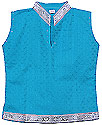
It is sleeveless garment with a deep horseshoe shaped neckline. Since the neck beneath is expanded most of kanchali beneath is exposed.

Different Styles

Kurti worn by Bishnoi class has a slitted side and a deep neckline that reveals all of Kanchali. The kurtis has its front open like a jacket, the piping at edges with a string holding the overlap at side seam and front is fastened with buttons and loops.

Rajput women kurti has no front opening and is easily slipped over the head.

Kurti Varieties

Embroidered Kurtis

Different embroidery, artworks like at needle work, cross-stitch,  suzani, phulkari, handanger are used to make embroidery kurtis. They are further decorated with zardosi work, beads, threads sequins and machine embroidery.

Printed Kurtis

The material used for this type of kurtis are cotton, silk, crepe and georgette. Tie and die, lehariya and mothra kurtis are most popular ones. Mirror work, kundan, stones, sequins and zari are used to make it attractive.
Tags: , , , , , , , , , , , , ,

Puthia – Traditional Wear of Rajasthani Women

Puthia is the upper part of attire of Rajasthani women. Rajasthan newborn babies, young married girls, elderly women and widows wear it as a upper garment.

It is a traditional wear of Rajasthan which gives comfort and protection from heat waves of Rajasthan state.

Rajasthani Costume

Puthia is much like angarkhi. The unbleached hand woven khadi cloth is used to create garment while some class wear printed cotton, brocade sand plain coloured fabric.

It is double breasted garment with a higher flap crossing over right side and tied with a  cord under left armpit. There is no joint at the waist and garment ends at hips itself.

The sleeve length vary from short elbow to full length.

The Puthia is constructed of two panels, one front extension, one back piece, two sleeves from side panels and gussets. The opening is in front with one to three ties. The neck is deep with widest portion over the chest . An inner flap covers the chest with a rounded neck and thus fastens with a loop and cloth button. This flap is held at waist with cloth tie chords and is further attached to ridge.

The shape of sleeve of armhole is made by use of triangular gussets known as Khankhi. The back has plain and straight cut. The fabric is turned with fold on outside and unfolded edges stitched into garment.

COLOUR

It is  the important factor as it denotes the community and class of a woman. A newborn baby wear red puthia with green piping but after  child first Holi it is  transform into white. An unmarried Bishnoi girl usually wear white pichodi with red piping.

MATERIAL

Rajputs wear puthia of satin, velvet, cotton and brocade fabric which are normally in white, pink and whitecolour.

Tags: , , , , , , ,

Multicolored Base for Rajasthani Women – Wedding Attire of Traditional Females

Rajasthani Bridal Lengha - Wedding Attire

Rajasthani Bridal Lengha - Wedding Attire

BASE

It is a combination of lengha, kurti/ kanchali and odhani. Lengha is quite similar to ghagra but is usually longer in length and it hangs all the way to the ground.

It is a special dress worn by Rajasthani women on special occassions especially weddings.

Festive Colors

According to psychology, colour has a great impact on human personality. There are different colours of base for different purposes.

Red, maroon, saffron and pink colour base  are best for marriage purposes. All these colours are symbols of love and affection. Red denotes the power of goddess Lakshmi.

History

In early times, the printing and bandez work on the base used to be done by special caste called as Chippa. Now this art is transfered to garment industry and textile mills. This cloth is now exported outside the country.

Popular Base

On Diwali, Gota base was quite famous and it used to be worn by high class women. It is black in colour on which golden wires are beautifully used. It is exhibited in  City Palace of Jaipur.

On Teej, Lehariya base used to be worn. It was quite in demand in local market.

The lengha with 400-450 kaliyan was quite ethnic which worn earlier and it  is spread around 44 feet. It is kept in the museum of Churu.

Materials Used

Base are made of satin, silk tissue velvet, georgette and crepe.

Art

The work which is most prevalent on base is salma sitare, gulibar, jardosi, kundan, gadchula, tie and die .

Antique

The ocean wave base is made of 7-8 colours waves. Neelgiris and Tripolia areas used to prepare this type of base.

Tags: , , , , , , , , ,