Puthia is the upper part of attire of Rajasthani women. Rajasthan newborn babies, young married girls, elderly women and widows wear it as a upper garment.
It is a traditional wear of Rajasthan which gives comfort and protection from heat waves of Rajasthan state.
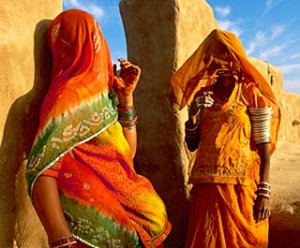
Puthia is much like angarkhi. The unbleached hand woven khadi cloth is used to create garment while some class wear printed cotton, brocade sand plain coloured fabric.
It is double breasted garment with a higher flap crossing over right side and tied with a cord under left armpit. There is no joint at the waist and garment ends at hips itself.
The sleeve length vary from short elbow to full length.
The Puthia is constructed of two panels, one front extension, one back piece, two sleeves from side panels and gussets. The opening is in front with one to three ties. The neck is deep with widest portion over the chest . An inner flap covers the chest with a rounded neck and thus fastens with a loop and cloth button. This flap is held at waist with cloth tie chords and is further attached to ridge.
The shape of sleeve of armhole is made by use of triangular gussets known as Khankhi. The back has plain and straight cut. The fabric is turned with fold on outside and unfolded edges stitched into garment.
COLOUR
It is the important factor as it denotes the community and class of a woman. A newborn baby wear red puthia with green piping but after child first Holi it is transform into white. An unmarried Bishnoi girl usually wear white pichodi with red piping.
MATERIAL
Rajputs wear puthia of satin, velvet, cotton and brocade fabric which are normally in white, pink and whitecolour.
