Posts Tagged palaces in rajasthan

The Bundi Palace and Chitrashala | Bundi, Rajasthan

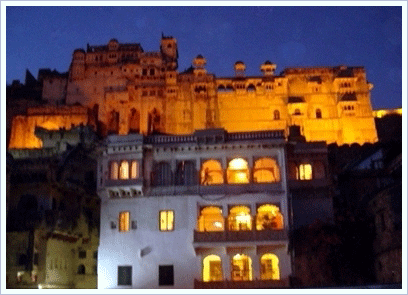
Bundi Palace, Rajasthan

Bundi Palace, Rajasthan

‘Picturesque, enchanting and magnificent.’ These would be just some superlatives that compliment the lingering medieval flavour that Bundi in Hadoti region holds.

The entrancing land of Palaces, stunning stepwalls or baoris and miniature paintings seems frozen in time. Bundi, also claims a take on the foundations of an authentic school of miniature painting.

An of beat destination ruled by the Hada Chauhans, Bundi is a rich repository on Indian art, culture and heritage and is frequented by domestic as well as international tourist.

It has magnificient medieval forts and palaces, miniature paintings, temples with intricately carved out idols and chattris, fabulous stepwalls and a picturesque lake.

The Bundi Palace

The Bundi Palace is situated adjacent to the Taragarh fort. This outstanding palace, built during the 16th and 17th centuries is a classic Rajasthani architecture. Only part of the palace is open to the public.

The quarried stone Bundi Palace is known for it’s traditional murals. Just one look at the monument will soak you with the royal opulence and splendour, an innate part of the lifestyle of the royals. Intricately engraved brackets, pillers, balconies, sculpted elephants and the extraordinary craftsmanship will catch your attention here.

The palace is entered through the Hathi Pole (Elephant Gate) into a small courtyard. You then come to the Ratan Daulat, the Diwan-i-am (Hall of Public Audience), where there is a marble throne. The highlight of this palace is the beautiful murals that carry the spectators back into the time of Bundi royalty.

Chitrashala

The silent, secret garden, with it’s elegant formal layout still visible through the tangle of wild-roses and weeds is the most enchanting place at the Bundi Palace. Showcasing the Bundi genre of miniature art, the walls and the ceiling are festooned with pictures out of the Ragmala and Raaslila-the story of Radha-Krishna.

Then there are hunting and court scenes, festivals, processions, animal and bird life that spring back images of all that was a part of the artist’s acuity then. The vibrant blue, green and turquoise on white with touches of terracotta yellow lend an arresting view.

The Bundi style of painting famous for its Rang Yojna infuses life in every bit and corner of Chitrashala. If you are an art connoisseur you could visit Bundi just for a glimpse of the miniature artwork that holds inspiration to people from world over.
Tags: , , , , , , , , , , , , , , , ,

Umaid Bhawan Palace, Jodhpur, Rajasthan – An Amazing Palace Hotel

About Jodhpur

Jodhpur, a gateway to the Thar desert towns, is the second largest city of Rajasthan and for almost five centuries it was the capital of Marwar. Historically too this region was important for being a part of major trade route caravans loaded with the most precious merchandise made their way here from the ports of Gujarat. This Blue City seems to have been put together for the benefit of the tourist.

Some of the very famous places of interest of Jodhpur are Mehrangarh Fort, Umaid Bhawan Palace, Mandore, Mahamandir Temple, Jaswant Thada, Kailand Lake, Balsamand Lake, Gardens, Osian, Dhawa and Luni Fort.

About Umaid Bhawan Palace

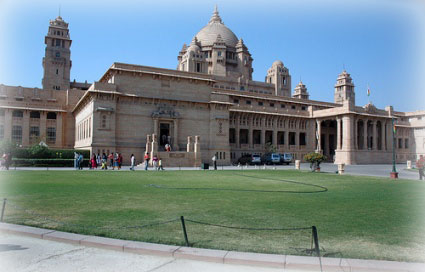
Umaid Bhawan Palace, Jodhpur, Rajasthan

Umaid Bhawan Palace, Jodhpur, Rajasthan

Umaid Bhawan Palace constructed with marble and pink sandstone is also known as the Chhittar Palace as it uses local Chittar sandstone.

Begun in 1929, it was designed by president of the British Royal Institute of Architects for Maharaja Umaid Singh and took 15 years to complete.

Probably the most surprising thing about this grandiose palace is that it was built so close to Independence, after which Maharajas and their grand extravagances were a thing of the past.

Umaid Bhawan was one of the last royal constructions in Rajasthan. The building stands as a grand palace and features gardens, palace halls, balconies, terraces and more. The palace is built in the sandstone and highlights the typical Rajputana style.

The complex is divided into three main segments – the heritage hotel, private residence and the museum. The whole palace complex has as many as 347 rooms. The palace stands grounded in an area of about 26 acres. Out of these 15 acres are occupied by palace lawns.

The heritage hotel is a popular venue for some of the most talked about weddings of film stars to business barons. It’s a magnificent structure that uses local stone and is representative of the Indo- Saracenic style of architecture.

Some sections are not open to the public, but one can still visit the palace to see the museum. To see the collection of old watches here is a sheer delight.

A Tip

If you really wish to spend a luxirious holiday, Umaid Bhawan Palace is the place. I have personally been there and frankly speaking I have never seen a more grandiose palace hotel than this one.

Tags: , , , , , , , , , , , , , , ,

Deeg Palace – Bharatpur Rajasthan

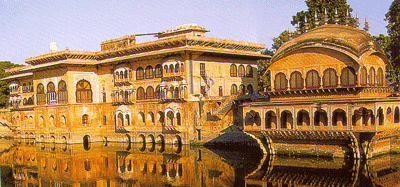
Deeg Palace, Bharatpur, Rajasthan

Deeg Palace, Bharatpur, Rajasthan

Deeg is a palace that may force you to change your image of Rajasthen as an arid state with a perennial shortage of water.  It will also explain the term “land of contrasts” like nothing else will.

The road north of Bharatpur goes via Kumher to Deeg ( 34 km). Kumher was founded by Kumbi Jat of Sinsini and was at one time the second capital of Bharatput State.

Badansingh in 1722 built the palaces and many of the fortification which are now impressive ruins to the east of the road.

The important palaces here are Nand Bhawan, Gopal Bhawan, and Krishna Bhawan. The Palaces are still in very good condition and it is possible to see the kind of meticulous planning that has gone into their construction.

Deeg Palace Attractions

Deeg is justly known for its palaces and gardens begun by Badan Singh and laid out by Suraj Mal following the tradition brought to India by the early Mughals. The Palace pavilions and gardens are laid out with an excellent sense of balance.

The present area is probably only half what was originally planned with two complementary gardens to be linked by a broad terrace. However, what was built is exciting and well preserved, with the buildings forming a large rectangle enclosing the gardens and two large tanks at the eastern and western ends.

The largest and most impressive building, Gopal Bhawan, was built around 1763 and overlooks the Gopal Sagar (tank) to the west. It is flabked by two smaller pavilionswhich purport, in their curved roofs and pillers, to simulate  a large pleasure barge, and is fronted by an arch for a swing and two marble thrones with the gardens beyond.

On the northen side of the garden is a large audience hall known as Nand Bhawan. The focal point of the garden is the pillered summer pavilion with its ingeniouslydesigned waterworks overlooking Roopsagar to the east.

At the southwestern corner is Suraj Bhawan, completed by Jawahar Singh. Suraj Bhawan is built of white marble, decorated with a mosaic and inlay of semiprecious stones. Puran Mahal, at the southeastern corner, has a display of Rajput wall paintings, many influnced by the Mughal schools.

This palace is an attraction spot for each and every tourist who visits Rajasthan. Bharatpur Bird Sanctury makes Bharatpur well known all over the world but Deeg Palace makes it well known into the hearts of tourists who visit it even once.

Tags: , , , , , , , , , , , , , ,