Posts Tagged jaipur tourist attractions

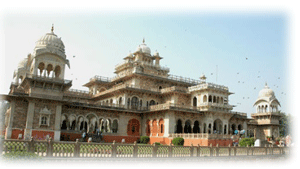
Albert Hall in Jaipur – Reflection Of Excellence of Indo-Saracenic Style of Architecture

Albert Hall Museum in Ram Niwas Bagh, Jaipur

Albert Hall Museum in Ram Niwas Bagh, Jaipur

Jaipur the pink city of India houses lot of attractions for the tourists in which Albert Hall Museum is one of them. The museum is located in the centre of the sprawling Ram Niwas Bagh. This is one of the oldest of Museums in Rajasthan.

This magnificent building reflects the excellence of Indo-Saracenic style of architecture. It has been modeled in accordance with the Victoria and Albert Museum in London.

The exquisitely designed garden with forcentry doors and a vast complex with small pools and fountains, flourishing lawns and beautiful flower beds all around was named after Albert, the consort of Queen Victoria’s husband.

The various sections represented in the museum includes  Armour, Textiles, Carpets, Paintings, Geology and Dolls Sections.

Beautiful and Fascinating Carpets of Persian

As you start looking around, you will get to see many beautiful and fascinating carpets including the magnificent Persian Garden Carpet, one of India’s finest art treasures in the Durbar Hall.

Egyptian Mummy of  Ptolemaic Epoch and Miniature Paintings

There is an Egyptian mummy belonging to the Ptolemaic Epoch. There are miniature paintings of various sub-schools of Rajasthan. A glimpse of the land the people of Rajasthan is presented through well planned dioramas.

Beautiful Galleries in Museum

From 1959 onwards the various galleries along the ground floor of the museum were completely reorganized and renovated. People of Rajasthan from the higher strata of society, such as Rajputs and seths as well as the common tribal people like Mennas, Bhopas, Bhils, Gadoliya Lohar etc. find depiction here in their typical dresses and ornaments.

Typical Designs and Motifs in Mehndi Mandana

Typical designs and motifs in Mehndi Mandana, so characteristic of Rajasthani ladies, are also highlighted in the gallery. In the antechamber of wing is exhibited puppetry from Rajasthan & the painted scroll delineating the scenes from pabuji Rathore’s life, a great folk hero from Marwar.

The central gallery is devoted to Rajasthani music and dance. Original musical instruments, both classical and folk, are displayed in their functional positions. Specimens include typical folk instruments like Masak, Kama, Yacha, Dadh, Madal, Khanjari, Satari, Bankia, Pungi, Alogoja, Iktara etc.

Tags: , , , , , , , , , , , , , ,

Museum of Indology, Jaipur – Excellent Collection of Folk, Tantric Art Objects and Paintings

Paintings in Indology Museum, JLN Marg Jaipur

Paintings in Indology Museum, JLN Marg Jaipur

Richness of culture, tradition and glorified part can be traced in the vista of exhibits that are reserved in the multiple of museums that are constructed in Jaipur. In fact, all the museums in Rajasthan are storehouses of manuscripts, scriptures, and artworks, which waive the aura of the imperial Maharajas.

Some of the museums in State Capital Jaipur are Albert Hall, City Palace Museum and Museum of Indology.

Museum of Indology in Jaipur

Museum of Indology was created and developed by Acharya Ram Charan Sharma “Vyakul in 1960. The museum has an excellent private collection of folk and Tantric art objects, paintings done on rice, manuscripts, ornaments, fossils, clocks and currency.

Different Exhibits of the Indology Museum

Some of the priced collection includes a map of india painted on a grain of rice, misprinted rupees, a 180 million year old fossil,and Gaytri Mantra written on a single strand of hair and manuscript written by Aurangzeb to a glass bed.

The eighteen sections of this museum include old manuscripts and indian textile designs, Tantrik Paintings, gems etc. making it one of the finest museum of Rajasthan.

The museum is situated at Jawahar Lal Nehru Marg of Jaipur City and is open from 10:00 to 17:00 hrs daily except holidays.

Tags: , , , , , , , , , , , ,

Jantar Mantar of Jaipur To Be World Heritage Site of UNESCO

Jantar Mantar - An Astronomy Observatory to be included in UNESCO

Jantar Mantar - An Astronomy Observatory to be included in UNESCO

Jaipur’s historic astronomical observatory, Jantar Mantar, is likely to be included in Unesco’s list of World Heritage Sites soon. After Keoladeo National Park in Bharatpur, it would be the second site from Rajasthan to make it to the heritage list.

The government of India has sent the Archaeological Survey of India (ASI) to the UNESCO to include Jantar Mantar in the world heritage site lists.

According to sources the Jantar Mantar, is already in the tentative list of Unesco, and will finally get the heritage status next year after a visit by Unesco officials from Paris before the end of this year. This move to expedite the approval has also come in the wake of 2009 being declared as the “International Year of Astronomy” at the 33rd session of Unesco General Conference.

Other Famous Astronomical Observatories of the India

The other astronomical observatories of the country which are included in the heritage list are the Jantar Mantar in New Delhi, the Man Singh Observatory in Varanasi and the Jantar Mantar, Ujjain.

A Quick Insight on Jantar Mantar of Jaipur

The Jantar Mantar Observatories built by Sawai Jai Singh in 1728  represents the pre-telescopic masonry type observatories of the medieval period, marking the last and the most ambitious attempt of creating such architectural ensembles for observational astronomy at a large scale.

Remarkable Collection of Architectural Astronomical Instruments

At first glance, this famous Astronomical monument of Jaipur appears to be a curious if somewhat compelling collection of sculptures. In fact, each construction has a specific purpose, for example measuring the positions of the stars, altitude and azimuth, and calculating eclipses.

Big Sundial – Most Impressive Structure

Over 90 feet in height, the big sundial (Brihat Samrat Yantra) is the most impressive and the largest structure. The ramp that forms the indicator is orientated to the north at 27 degrees, gradient equivalent to the latitude of Jaipur. Thus the ramp points exactly to the Celestial North Pole.

The wing shaped scales are made of marble as the side edges of the indicator are covered with delicate measuring divisions. According to the size and architectural precision, the shadow shows the local time accurate within four minutes.

Jantar Mantar is wholly constructed with stone and marblewas declared a national monument in 1948.

Tags: , , , , , , , ,