Posts Tagged royal residence of jaisalmer

Tazia Tower in Jaisalmer Rajasthan – Five Storied Structure of Great Historical Significance

Tazia Tower is one of the major tourist attractions in Jaisalmer. It is a five-storied structure of great historical significance, which ascends from Badal Mahal (Cloud Palace) in Jaisalmer.
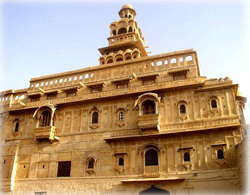
Tazia Tower in Jaisalmer

Imposing Architecture

Each storey of this pagoda like imposing figure features a beautifully carved balcony that is famous for their individual designs.

The most important palaces in this complex are Badal vilas, Jawahar Vilas, Dari Khana and Zenana Mahal. These were the homes of the former royal family adorned with modern facilities which indicates the British influence.

Significance of Tazia ?

Tazias are the fragile, split bamboo and elaborately decorated paper and tinsel models of Taj like mausoleums made by Shia Muslims during the period of Muharram, to commemorate the martyrdrom of Hassan and Hussain, the Prophet’s grandsons.

History about Tazia Tower

The silavats of Jaisalmer, being Shia Muslims, decided to migrate to Pakistan when it was established in 1947. Before leaving their desert Home, they expressed their love for their homeland and their ruler by building this tower in the shape of tazia and presenting it to the ruler.

Tags: , , , , , , , , , ,

Nathmalji Ki Haveli in Jaisalmer – Offers Rich Architectural Imagination and Miniature Art

Nathmalji Ki Haveli in Jaisalmer is one of the splendors among the other havelis in Jaisalmer. It was commissioned to serve as the residence of Diwan Mohata Nathmal, the Prime Minister of Jaisalmer in 19th century.

Nathmalji Ki Haveli in Jaisalmer

Nathmalji Ki Haveli in Jaisalmer

Haveli’s Attractions

Harmonious Symphony in Stone

Looking at this haveli you would be amazed to find how to brothers Lallu & Hathi working on the haveli from different ends could arrive at such harmonious symphony in stone.

One working on the right side and the other on the left. Though the motif used by one is not similar to the other, yet they are in harmony. One has to look closely to spot any dissimilarities. The boundary however, has been dissolved by a common facade at the front.

Guarding the Haveli

Barring that, this haveli is still considered the best in Jaisalmer in terms of grandeur. There are other minute details worth appreciation. For example there are two Elephants made of yellow stone.

These life-size replicas have been put in front of the main entrance so that it looks as if they are guarding the Haveli. Other than these, there are pictures engraved on pillars and walls.

These consist of Horses, Cattle, and depiction of Flora among other things. The most interesting aspect of this haveli is the drawing of modern amenities such as cars, fans etc.

Nathmalji-ki-Haveli draws several tourists from far and wide who are absolutely awed by the marvelous creation of the grand edifice of the structure. If you want to witness  the continuity in Rajasthani architecture you should visit Nathmalji ki Haveli.

Tags: , , , , , , , , ,

Patwon ki Haveli, Jaisalmer – Cluster of Seven Small Havelis Adorned with Intricately Latticed Work

Going through several havelis in Jaisalmer is certainly a absolute treat.

If in the earlier part of Rajasthan history, Rajput architecture dominated the scene. A little later came in the Islamic influence which resulted in a fantastic fusion of the two. This era saw the construction of most of the havelis which served as the residence of rich traders.

jaisalmer_patwon_ki_haveli

Patwon ki Haveli

The most famous among these is Patwon ki Haveli that pioneered the trend. This Haveli was the first to be made in Jaisalmer and that’s why it carries immense significance.

Cluster of Seven Small Havelis

The Patwon ki Haveli is a cluster of seven small havelis adorned with intricately latticed work. The biggest and the most grandiose haveli, this one was constructed in 1805 A.D by Guman Chand Patwa, a rich trader who set the trend.

He could afford and thus ordered the construction of separate stories for each of his 5 sons. These were completed in the span of 50 years. All five houses were constructed in the first 60 years of the 19th century.

Mega Structure Features

This mega structure features five suites and a number of balconies projecting from different storeys. Its intricately carved facade with pillars and balconies is one picture worth capturing. It is an open air museum and has preserved for centuries the heritage of the rich merchant class and the architecture of Rajasthan.

Now the haveli has been taken over by the government. A tour through the haveli will lend an interesting insight in to the lifestyle of the rich traders.

Tags: , , , , , , , ,