India has the largest livestock population in the world and people have worked on leather since ancient times. Rajasthan in particular, has a rich and long tradition of leather crafts. Different leather products famous all over India and most of the product are functional and utilitarian.
One such product is the ubiquitous jooti, shoe an item of daily use, well known in Rajasthan for the quality of workmanship and the variety and richness of design. Jooties variously known as mojaris or pagarkhiyas, are entirely hand crafted and sizes are always measured with fingures.
Process of Making Jootis
The process of production starts with cutting the leather with a sharp knife, both for the upper as well as the sole. Different layers of the sole are stuck together with home made glue. Once this is dry, the sole is stitched with cotton or leather thread.
The upper is then embroidered by the women who perform this delicate task with skill. A piping – plain or colored- is stitched to the edge of the inside portion of the upper, after the leather is dipped in water to make it soft. At every stage the leather is hammered to make the stitching and pasting firm. Once the upper has been attached to the sole. It is put on a wooden last to give its final shape. Sometimes, local dyes are sprayed on the upper, in shades of red green and dark pink.
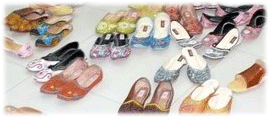
Jootis - Traditional Footwear in Rajasthan
The entire operation, done by hand, requires concentration. Artisans sit for long hours crouched over the work, usually in badly lit and poorly ventilated huts , that cause tremendous strain on the spine and the eyes.
Types of Jootis – Peshawari and Nagra
The peshawari , the most common type is a heavy jooti used by both men and women. Nagra jooties are lighter and consist of one or two layers and prominently embroidered in Mughal motifs with gold and brightly coloured threads.
Special jooties are also made for marriages and other important ocassions.